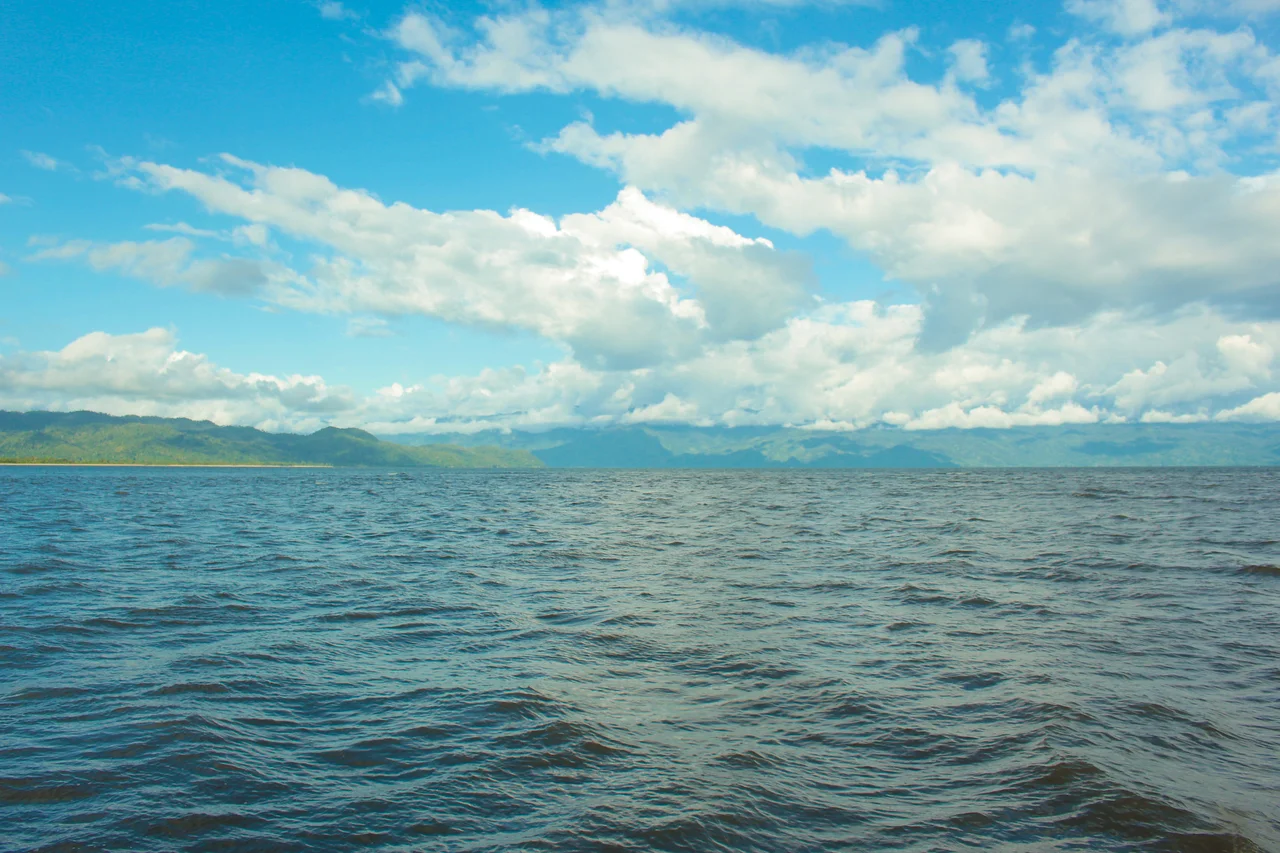

Antongil Bay
Each year between July and September, the calm water of Antongil Bay fills with the sound of singing. Roughly seven thousand humpback whales make their way here from the cold Antarctic feeding grounds to mate and to give birth, and the sheltered bay becomes one of the most important whale nurseries in the entire Indian Ocean. Mothers nudge newborn calves toward the surface to breathe in waters warm and shallow enough to keep them safe. This is Madagascar's largest bay - some 44 miles long and 19 miles wide, yet nowhere more than about 400 feet deep - a broad green-rimmed gulf on the island's northeast coast, walled on its eastern side by the rainforested ridge of the Masoala Peninsula.
The Singing Season
Humpbacks are among the ocean's great travelers, and the ones that gather here have crossed thousands of miles of open sea to reach a bay barely deeper than a swimming pool at its center. That shallowness is the point. Calves are born small and weak, and the bay's protected water shelters them from predators and heavy swell while they grow strong enough for the return journey south. Males fill the season with the long, looping songs for which the species is famous. From a boat - or from the air - you can sometimes see a dozen whales at once, breaching and slapping their fins, the bay alive with the largest animals ever to migrate through it.
The Man Who Would Be King
In 1774 a Hungarian-born adventurer named Maurice Benyovszky landed on these shores and founded a settlement he called Louisbourg, near present-day Maroantsetra at the head of the bay. Officially he had come to establish a French trading post. Unofficially, he had grander designs. Benyovszky learned the local languages, took sides in local politics, and made himself indispensable - and in 1776 a gathering of Malagasy chiefs formally declared him Ampansacabe, a paramount chief, or king, of the surrounding territory. How much of his claimed kingdom was real and how much was self-invention is still argued. But the title was no idle boast to him.
A Death on the Beach
Benyovszky's ambitions outran his backers. France lost interest, and his independent maneuvering alarmed the colonial government on nearby Mauritius. In May 1786 a French military force landed to shut his operation down. On 23 May, in a brief skirmish, Benyovszky was shot in the chest and killed on the beach he had claimed as the seat of a kingdom. He was thirty-nine years old. The whole episode lasted barely a dozen years - a meteor of a colony that flared and vanished, leaving behind little but a name on old maps and one of the stranger footnotes in the island's tangled history.
The Living Bay
Today Antongil Bay is prized for what swims in it rather than who once ruled it. It is the largest and most productive bay in the western Indian Ocean, a breeding ground not only for humpbacks but for sharks and countless other marine species, ringed by the forests of Masoala National Park and the island reserve of Nosy Mangabe near its northern shore. The town of Maroantsetra anchors the head of the bay; the mouth of the Mananara River marks its southern end. It is a place where the wild and the historical sit side by side - a quiet, immense body of water that has cradled both whale calves and the dreams of a self-made king.
From the Air
Antongil Bay opens at roughly 15.75°S, 49.84°E on Madagascar's northeast coast, a large U-shaped gulf walled on the east by the forested Masoala Peninsula. From the air it is unmistakable: a broad bay biting deep into a coast of dense green rainforest, with the town of Maroantsetra and the small island of Nosy Mangabe at its northern head. The nearest airport is Maroantsetra Airport (ICAO FMNR, IATA WMN) at the bay's northern tip. Recommended viewing altitude 2,000 to 5,000 ft AGL; the calm bay water is ideal for spotting whales during the July-to-September season, though the Masoala coast is among the wettest in Madagascar, so expect frequent cloud and squalls.
Nearby Stories
- Makira Natural Park 23 km away
- Nosy Boraha 102 km away
- Lake Alaotra 184 km away
- Zahamena National Park 214 km away
- Anjajavy Forest: Where Stone Forests Meet Living Ones 219 km away
- Tromelin Island: The Forgotten Enslaved People of the Isle of Sand 455 km away
- Battle of Reunion 763 km away
- Erythraean Sea 3098 km away