
Archaeological Museum of Paros
Somewhere around 264 BC, a craftsman on the island of Paros carved a list into white marble. The list was a chronicle — a year-by-year account of Greek history stretching from the legendary reign of the first Athenian king Cecrops back into mythological time, and forward to the present moment of the carving. It recorded the dates of wars, the births of poets, the first performances of dramatic festivals, the inventions of music. It was, in short, an attempt to write down everything that mattered. Most of it survives only in fragments scattered across the world. One piece — the lower portion of the original stele — sits in Parikia, in the Archaeological Museum of Paros.
The Marble That Counted the Years
The Parian Marble, known formally as the *Marmor Parium*, is among the most important documents of ancient Greek chronology. Inscribed in the 3rd century BC, it organized Greek history into a sequence of dated events — not the official, dynastic history of kings and battles, but a cultural history: when Hesiod and Homer were born, when tragedy was first performed, when particular musical instruments were invented. For modern scholars trying to establish the dates of ancient Greek literature and art, it has been indispensable.
The chronicle survives in three fragments. The larger upper section is now in the Ashmolean Museum in Oxford; a second section from the same early tranche has been lost. The shorter fragment — the base of the original stele, found on Paros in 1897 — remains on Paros, where it was inscribed. The Archaeological Museum displays it alongside a cast of the second part, allowing visitors to read the surviving text in sequence. Standing before it, you are looking at a 3rd-century attempt to impose order on 1,500 years of Greek cultural memory.
Five Thousand Years in Three Rooms
The museum itself is modest in scale: two rooms and an atrium, founded in 1960 in Parikia, the island's capital. Room A focuses on Archaic and Classical sculpture. Room B ranges further — from Neolithic to Roman, with pottery, small finds, and carved objects accumulating into a layered picture of the island across millennia. The atrium holds larger pieces: sculptures, architectural fragments, urns, and a Roman-period mosaic floor.
What the building lacks in grandeur it compensates for in density. Paros was an important island throughout antiquity, prized above all for its fine white marble — the same stone used by Praxiteles and in the construction of the Temple of Apollo at Delos. That material left the island constantly and left records of itself constantly, and the museum catches many of those records before they scattered further.
The Oldest Known Cycladic Figure
Among the smaller objects in the collection, one carries particular weight. The Fat Lady of Saliagos — sometimes called the Naked Lady — is a marble figurine from the Neolithic period, recovered from the submerged site of Saliagos, a former islet between Paros and Antiparos that is now barely above water. It is the oldest known Cycladic figurine, predating the more famous, schematic Cycladic figures by thousands of years.
Cycladic figurines have become one of the icons of ancient Greek art — their clean, abstracted forms influenced Picasso and Brancusi in the 20th century. The Fat Lady of Saliagos is their ancestor, rounder and less stylized than her descendants, but already participating in whatever impulse drove early Aegean people to render the human form in marble. She is small enough to hold in one hand. She is roughly 4,500 years old.
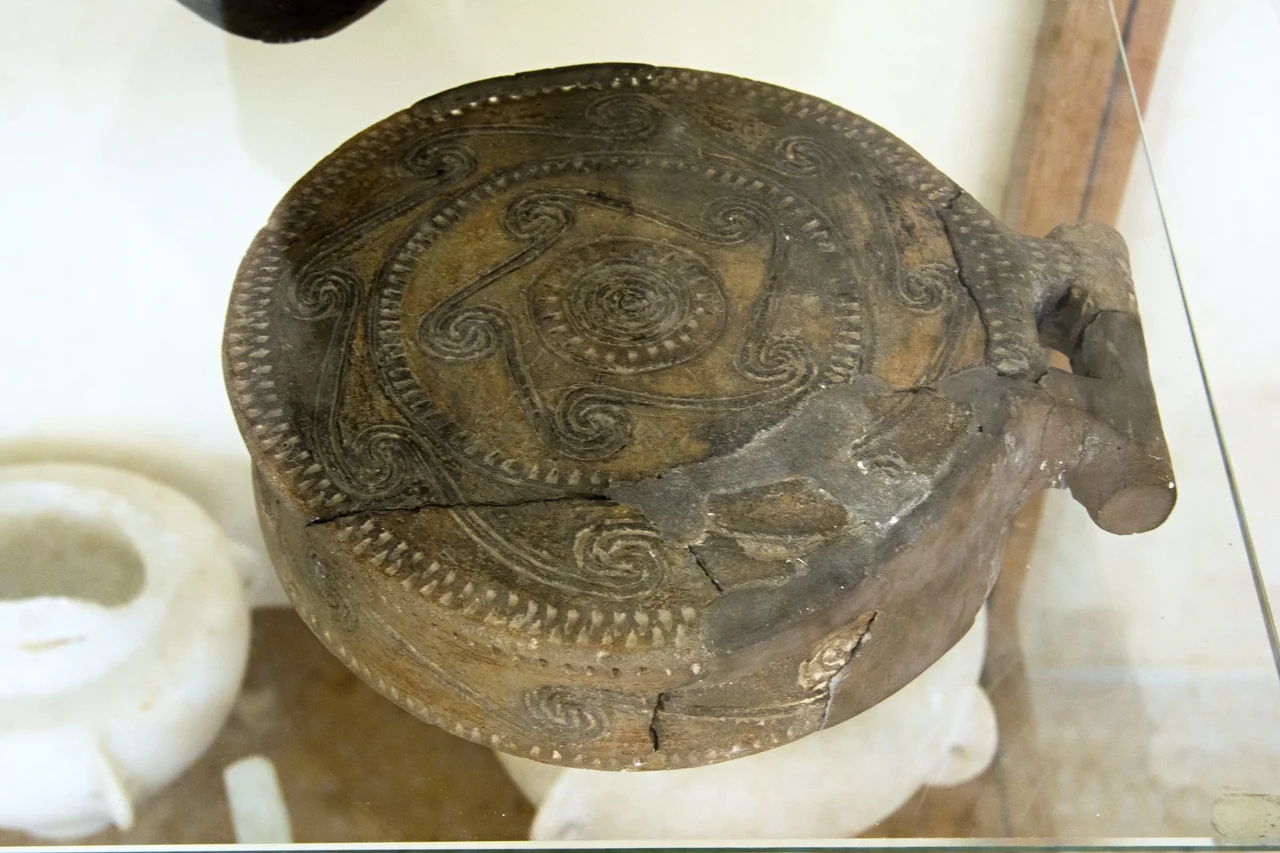
Other standouts include the Gorgon of Paros, a marble statue from the 6th century BC; the Nike of Paros, an early classical depiction of the winged goddess; a large Melian-style amphora from the 7th century BC; and a Cycladic frying pan — an enigmatic Early Bronze Age ceramic object whose actual function remains debated.
Objects from the Island and Its Neighbours
The museum also receives finds from ongoing excavations nearby. The dig at Despotiko — the uninhabited islet southwest of Antiparos where archaeologists have been uncovering a major sanctuary of Apollo since 1997 — has yielded pottery, inscriptions, and votive objects. Some of those pieces have made their way to Parikia, joining a collection that spans the central Cyclades rather than Paros alone.
This regional scope matters. The Cyclades were never isolated from one another; they were a network, linked by sea routes and shared culture. The Archaeological Museum of Paros does not only tell the story of one island. It tells the story of a maritime world in which marble, pottery, ideas, and people moved constantly between the islands visible from any high point on Paros itself.
Finding It
The museum is located in Parikia, the ferry port and principal town of Paros, within easy walking distance of the waterfront. It is a natural first or last stop on any visit to the island — small enough to see thoroughly in a couple of hours, substantial enough to change how you look at everything else you encounter on Paros and its neighbours. The Parian Marble alone is worth the detour: a chronicle of a world that thought its history worth writing down, carved into the island's own stone.
From the Air
The Archaeological Museum of Paros is located in Parikia at approximately 37.08°N, 25.15°E, on the western coast of Paros. From the air, Parikia is the largest settlement visible on Paros's western shore, with the ferry harbour clearly identifiable. The nearest airport is Paros National Airport (ICAO: LGPA), located roughly 10 km to the southeast of Parikia. At 2,000–4,000 feet, the whitewashed town and its harbour are clearly distinguishable. Athens Eleftherios Venizelos (LGAV) is the main international gateway, approximately 160 km to the northwest.
Nearby Stories
- Panagia Gremniotissa 13 km away
- Milos 17 km away
- Panagia Kanala 18 km away
- Delos 18 km away
- Serifos 19 km away
- Amorgos 27 km away
- 1956 Amorgos Earthquake 27 km away
- Ikaria 57 km away