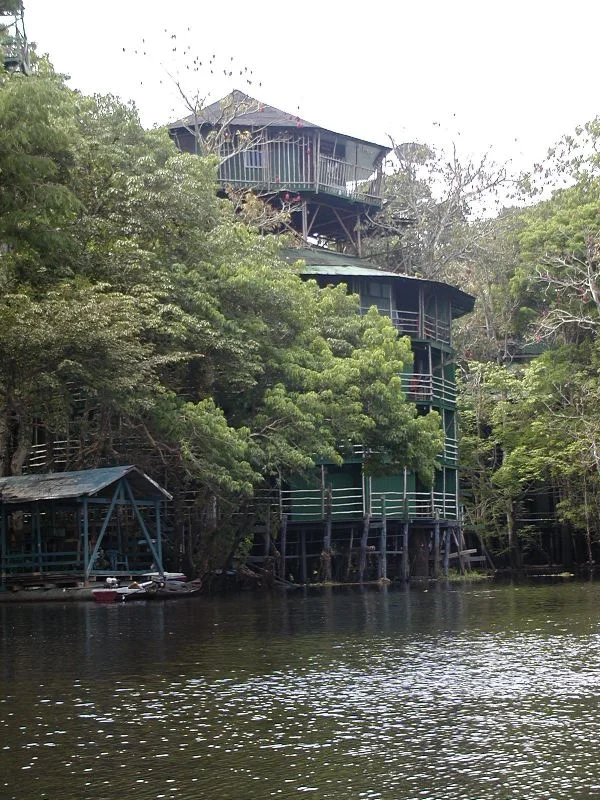

Ariau Towers
Somewhere between luxury and folly, Dr. Francisco Ritta Bernardino built a hotel in the treetops. The Ariau Towers rose along the Rio Negro about 60 kilometers northwest of Manaus, six towers holding 291 rooms 10 to 20 meters off the rainforest floor, linked by roughly five miles of wooden catwalks threading through the canopy. Jimmy Carter stayed here. Bill Gates stayed here. Travel writer Patricia Schultz listed it in her 1,000 Places to See Before You Die. The editors of Frommer's South America called it all that is wrong with Amazon ecotourism. Both verdicts had some truth. The hotel closed in 2016, and today its metal railings and stripped fixtures stand slowly being reclaimed by the forest that was always its main attraction.
The Ultimate Treehouse
The concept was audacious. Walkways ran through the canopy at tree-level, connecting suites and tree houses perched in the upper branches of rainforest trees. Two swimming pools hung in the air, along with two 134-foot observation towers and a panoramic auditorium that seated 450. The tallest unit, the Tarzan House, was built on top of a living mahogany at 22 meters above the ground. Guests could reach out from their balconies and have breakfast with macaws on the railing. There were two restaurants serving regional foods, bars, convenience stores and a panoramic hall where river pilots and jungle guides gave talks on piranha fishing and caiman spotting. The complex was one of the oldest and largest jungle lodges in the Amazon, and at its peak it drew a dependable parade of honeymooners, adventurers and celebrities.
Just Downstream from the Meeting of the Waters
The location was part of the appeal. From the towers, guides took visitors on dugout canoe rides through flooded igapo forest to see the Meeting of the Waters, where the black-tea currents of the Rio Negro slide alongside the pale Solimoes for over four miles before the two rivers finally mix and become the Amazon. Because the waters differ in density, temperature and pH, they refuse to blend at first. From a boat on the line itself, guests could run their hands through both currents at once. Other offerings included piranha fishing, jungle walks through the 500-year-old rainforest of the Anavilhanas region, visits to caboclo families along the river, and nighttime spotlight excursions to see caiman, night monkeys and tree frogs. Macaws and various monkey species, both native and non-native, gathered around the towers for the scraps.
Ecotourism or Theme Park?
The criticism was not unfair. Frommer's editors targeted the hotel's mass-market packaging of the Amazon, its non-native monkeys fed by staff for guest photographs, its swimming pools fed from the Rio Negro, its logistical footprint on a fragile ecosystem. Ariau had become the kind of place where the forest was part of the package rather than the point, where every tree house had a private bathroom and a mini-fridge. Defenders countered that the towers brought serious money to a rural stretch of the Amazon and employed hundreds of locals as guides, cooks and maintenance staff. Ecotourism was a compromise, they argued, better than logging or ranching on the same land. Both positions had merit. Both also mattered less than the financial troubles that would ultimately close the place.
Seized, Listed, Stripped
In 2015 the government seized the property to satisfy debts, planning to auction it for an asking price of 8.3 million US dollars. The hotel closed in 2016. A May 2017 news item noted that an online auction was scheduled for September with a suggested price of 2.3 million dollars and a minimum bid of 2 million. By August 2019 a real estate listing had it on offer for 2.5 million euros. Nobody bought. Over the years that followed, locals climbed the catwalks and stripped out everything that could be carried away: copper wiring, fixtures, furniture, window frames. A 2019 real estate description still insisted that with proper restoration the facilities could impress again, with an architecture totally adapted to the forest and the river. The forest had other plans. Vines now reach up the stilts. The mahogany at the heart of the Tarzan House still grows. The towers that hosted Jimmy Carter and Bill Gates wait in the canopy for whatever comes next.
From the Air
Located at 3.09S, 60.44W, on the Rio Negro about 60 kilometers northwest of Manaus. Nearest airport is Manaus/Eduardo Gomes International (SBEG), with small airstrips at nearby lodges accessible by charter. Recommended viewing altitude 20,000-30,000 feet along the Rio Negro corridor; the dark blackwater of the Rio Negro contrasts sharply with the surrounding forest and the muddy Solimoes downstream. On clear mornings the complex of elevated towers may be briefly visible at low altitude, though the forest is rapidly enclosing the structures. Expect afternoon buildups in the wet season.
Nearby Stories
- Novo Airao 25 km away
- Biological Dynamics of Forest Fragments Project Area 64 km away
- Lower Rio Negro Mosaic 65 km away
- Anama 70 km away
- Amazon Tall Tower Observatory 113 km away
- 2019 Amazon rainforest wildfires 214 km away
- Alto Maues Ecological Station 315 km away
- Parintins 340 km away