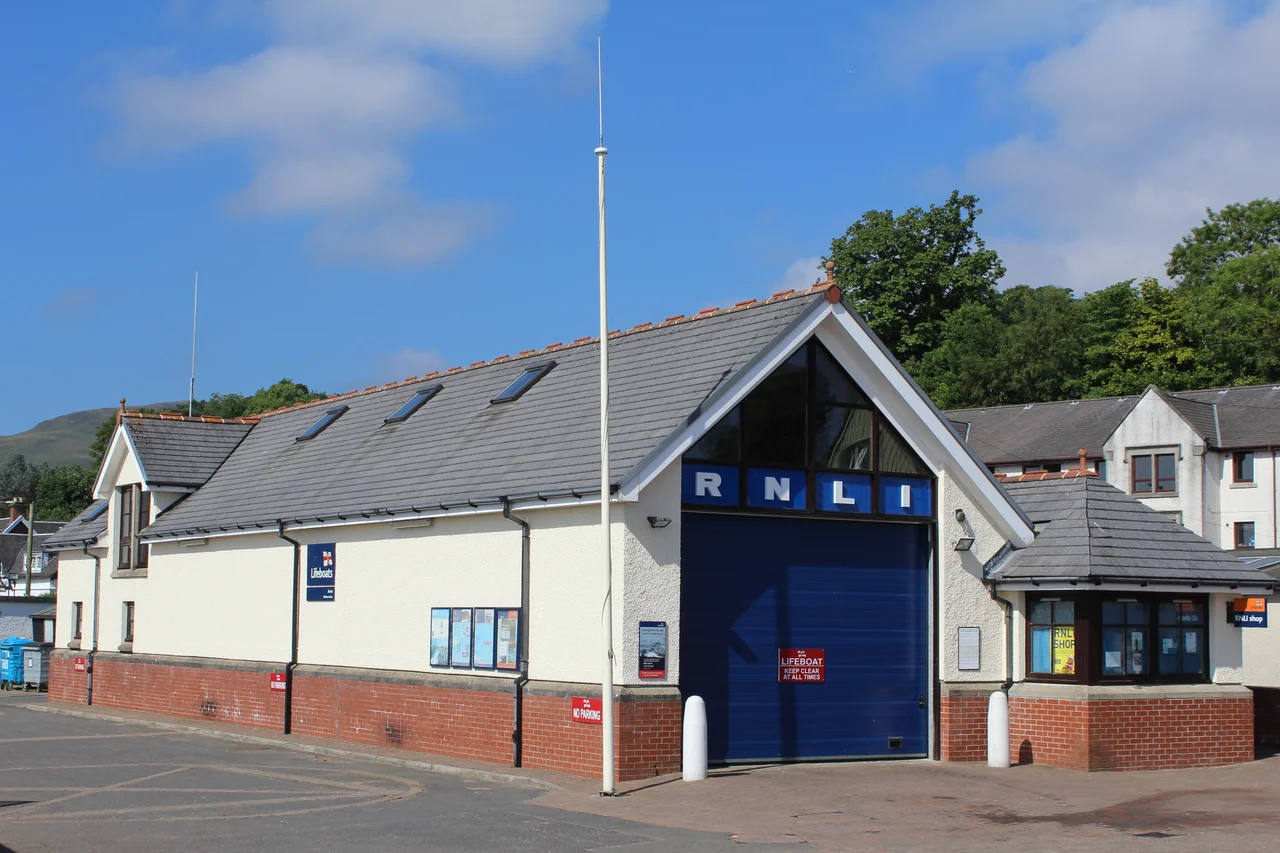

Arran Lifeboat Station
At 11:45 on a February morning in 1992, the call came in. Three canoes had capsized in Brodick Bay, three miles north of the Arran Lifeboat Station at Lamlash. A fourth person was already paddling out to help. Eight minutes later, at 11:53, the Prince of Arran was launched into force-6 winds and choppy seas. The crew reached the scene at 12:05. They found two empty canoes drifting and a single woman in the water who told them a man and two boys were still missing. The search continued. All three were found alive. All four people were brought ashore and transferred to hospital, where one of the boys was treated for severe hypothermia. This is the work of the Arran lifeboat — the kind of call that comes without warning, sends a small boat out into rough water, and returns with everyone accounted for.
A Lifeboat Returns to the Island
Arran first had an RNLI lifeboat in 1870, stationed at Kildonan on the south coast of the island. That station served for 31 years before closing in 1901. For nearly seven decades after that, the island had no lifeboat — its waters were covered by stations on the mainland and on neighbouring islands. Then in 1964, the RNLI started placing small fast inshore lifeboats — easy to launch with a few people, ideal for the increasing recreational sailing, canoeing, and small-boat use along the British coast — at 25 new locations. The programme expanded. In 1970, an inshore lifeboat (D-185) arrived at Lamlash, and the Arran Lifeboat Station was reborn. A boathouse went up in 1985, replaced in 1997 by a larger building with crew facilities, training room, workshop, and space for a launch vehicle and the larger Atlantic-class boat that would arrive the following year.
Prince of Arran
On 17 June 1988, the station received its permanent C-class lifeboat, named Prince of Arran (C-521). The boat was the third lifeboat funded by guests aboard the vessels of Fred. Olsen Cruise Lines — a model of charitable giving where cruise passengers, having seen something of the sea themselves, contributed to the rescue service that watches the same waters. Prince of Arran would be the boat that responded to the canoeists in Brodick Bay in 1992. Helm Nigel Marshall and his crew of three received written thanks from Commodore George Cooper, the RNLI's Chief of Lifeboat Operations, who praised them 'on a fine service, especially from the first aid aspect.' The medical care given to the hypothermic boy on the run back to shore was as much a part of the rescue as the boat-handling that found him.
The Rachel Hedderwick
The current lifeboat at Lamlash, Rachel Hedderwick (B-876), is named for Rachel Antoinette Hedderwick of East Saltoun — granddaughter of Sir Henry Duncan Littlejohn, the pioneering Scottish public health doctor — whose bequest funded its purchase. The boat was placed on service at Lamlash on 7 July 2014. The naming convention runs deep in RNLI tradition: lifeboats are named for the donors whose money paid for them, so that the people who saved lives at sea and the people who paid for the boats they did it in stand together in the institutional memory. Rachel Hedderwick replaces a long line of Arran inshore boats. The station continues to respond to all the modern calls of an inshore service: drifting recreational craft, capsized kayaks, people cut off by the tide, emergencies on the islands offshore.
Smaller Calls, the Same Work
Not every service is a high-drama rescue. On 22 July 1984, Clyde Coastguard reported a speedboat adrift. The Arran inshore lifeboat launched at 21:17 and reached the vessel at 21:40. The boat had been adrift for five hours after the engine's ignition key had broken — a small mechanical failure with the potential to become a serious problem if a wind had come up. The five occupants were taken under tow back to Lamlash. One man, who had been exposed for hours, was sent to hospital with hypothermia. These are the routine calls — broken-down boats, lost canoes, kayakers in trouble — that fill most of an inshore lifeboat's working year. Lifeboat Operations Manager Geoffrey Michael Norris was appointed Member of the Order of the British Empire in the 2012 New Year Honours for his service. Volunteer crews and shore staff have kept the Arran station running since 1970, on a sound, sheltered bay at the centre of one of Scotland's busiest inshore yachting grounds.
From the Air
Arran Lifeboat Station sits at Lamlash Pier on the Isle of Arran's east coast, at 55.54 degrees north, 5.12 degrees west. From altitude, look for the broad sheltered Lamlash Bay protected by Holy Isle to the east, with the lifeboat pier on the bay's western shore. Visual landmarks around Arran include Goat Fell (875m) to the north, Brodick Bay slightly north of Lamlash, and the granite ridges that form the island's mountainous interior. There is no airport on Arran. Glasgow Prestwick (EGPK) is roughly 25 nautical miles east across the Firth of Clyde. Weather here is mild oceanic, with frequent low cloud and rain off the Atlantic, and gales in winter that drive the kind of services that keep the lifeboat busy.
Nearby Stories
- RAF Machrihanish 4.6 km away
- 1948 KLM Constellation Air Disaster 6.9 km away
- Ballantrae Lifeboat Station 12 km away
- Great Cumbrae 12 km away
- Battle of Glen Trool 13 km away
- Paisley Abbey 17 km away
- Jura Distillery 24 km away
- Cushendall 30 km away