.jpg)
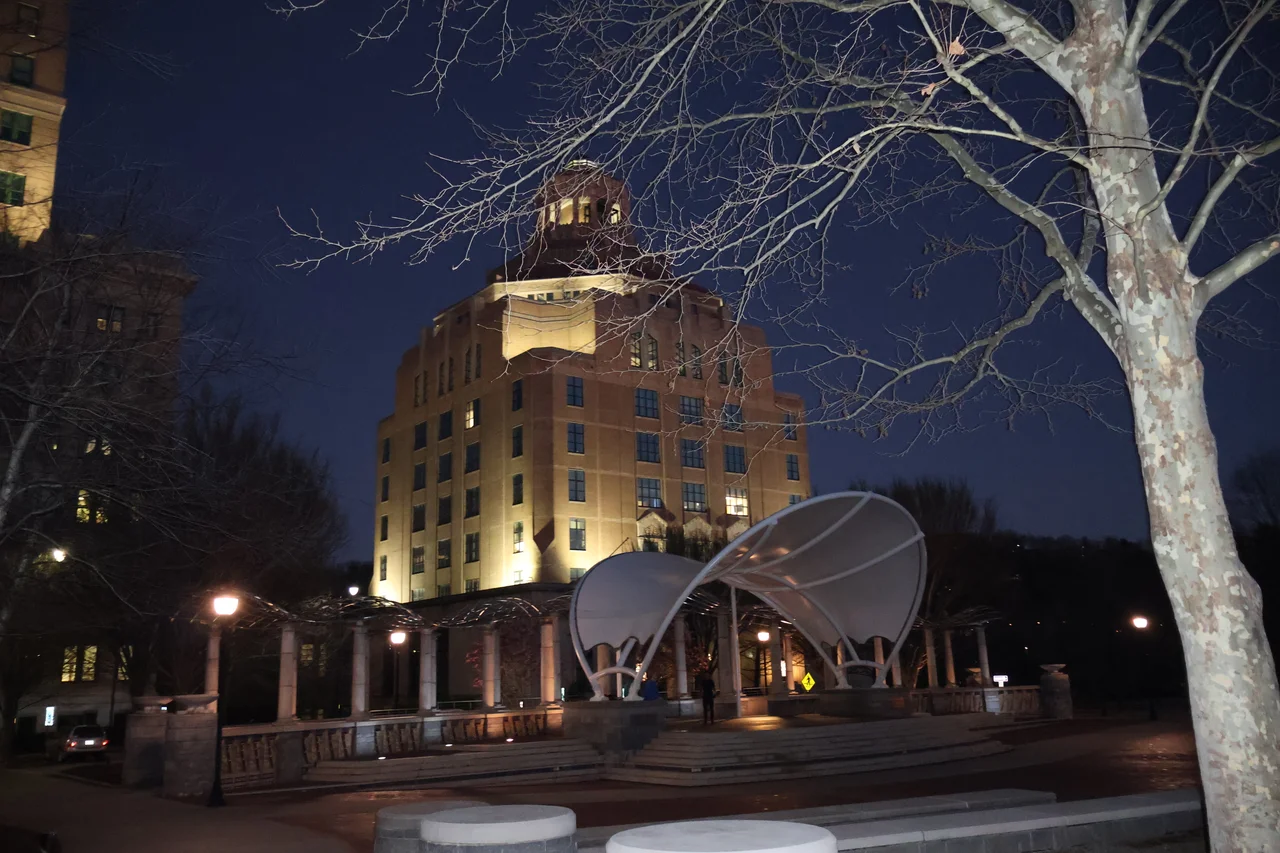
Asheville City Hall
It was supposed to have a twin. When Douglas Ellington designed Asheville City Hall between 1926 and 1928, the plan called for a matching building next door - a courthouse rising from the same plaza, the two structures connected by a wing, the whole composition reading as a single Art Deco statement at the head of Court Plaza. Then politics intervened. Buncombe County's commissioners overruled Ellington and built a taller, more conservative Beaux-Arts courthouse instead. The connecting wing was never built. Asheville City Hall stands alone - octagonal, salmon-tiled, and unmistakable - the most photographed building in the city and the silhouette that anchors the city seal.
Douglas Ellington
Ellington was born in Clayton, North Carolina, trained at Drexel Institute and the University of Pennsylvania, then won a scholarship to the Ecole des Beaux-Arts in Paris. He arrived in Asheville in 1926 at the height of a Florida-fueled mountain building boom and produced - in five remarkable years - three of the city's signature structures: City Hall, Asheville High School, and the First Baptist Church, all three rendered in his distinctive synthesis of Art Deco geometry with Beaux-Arts classical training. The city hall commission gave him a full plaza to work with. He used it to compress symbolism into form - the stepped octagonal roof, the pink Georgia marble base, the brick rising in subtle vertical bands.
The Pink Octagon
The terra-cotta roof tiles came from Ludowici in Ohio, fired in shades of salmon and rose that catch the late afternoon sun and turn the entire upper third of the building the color of a tropical fish. Ellington layered pink Georgia marble, buff brick, and limestone trim - colors he chose to harmonize with the local mountains rather than impose a metropolitan vocabulary. The stepped roof references both Mayan revival pyramids (which were having a moment in 1920s American Art Deco) and the form of nearby Mount Pisgah and the surrounding ridges. The City Council Chamber inside was decorated with five murals by painter Clifford Addams depicting Native Americans and early white settlers of the region — work now covered with mountain landscape panels following criticism of their racial stereotyping.
The Plaza That Wasn't
When the county commissioners chose a more conservative courthouse, they did so partly out of expense and partly out of caution - Art Deco was new, modern, and unproven in a place that prided itself on respectability. The Buncombe County Courthouse, completed in 1928, rose seventeen stories in stripped-classical style, taller than City Hall, structurally separate, with no architectural conversation between the two. Critics ever since have lamented what Ellington's full plaza might have been. The city hall, by contrast, was a building local newspapers initially called the strangest in the South. Now it is the building visiting architects come to see.
On the Register
Asheville City Hall was added to the National Register of Historic Places in 1976 as a contributing structure to the Downtown Asheville Historic District. Ellington's building has appeared on city seals, business logos, postcards, brewing labels, and tourism brochures so often that for many people the pink-octagon silhouette is Asheville. The city hall still serves its original function - council meetings, mayor's office, municipal offices. Visitors are welcome in the chamber when the council is not in session, though the Addams murals have been covered since the city draped them with mountain landscape panels following community debate over their imagery.
Ellington's Legacy
Ellington left Asheville in 1932 when the Depression killed the boom that had brought him here. He continued practicing - notably designing buildings at Charleston Naval Yard and at Greenfield Village in Michigan - but never again had a stage like the one Asheville gave him in the 1920s. His three Asheville buildings remain in active use almost a century later. The city hall sits at the corner of Marjorie and Court Plaza, two blocks from the Asheville Art Museum, three blocks from the Vance Monument. On a clear afternoon, the salmon tile glows against the blue ridges visible to the south. Ellington designed the building for exactly that view.
From the Air
Asheville City Hall is at 35.5956N, 82.5486W, downtown Asheville at 2,134 ft elevation. The salmon-pink terra-cotta roof and distinctive stepped octagonal silhouette make the building easy to spot from altitude. It sits in central Pack Square / Court Plaza area. Asheville Regional (KAVL) lies 8 nm south. Hickory (KHKY) 50 nm east; Greenville-Spartanburg (KGSP) 40 nm southeast.
Nearby Stories
- Hendersonville, North Carolina 2.2 km away
- Forest City, North Carolina 4 km away
- North Carolina Mountains 7.7 km away
- Chattooga River 27 km away
- Grandfather Mountain 30 km away
- Joara 30 km away
- Great Smoky Mountains National Park 41 km away
- Knoxville: The Gateway to the Smokies Where Tennessee Began 87 km away