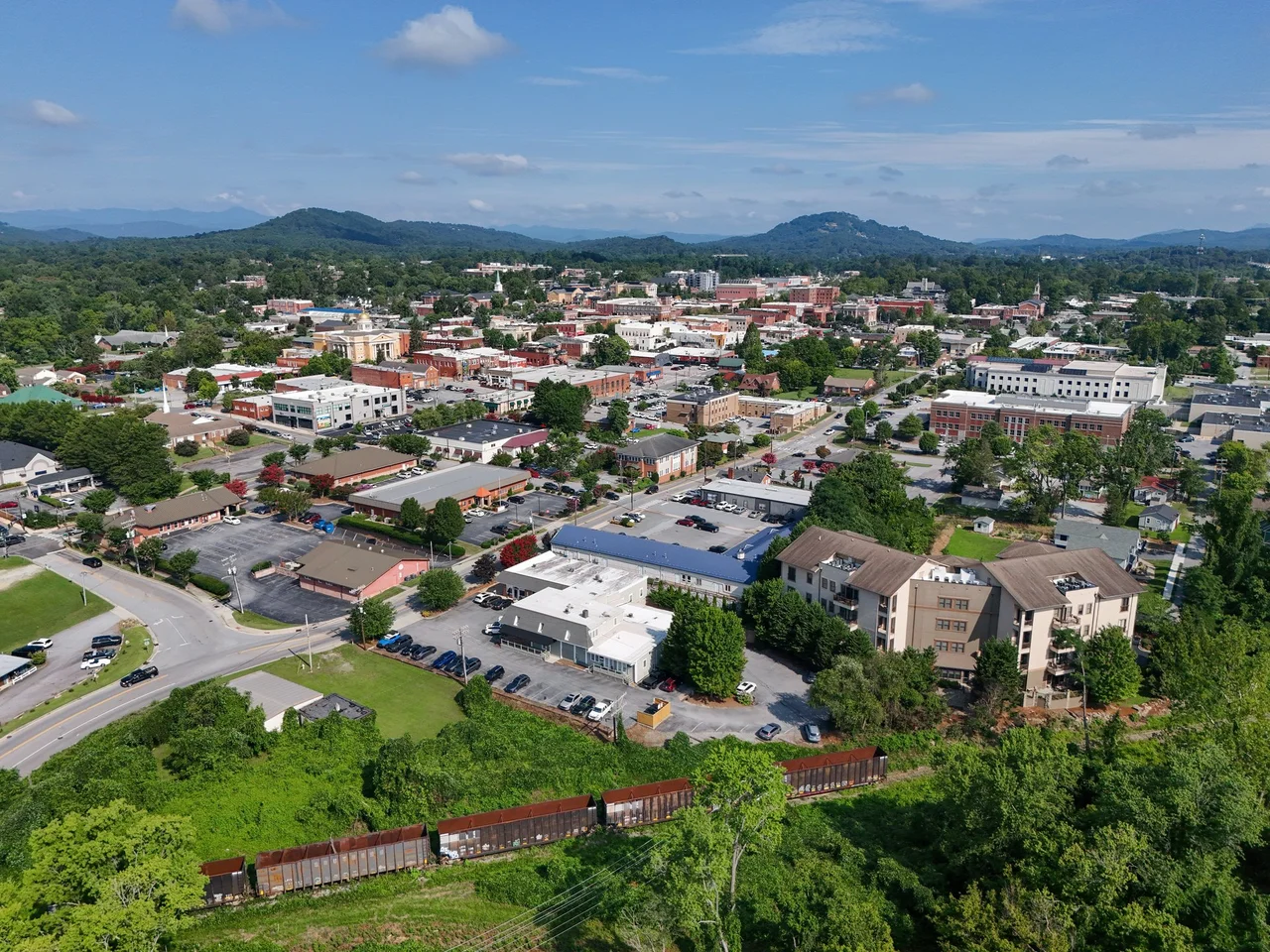

Hendersonville, North Carolina
An Italian marble angel stands in Oakdale Cemetery, on the west edge of town. Thomas Wolfe saw her as a boy. Her quiet pose became the title and the haunting image of his first novel, Look Homeward, Angel, in 1929. She is still there - weathered, a little smaller than memory would have her, watching over Hendersonville the way she always has. The town she watches over has stayed small on purpose: 15,137 people at the 2020 census, a median age of 52, a Main Street where shop awnings still extend over brick sidewalks and the apple festival closes the road every Labor Day weekend.
The Angel and the Town
Wolfe grew up in Asheville, twenty-five miles north, but he carried the Hendersonville angel with him. The novel's protagonist Eugene Gant - barely disguised Wolfe - watches his stonecutter father sell a marble angel from his shop, and Wolfe described her with the precision of a kid who had memorized her face. After the book made him famous and the people he had thinly veiled refused to speak to him, Wolfe came back. He is buried in Riverside Cemetery in Asheville. The angel is buried in nobody's memory but every reader's. Look Homeward, Angel turned a piece of cemetery sculpture into one of American literature's enduring images.
Apples and Altitude
Henderson County sits on a high plateau at roughly 2,150 feet, cool enough in summer that Charleston and Savannah families have been escaping the lowland heat here since the 1830s. The climate suits apples - Henderson is the largest apple-producing county in North Carolina and one of the top producers east of the Mississippi. The North Carolina Apple Festival, held downtown every Labor Day weekend since 1947, fills Main Street with cider donuts, pie contests, and the smell of fryers running fritters non-stop. Sierra Nevada chose Mills River, just outside town, for its East Coast brewery in 2014. The water comes off the Pisgah ridges; the brewery's beer garden draws a steady weekend crowd.
Main Street
The 1905 Henderson County Courthouse, gold-domed and Classical Revival, anchors the Main Street Historic District. The Mineral and Lapidary Museum at 400 North Main displays giant geodes, dinosaur eggs, and an actual Tyrannosaurus skull - free admission, in a building that also houses the Henderson County Genealogical Society. The Hendersonville Rail Road Station, built between 1902 and 1916, sits two blocks east in the Seventh Avenue Depot District; Southern Railway opened the line in 1879, and passenger service lasted until 1968. Today the station and the depot district anchor a slow-walking, brick-paved kind of downtown that other small American towns have spent decades trying to recover.
Jump Off Rock
Five miles west of downtown, atop Jump Off Mountain in the small town of Laurel Park, sits Jump Off Rock - a Cherokee legend says a young woman leaped from the cliff after learning her warrior love had died in battle. The overlook gives one of the cleanest panoramas in the Blue Ridge: Pisgah Ridge to the west, the Balsam Mountains south, layers of blue ridges fading into haze. Admission is free. Sunset draws a small crowd of locals every clear evening. The view has not changed since Wolfe's day. Neither, mostly, has the town below it.
Famous Sons and Daughters
For a town this size, Hendersonville has sent unusual numbers of people into the world: sportscaster Jim Lampley, who covered fourteen Olympic games. Doug Llewelyn, the original host of The People's Court. Actress Kelly McGillis of Top Gun and Witness, who makes her home here. The pastor Charles Stanley, who later led the Southern Baptist Convention, started preaching at Fruitland Baptist here in 1957. Long-distance hiker Jennifer Pharr Davis grew up here before setting the Appalachian Trail speed record. The town has two sister cities - Almunecar in Spain and Verbania in Italy - both lakeside resort towns at roughly the same latitude, both, like Hendersonville, in the business of being pleasant places to spend a long afternoon.
From the Air
Hendersonville sits at 35.3206N, 82.4617W, elevation 2,150 ft on the French Broad plateau. Asheville Regional (KAVL) is 12 nm northwest. Hendersonville Airport (0A7), a small uncontrolled field, lies just east of downtown. Greenville-Spartanburg (KGSP) is 35 nm southeast across the escarpment. Watch for terrain on the southeastern side: the Blue Ridge wall drops 1,500 ft toward South Carolina just south of town.
Nearby Stories
- Furman University 6.1 km away
- Forest City, North Carolina 11 km away
- Biltmore Estate 11 km away
- Chattooga River 19 km away
- Stumphouse Mountain Tunnel 24 km away
- Battle of Blackstock's Farm 35 km away
- Joara 39 km away
- Great Smoky Mountains National Park 43 km away