
Furman University
Charles Hard Townes earned a bachelor's degree in physics at Furman in 1935. Thirty years later he won the Nobel Prize for inventing the maser, the microwave amplification device whose principles directly led to the development of the laser. He liked to tell the story that the idea for the maser came to him on a park bench in Washington, DC, after a frustrating meeting. He had been a Furman undergraduate at age eighteen, the youngest in his class, and he traced his interest in physics back to a Furman professor who taught quantum mechanics as if it were a foreign language he expected his students to speak fluently. That kind of teaching ambition, undersized faculty pushing oversized ideas, is part of what Furman has always done well. It is also part of why a small Baptist college in upstate South Carolina has produced twenty Truman Scholars, several Rhodes Scholars, and a Nobel laureate.
Founded in 1826, Closed in 1834
Furman opened in 1826, named for Richard Furman, the Baptist pastor in Charleston whose denomination had been pushing for an educated ministry. For its first quarter-century the institution was constantly on the edge of insolvency. Average enrollment through 1850 was about ten students. From 1829 to 1834 it operated out in the High Hills of the Santee, which is now Stateburg, before closing entirely for three years. It reopened, struggled, moved again to Greenville in the 1850s, and slowly grew. The Civil War nearly killed it a second time. By 1933, when Furman finally merged with the Greenville Woman's College, the institution still felt small and provincial. What turned Furman into a nationally recognized liberal arts college was, partly, the money. In 1924 Furman was named one of four collegiate beneficiaries of the Duke Endowment, alongside Duke, Davidson, and Johnson C. Smith. Through 2007 that endowment had given Furman over $110 million, and the gift has continued.
Desegregation, the Hard Way
The story of Furman's desegregation is not a story of an institution gracefully ahead of its time. When the Supreme Court decided Brown v. Board of Education in 1954, Furman, like nearly every white Southern college, did not admit Black students. Some students wanted to change that. In 1955 a student literary magazine, The Echo, published short stories and poems in support of integration. School administrators destroyed all 1,500 printed copies. By 1963 enough faculty had sided with the students that the board of trustees voted to admit Black students. The South Carolina Baptist Convention, which still controlled Furman's charter, overturned the decision. Desegregation only happened in 1965 because the incoming president, Gordon W. Blackwell, made it a condition of accepting the job. In 1992 Furman formally separated from the Baptist Convention and became secular. In 2018, after years of student and faculty pressure, the university issued a report called Seeking Abraham, which acknowledged that Richard Furman and his son James Clement Furman, the school's first president, had been slave owners and active defenders of slavery. James C. Furman Hall was renamed simply Furman Hall, and a statue of Joseph Vaughn, the first Black student at Furman, was placed on the campus. The 'Abraham' in the report's title is Abraham Sims, who was enslaved in James Furman's household.
The Most Beautiful Campus, Sort Of
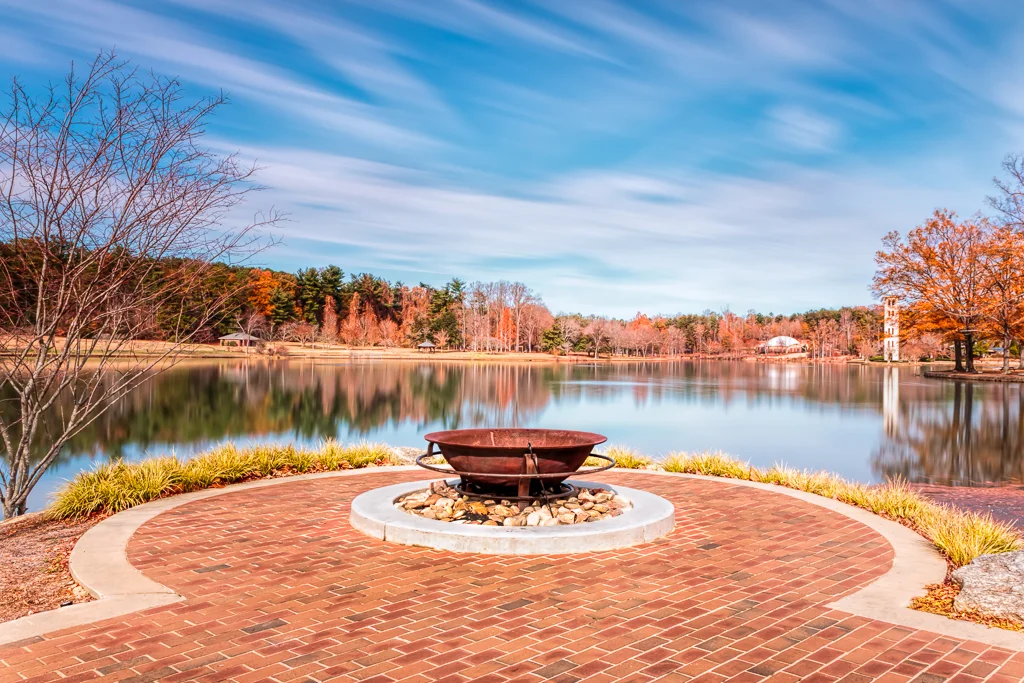
Furman moved to its current 750-acre campus, five miles north of downtown Greenville, in 1958. The campus was designed around a lake, with a Bell Tower at one end and rolling lawns leading down to the water. USA Today called Furman the fourth most beautiful campus in America in 2016. Times Higher Education ranked it ninth in 2017. The campus often gets snow in the winter, which is unusual enough in the upstate that it makes news every time it happens. Beyond aesthetics, Furman has built a reputation for environmental sustainability: a six-acre solar farm with a 743 kilowatt array, a quarter-acre working farm on campus, an off-grid demonstration home called Cliffs Cottage, and a target of carbon neutrality by 2026. The Princeton Review ranks Furman among the top fifty green colleges in America. The Sierra Club has named it one of the top fifty eco-friendly universities. All of these designations sit comfortably with Furman's positioning as a small, elite liberal arts college with a strong sense of place.
Who Came Out of Here
The list of Furman graduates is unexpectedly long for a university of 2,500 students. Charles Townes, the Nobel laureate physicist. Herman W. Lay, the founder of Frito-Lay potato chips. Richard Riley, the U.S. Secretary of Education under Bill Clinton and former governor of South Carolina. Mark Sanford, also former governor of South Carolina, and former U.S. Representative. Amy Grant, the contemporary Christian and pop musician who gave her first ticketed concert as a Furman freshman. Brad Cox, the computer scientist who invented Objective-C, the programming language that ran iPhones for the first decade of their existence. Clint Dempsey and Walker Zimmerman, both U.S. men's national team soccer players. Alexander Stubb, the current President of Finland, who graduated from Furman in 1993. Thomas T. Goldsmith Jr., the physicist who co-invented the first arcade video game, the Cathode-Ray Tube Amusement Device, in 1947. The Furman Paladins compete in NCAA Division I in the Southern Conference. The campus is quiet most weekends. The graduates, somehow, are not.
From the Air
Located at 34.93 degrees North, 82.44 degrees West, approximately five miles north of downtown Greenville, South Carolina. The Furman campus is built around a man-made lake, with a distinctive Bell Tower visible from the air. Nearest airports: Greenville Downtown (KGMU) about 4 nm south-southeast, Greenville-Spartanburg International (KGSP) about 13 nm east, Pickens County (KLQK) about 17 nm west. Best viewed at 2,500 to 4,500 feet AGL; the lake and Bell Tower create a recognizable visual signature against the surrounding suburbs of north Greenville.
Nearby Stories
- Battle of Musgrove Mill 6.9 km away
- Carl Sandburg Home National Historic Site 13 km away
- Stumphouse Mountain Tunnel 17 km away
- Forest City, North Carolina 20 km away
- Chiquola Mill Massacre 20 km away
- Battle of Blackstock's Farm 26 km away
- Great Smoky Mountains National Park 65 km away
- Tree That Owns Itself 84 km away