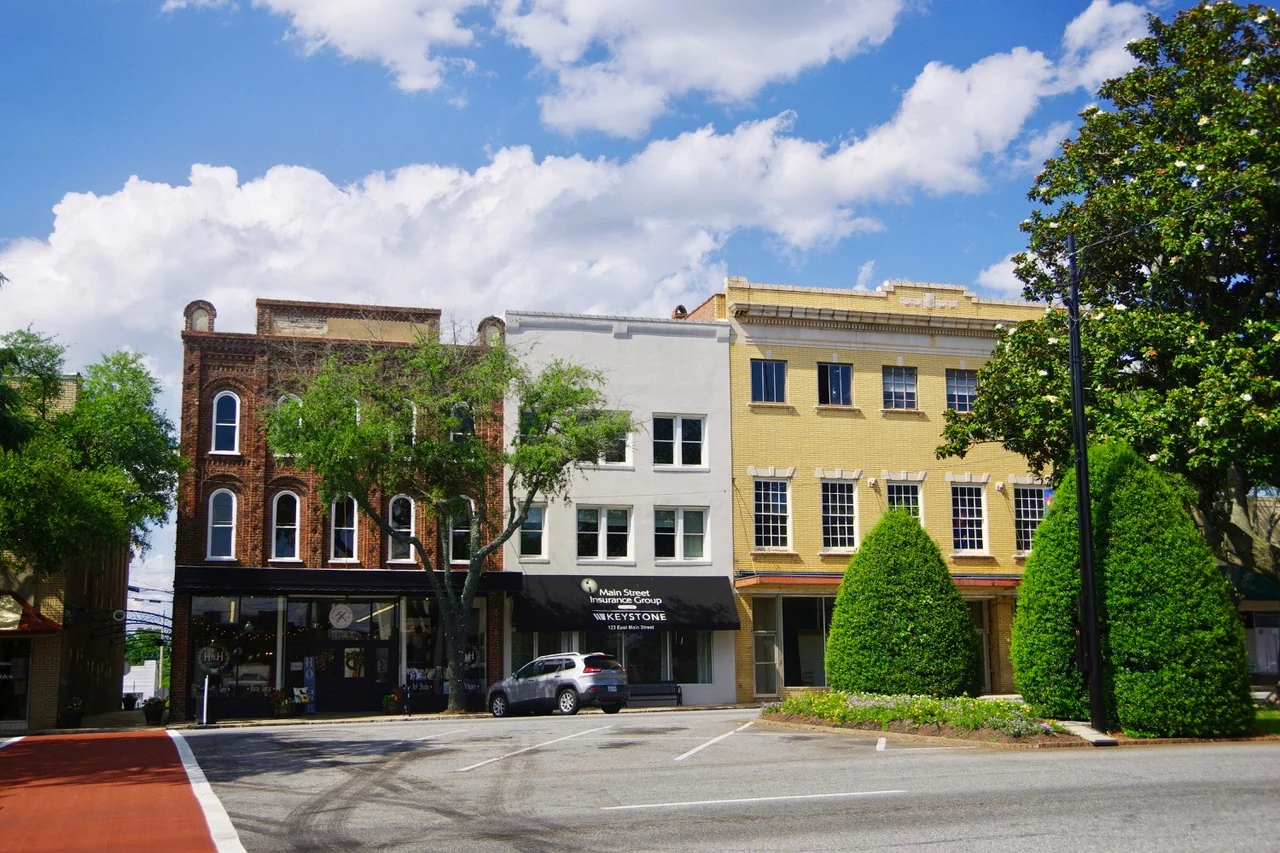

Forest City, North Carolina
The town was called Burnt Chimney before it was called anything more dignified. The chimney in question was the relic of a burned-out homestead at the crossroads, and for decades that smudge of charred brick was the most distinctive landmark for travelers passing through. The town renamed itself Forest City in 1887, traded its scar for an aspiration, and got down to the business of becoming a cotton-mill town - and then, more than a century later, a Facebook data center town, which is its own kind of strange.
Burnt Chimney, Cotton Mills, and a Lynching
Forest City sits in the heart of Rutherford County, along the railroad corridor that the Rutherford Railway Construction Company laid south to the Carolinas border in the 1880s. Cotton mills came with the railroad. Mill villages spread across the surrounding countryside - Alexander Mills, Cliffside, Caroleen - each anchored by a textile operation and the company-built worker housing that came with it. The historic districts the town carries today reflect that era: the East Main, Main, and West Main Street districts, the Alexander Manufacturing Company Mill Village Historic District, the Forest City Baptist Church, all listed on the National Register of Historic Places. The same era also produced the Forest City lynching of 1900, an act of racial violence that is part of the town's documented history and a piece of what mill-town North Carolina was alongside its prosperity.
Christmas Lights and Charles Z. Flack
In 1929 the mayor was Charles Z. Flack. He built the original City Hall, and - in a gesture that became a permanent civic ritual - was the first to string Christmas lights across Main Street. The tradition has held. Every December, downtown Forest City lights up the way Flack lit it up almost a century ago, and the four-lane stretch of merged US 221A and US 74 Business that runs through the historic district transforms into something more like a stage set than a state highway. The town hall still sits along that boulevard. So do the mill-town storefronts and the small museums - the Rutherford County Farm Museum and the Carolina Arcade Museum - that catalog the place's layered history.
Facebook Comes to Burnt Chimney
In 2010 Facebook announced it would build a $450 million data center in Forest City, drawn by inexpensive land, available power, and the kind of local government that says yes quickly. The center came online in 2012 and has expanded since - a quiet, vast installation of servers humming on the outskirts of a town with 7,377 residents. It was an early example of what was about to happen to small Southern towns that had electrical and water infrastructure left over from textile manufacturing: the post-industrial buildings stayed empty, but the post-industrial grid attracted hyperscale tech. For Forest City the data center is an employer, a tax base, and a reminder that the global internet runs on real infrastructure in real places, and that one of those places is a former mill town in the North Carolina foothills.
Owls, Trails, and a Pavilion
Forest City is home to the Forest City Owls of the Coastal Plain League, a wood-bat collegiate summer league that fills the gap between college baseball seasons. The Owls play at McNair Field. They won the CPL championship in 2009 with a 51-9 record and won it again in 2010 - the back-to-back run that briefly made them the top-ranked summer collegiate team in America. The town has invested in its public spaces in other ways too. The Forest City Pavilion opened on Park Square in 2019, a multimillion-dollar venue designed by Odom Engineering that hosts concerts and community events. The Thermal Belt Rail Trail, a 13.36-mile bike and walking path on an old rail bed, was completed in stages to link Forest City with neighboring communities.
What the Numbers Say
The 2020 census recorded 7,377 residents - the most populous municipality in Rutherford County. The 2014-2018 American Community Survey put the median household income at $27,861, with 31.8% of residents below the poverty line. The town is about 70% white, 24% Black, with growing Hispanic and Latino populations. Notable people from Forest City include statistics educator Christine A. Franklin, NASCAR driver John McFadden, former MLB pitcher Todd Coffey, professional basketball players Rob Gray and Venson Hamilton, and Bob McNair, the late founder of the Houston Texans. Burnt Chimney became Forest City. Forest City became a mill town. The mill town became, among other things, the town that hosts a Facebook data center on its edge and Christmas lights strung across its downtown every December. The chimney itself is long gone.
From the Air
Coordinates 35.3311° N, 81.87° W, in Rutherford County's east-central foothills. Nearest airports: Rutherford County Airport (KFQD) about 7 nm northwest at Rutherfordton; Hickory Regional (KHKY) about 45 nm northeast; Greenville-Spartanburg International (KGSP) about 35 nm south; Charlotte Douglas (KCLT) about 55 nm east. Recommended viewing altitude 3,500-5,500 ft AGL. Look for the four-lane US 74 Business / US 221A corridor passing through the historic district, the cluster of small museums and the pavilion at Park Square, McNair Field on the east side, and the distinctive geometry of the Facebook data center campus on the outskirts. The Thermal Belt Rail Trail traces a curving green ribbon through the town's geography.
Nearby Stories
- Gastonia, North Carolina 3 km away
- Huck's Defeat 13 km away
- Black Mountain, North Carolina 14 km away
- Greenville County, South Carolina 14 km away
- Carl Sandburg Home National Historic Site 17 km away
- Spartanburg 18 km away
- Lake Norman 24 km away
- Marion, North Carolina 31 km away