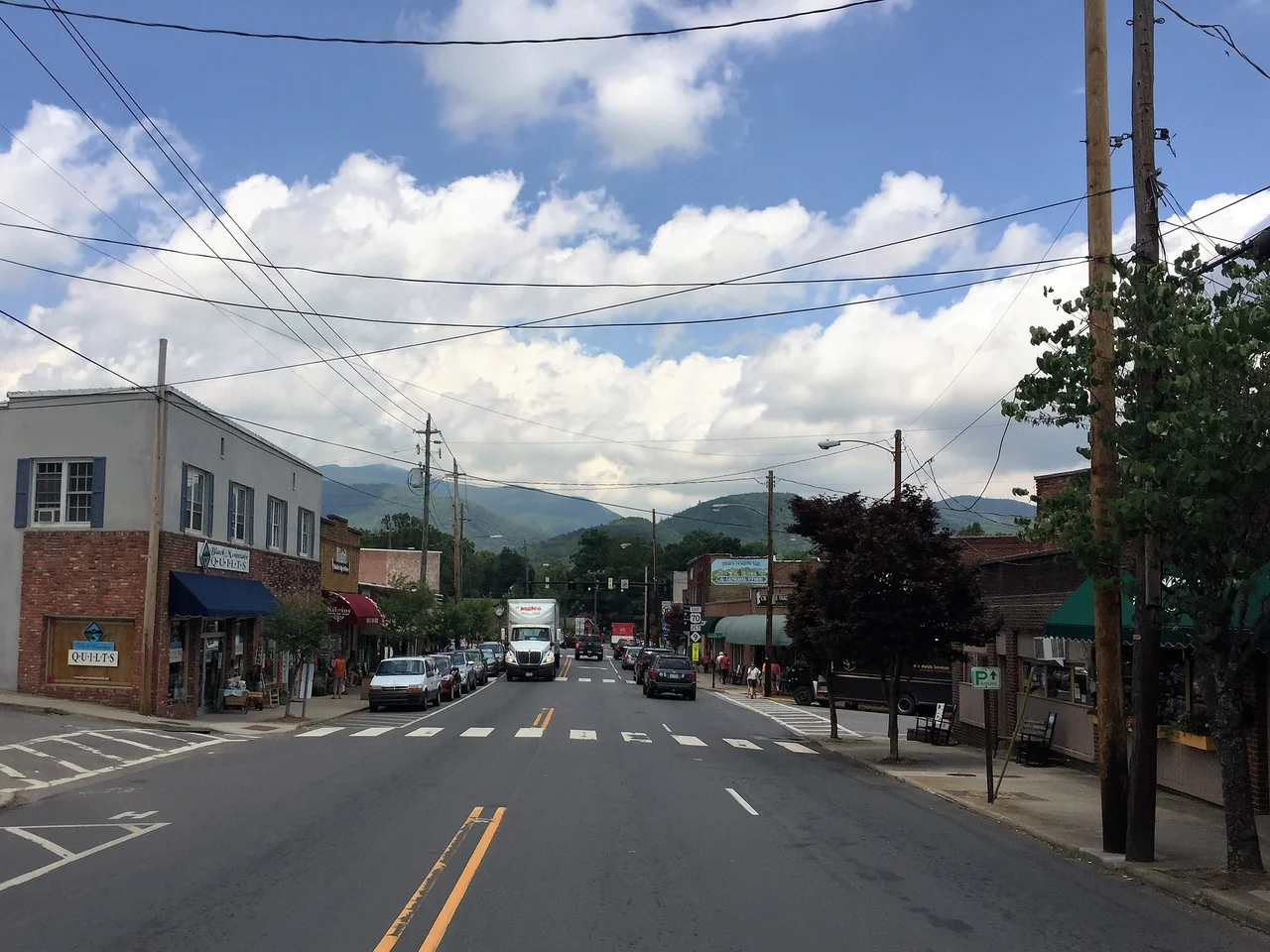

Black Mountain, North Carolina
On September 27, 2024, the Swannanoa River left its banks and tried to take Black Mountain with it. Hurricane Helene's remnants dumped foot after foot of rain into the headwaters above town. The river rose. Power went down. Water and sewer systems failed within hours. Bridges washed out. The Ingles supermarket chain - headquartered here, with its distribution center on the floodplain - had its operations crippled, sending grocery stores across the Southeast into cash-only chaos when payment systems went dark. Black Mountain absorbed one of the worst floods in its history. The town's older identity - mountain resort, summer camp town, home of a vanished avant-garde college - had to be remembered through the recovery.
The Watershed Town
Black Mountain sits in eastern Buncombe County at the foot of the Swannanoa Gap, where the Appalachian crest divides waters that flow to the Gulf of Mexico from waters that flow to the Atlantic. The Swannanoa River rises three miles east of town at the gap, then flows west through the center of Black Mountain on its way to the French Broad and ultimately the Tennessee-Mississippi system. East of the gap, Swannanoa Creek heads the other direction, joining the Catawba and reaching the Atlantic near Charleston. Black Mountain straddles a continental drainage divide. In 2024 the town learned what that means when a tropical storm sits over the gap and dumps its load on both sides at once.
Black Mountain College
Between 1933 and 1957, just east of town at Lake Eden, Black Mountain College ran what is now widely considered the most influential experimental art-and-education program in American history. Josef and Anni Albers, John Cage, Merce Cunningham, Buckminster Fuller, Willem and Elaine de Kooning, Robert Rauschenberg, Cy Twombly, and dozens of others taught or studied here. The college closed for lack of money. Its physical campus became Camp Rockmont, a Christian summer camp for boys. The town that hosted those twenty-four mountain summers continues to draw artists and writers in numbers disproportionate to its size - 8,426 people at the 2020 census, plenty of them making something.
Writers, Singers, Athletes
Roberta Flack grew up here before becoming one of the defining American singers of the 1970s. Patricia Cornwell, the crime novelist whose Kay Scarpetta series sold tens of millions, lived in Black Mountain. Nicholas Sparks set part of The Longest Ride in the area. William R. Forstchen, who teaches at nearby Montreat College, set his 2009 EMP-disaster novel One Second After in Black Mountain itself, using real local landmarks. Lynyrd Skynyrd drummer Artimus Pyle calls the town home, as does NBA player and broadcaster Brad Daugherty. NCAA basketball coach Roy Williams coached at Charles D. Owen High School here early in his career. The notable-people list for a town this size is unusual; the cultural pull keeps working.
Downtown and the Mountains
U.S. Route 70, the main street through town, runs as State Street through a compact downtown of brick storefronts, a converted town hall now serving as the Black Mountain Center for the Arts, McDibbs music venue, and a row of craft breweries and coffee shops. The Swannanoa Valley Museum tells the local story, including the railroad arrival in 1879 that first connected the valley to the outside world. Five historic districts and a handful of individual properties - including Rafael Guastavino Sr.'s estate, the Monte Vista Hotel, and Intheoaks - sit on the National Register of Historic Places. Interstate 40 passes just south of downtown; Asheville is fifteen miles west.
After Helene
The recovery from Hurricane Helene was painful and is ongoing. Roads and bridges needed rebuilding. Water systems needed weeks to come back online. The Ingles facilities returned to operation but the supply chain disruption rippled across the Southeast for months. Volunteers came in by the truckload from every direction. Local businesses turned into supply depots. The town's small population meant that everyone knew someone who had lost a house, a vehicle, or worse. As of 2026, downtown has reopened. The breweries are pouring again. The festivals have returned. The flood marks are still on some walls - a record of a 500-year event in a place that has lived along this river for two hundred years.
From the Air
Black Mountain is at 35.6192N, 82.3256W, elevation 2,405 ft in the Swannanoa Valley. Asheville Regional (KAVL) is 18 nm southwest. Hickory (KHKY) 38 nm east. Look for the Swannanoa Gap notch in the Blue Ridge crest directly east of town - the visual landmark that marks the continental divide here. I-40 cuts the south edge of town.
Nearby Stories
- Hendersonville, North Carolina 2.2 km away
- Forest City, North Carolina 4 km away
- North Carolina Mountains 7.7 km away
- Chattooga River 27 km away
- Grandfather Mountain 30 km away
- Joara 30 km away
- Great Smoky Mountains National Park 41 km away
- Knoxville: The Gateway to the Smokies Where Tennessee Began 87 km away