
Atlantic City Union Station
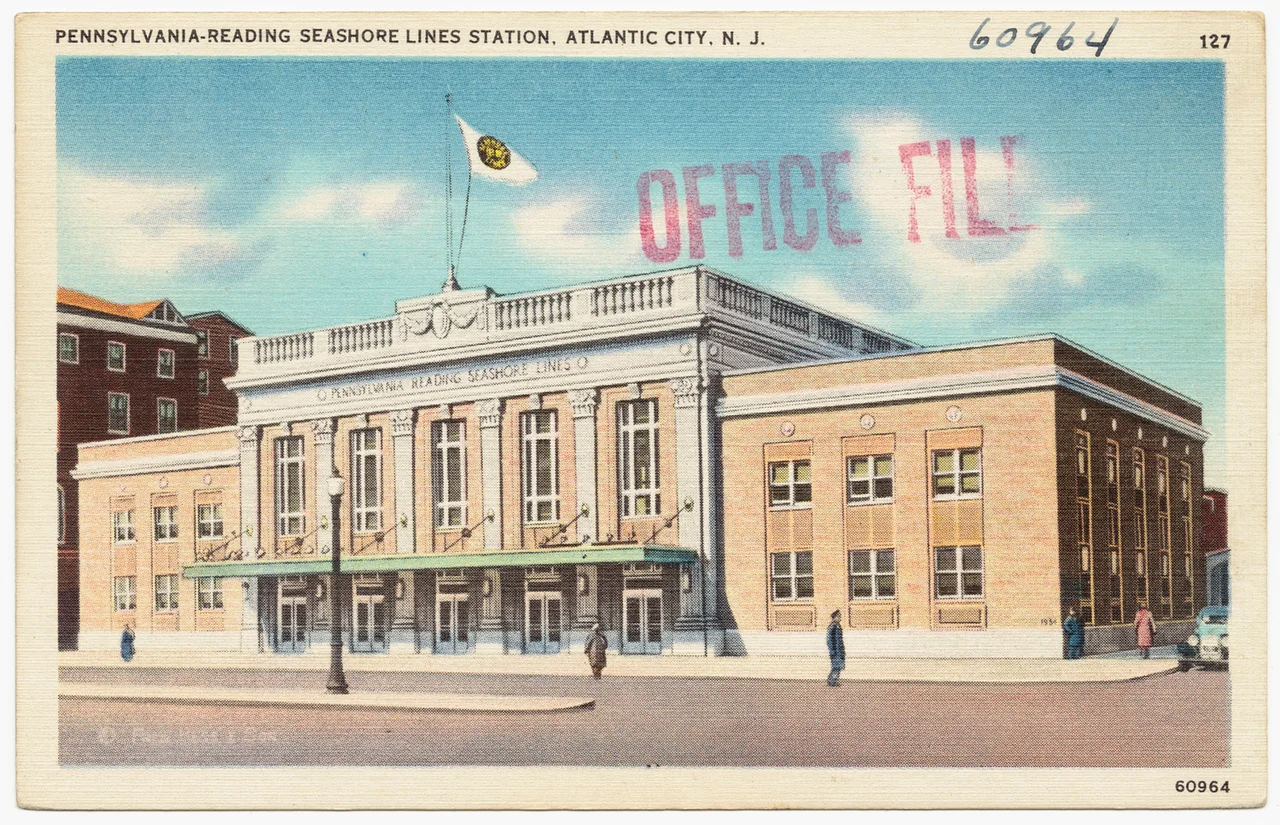
Before the Pennsylvania-Reading Seashore Lines existed, two competing railroads ran into Atlantic City - the Pennsylvania Railroad with its West Jersey and Seashore line, and the Reading Railroad with its Atlantic City Railroad. They had separate depots three blocks apart. They duplicated services on the same routes. By the Depression they were both losing money. In 1933 they did what competing American railroads almost never did willingly: they merged their southern New Jersey operations into a single new company, the PRSL, and built a single Union Station to consolidate their Atlantic City passenger operations. The new station opened September 30, 1934, at 2121 Arctic Avenue. It was, for one shining decade, the architecturally finest building of its kind on the New Jersey shore.
Rosenstein's Art Deco
The architect David A. Rosenstein designed the Union Station in what was then called a modified classic style - a transitional mix of beaux-arts symmetry with art deco surface decoration. The main waiting room was the showpiece: two stories high, 78 feet across, with a coffered ceiling, terrazzo floors, and a glazed terracotta frieze running around the upper walls. Stepped plaster pilasters rose to the ceiling. The Historic American Buildings Survey, documenting the room in 1995 before demolition, called it bright, airy, and pleasant. The boarding area had five platforms running 1,400 feet back from the headhouse, with the first 600 feet covered by canopies. Five trains could load simultaneously. The first floor held the ticket office, parcel room, telegraph desk, payphones, restrooms, lunch counter, and newsstand. The second floor was reserved for railroad employees - dispatchers, conductors, the operating staff of two merged railroads.
The Blue Comet and the Nellie Bly
Atlantic City Union Station hosted some of the most famous named passenger trains of the late steam era. The Central Railroad of New Jersey's Blue Comet ran from Jersey City to Atlantic City via Lakewood and the Pine Barrens until 1941, painted in the sky blue and silver scheme that gave it its name. The Pennsylvania Railroad's Nellie Bly - named for the pioneering investigative journalist who had grown up in New Jersey - ran direct from New York City to Atlantic City through 1961. The Shore Fast Line, an interurban electric railway between Atlantic City and Ocean City that became famous as one of the four railroads on the Monopoly board (along with the Reading, the Pennsylvania, and the B&O), also terminated at Union Station until it shut down in 1948. During a 1937 trade show for rail executives, the station accommodated a week of demonstration locomotives on display while normal summer passenger traffic continued through.
The Expressway Cuts the Tracks
In 1964 the Atlantic City Expressway opened, providing a fast highway from Camden directly to Atlantic City. The Expressway's path into the city crossed the rail line just west of Union Station - and rather than route around the new station, the highway engineers chose to sever the rail connection entirely. A new, smaller PRSL station was built at 2100 Bacharach Boulevard, tucked between an electrical generating station and a gas tank farm. The April 1965 PRSL timetable listed Bacharach as the new Atlantic City destination. The grand Union Station had become unreachable by rail almost overnight. The 1972 Bob Rafelson film The King of Marvin Gardens features brief footage of the small 1964 replacement station, capturing what Atlantic City rail service had been reduced to by the early 1970s. Service ended entirely in 1981.
The Bus Terminal Years
The Ballinger Company of Philadelphia was hired in late 1964 to convert the disused Union Station into a bus terminal. The five rail platforms were modified to accommodate buses. A metal sign reading ATLANTIC CITY MUNICIPAL BUS TERMINAL was bolted over the original PENNSYLVANIA READING SEASHORE LINES inscription. The ticket counter was replaced. Some of the waiting-room windows were covered over with asbestos board. The lunch counter closed. Buses that had been using the old Shore Fast Line terminal since 1948 were consolidated at the new Municipal Bus Terminal. The building served as the city's bus terminal for the next thirty-two years. The grand waiting room - the coffered ceiling, the terracotta frieze, the bright airy space - sat largely unchanged behind the cheap bus-station finishes, slowly accumulating dust.
Demolished for an Outlet Mall
In the mid-1990s, Atlantic City planners announced the Gateway Corridor Roadway Improvements - a redevelopment project meant to create a more attractive entry to the city from the Expressway. The plan called for demolishing the old Union Station. The Historic American Buildings Survey was rushed to document the building before the wrecking ball arrived. The HABS photographer took the surviving images of the original waiting room - the only record now of what Rosenstein had built. Demolition began in 1997. The Tanger Outlets The Walk - a stretch of brand-name discount stores running roughly down the path the old tracks had taken - now occupies the former station site. There is no marker. The Atlantic City Convention Center, with its own modern rail terminal beneath it, opened across town the same year. The Atlantic City Rail Terminal serves the same function the Union Station once served. The architecture is not the same.
From the Air
The former site of Atlantic City Union Station is at 2121 Arctic Avenue, at approximately 39.36 degrees north, 74.44 degrees west, on Absecon Island. From cruising altitude, the location appears as part of the Tanger Outlets The Walk shopping district, just inland from the casino district. Atlantic City International (KACY) lies about 7 nautical miles northwest. Nothing of the original station building remains - the site is now part of the outlet mall complex.
Nearby Stories
- Cape May 8.1 km away
- A. J. Meerwald 14 km away
- The Pine Barrens: Home of America's Oldest Monster 25 km away
- Hereford Inlet Lighthouse 38 km away
- Constitutional Convention (United States) 50 km away
- PS General Slocum 143 km away
- Wardenclyffe Tower 201 km away
- USS Atik 493 km away