
Bader Field
On July 1, 1910, Glenn Curtiss took off from the Atlantic City beach near Million Dollar Pier in his Albany Flier biplane. He flew ten laps around a five-mile course over the open Atlantic Ocean - and in doing so became the first pilot ever to fly an airplane over the sea. He won a $5,000 prize and a footnote in aviation history. At the same meet, Walter Brookins, flying a Wright biplane, set a new altitude record of 6,175 feet by climbing above the Atlantic City beach. Atlantic City had decided to make itself the East Coast's answer to Kitty Hawk - a place where pilots and manufacturers could test new aircraft over a long beach with steady winds. Nine years later, the Aero Club of Atlantic City built a proper airfield on the bay side of Absecon Island. They called it the Atlantic City Municipal Airport. After Mayor Edward Bader died suddenly in 1927, the city renamed it Bader Field. It would operate for the next seventy-nine years.
Charles Lindbergh's 90th Stop
In October 1927, five months after his solo transatlantic flight to Paris, Charles Lindbergh landed the Spirit of St. Louis at Bader Field. He was on the 90th of 92 stops on a national tour sponsored by the Daniel Guggenheim Fund for the Promotion of Aeronautics, a publicity campaign meant to convince American civic leaders that commercial aviation was the future. Lindbergh was the most famous person in the world at that moment. His arrival at Bader Field drew tens of thousands of spectators. He spoke at a public reception in the city, met local officials, slept overnight, and flew on to the next stop in the morning. The Spirit of St. Louis is now displayed in the Smithsonian. The Bader Field landing was one of the small moments in its tour that helped argue the case for aviation infrastructure across the country.
The Pride of Atlantic City
In July 1933, two Black aviators - C. Alfred Chief Anderson and Dr. Albert E. Forsythe - took off from Bader Field in a Fairchild 24 they had named the Pride of Atlantic City. Their goal was to make the first round-trip transcontinental flight by Black pilots in the United States. The plane had no parachutes, no radio, and no landing lights. Anderson was the pilot. Forsythe, an Atlantic City physician, was the navigator and financial backer. They reached Grand Central Airport in Glendale, California, two days later on July 19. They were feted by Los Angeles Mayor Frank Shaw. They returned to Bader Field on July 28, where Atlantic City Mayor Harry Bacharach told them that flying in a small plane with limited equipment called for a high type of courage and skill. Anderson would later become the chief instructor of the Tuskegee Airmen training program. The flight is a documented milestone in early African American aviation history.
Civil Air Patrol Coastal Patrol Base No. 1
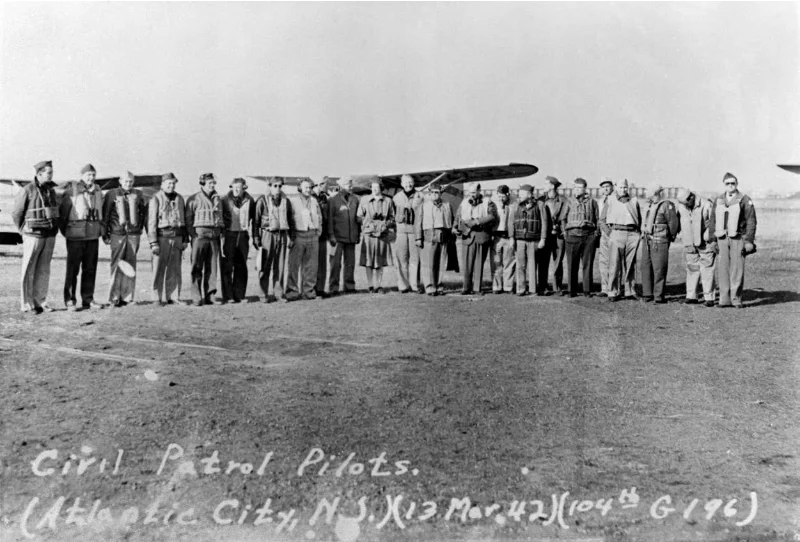
On February 28, 1942 - less than three months after Pearl Harbor and at the height of the German U-boat campaign along the Atlantic coast - the Civil Air Patrol activated Coastal Patrol Base No. 1 at Bader Field. It was the first of what would eventually be twenty-one CAP coastal patrol bases stretching from Maine to Florida. Civilian pilots flying privately owned aircraft - eventually thirty-four planes operating out of Bader Field by April 1943 - patrolled the offshore approaches looking for U-boats. They reported sightings to the Navy. Some carried small bombs. The Civil Air Patrol officially claimed sinking two U-boats and attacking many more — though historians have since questioned those sinking claims, as no corroborating losses appear in German naval records for the period. The base operated until 1943 when the Navy took over its patrol responsibilities. The role of Bader Field in the Battle of the Atlantic is one of the lesser-known pieces of World War II history along the Jersey Shore.
The Long Decline
In 1958 the Navy converted the former NAS Atlantic City into the joint civilian-military Atlantic City International Airport, nine miles inland from Bader Field. Commercial airlines moved to the new facility by 1959. Bader Field lost its scheduled service for a decade until Allegheny Commuter returned in 1971 with Twin Otters running to Newark, Philadelphia, and Cape May. Commuter service continued through the 1980s under various corporate names - Southern Jersey Airways, USAir, Continental, Eastern, TWE - but each successive carrier moved its operations to the larger international airport. By 1991 all commercial flights had left. Private planes continued to use the field until 2006. On May 15, 2005, a Cessna CitationJet 525A landed in a tailwind and slid off the runway into the Intracoastal Waterway. An eyewitness video of the small jet floating in the bay went viral. The NTSB report noted that the airport diagram in the cockpit read airport closed to jet aircraft.
What the Field Holds Now
Bader Field officially closed in 2006 as an aviation facility. The control tower had already been removed in the late 1990s. The 143 acres of mostly flat land facing the Atlantic City casino skyline have been considered prime redevelopment real estate ever since. Bernie Robbins Stadium - a 5,500-seat minor league baseball stadium - opened on a portion of the property in 1998 and hosted the Atlantic City Surf until 2009. The Flyers Skate Zone ice rink occupies another corner. The runways have hosted music festivals: the Dave Matthews Band Caravan in 2011, Metallica's Orion Festival in 2012, Phish for three nights in 2012, Global Rallycross in 2016. The Sports Car Club of America still runs autocross events on the asphalt. None of the various casino, luxury housing, or convention proposals that have been floated for the site has yet broken ground. The field sits, mostly empty, waiting for whatever Atlantic City decides to do with it next.
From the Air
Bader Field occupies a roughly 143-acre parcel on the bay side of Absecon Island at approximately 39.36 degrees north, 74.46 degrees west, less than a mile across the Intracoastal Waterway from Boardwalk Hall and the casino district. From cruising altitude, the field appears as a large flat open area near the center of Atlantic City, with two visible runway patterns and the Bernie Robbins Stadium on the eastern edge. Atlantic City International (KACY) lies about 6 nautical miles northwest. The airport is closed to all flight operations - markings remain but the field is no longer charted as an active airport.
Nearby Stories
- Cape May 8.1 km away
- A. J. Meerwald 14 km away
- The Pine Barrens: Home of America's Oldest Monster 25 km away
- Hereford Inlet Lighthouse 38 km away
- Constitutional Convention (United States) 50 km away
- PS General Slocum 143 km away
- Wardenclyffe Tower 201 km away
- USS Atik 493 km away