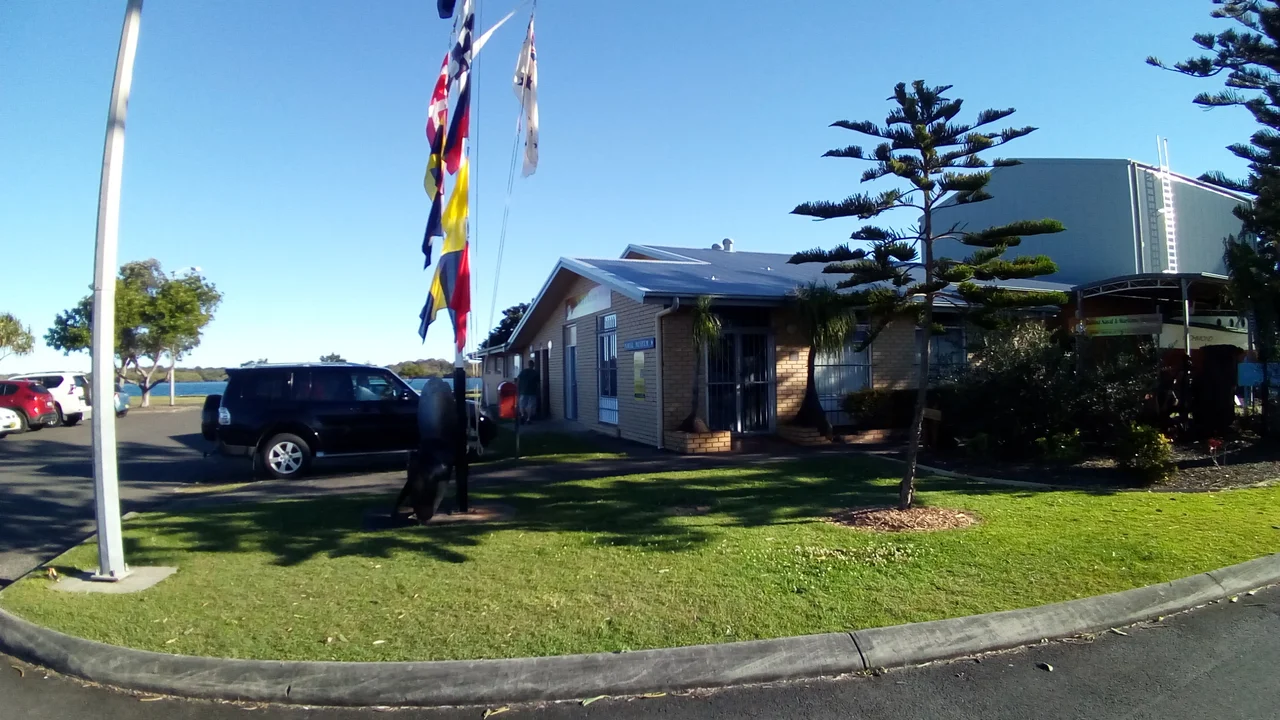

Ballina Naval & Maritime Museum
Tucked behind the tourist centre on Regatta Avenue is a low building that holds one of the strangest survivors in Australian seafaring. It is a raft - nine logs of balsa wood lashed together with rope, a simple cabin, a square sail - and it crossed the entire Pacific Ocean from South America under wind and current alone. In 1973 three of these rafts set out from Ecuador. The one that endures at the Ballina Naval & Maritime Museum is the heart of the collection, the physical proof of a voyage that pushed a 1940s theory to its limit and held, for a time, a world record that still astonishes.
Twelve Men, Three Rafts, One Ocean
On 27 May 1973, three balsa rafts left Guayaquil on the Ecuadorian coast, bound for Australia far to the west. The expedition was led by the Spanish adventurer Vital Alsar and crewed by twelve men of seven nationalities, sailing without an engine, relying on the same Pacific currents that carry warm water westward. The rafts were named for the journey itself: Guayaquil for the port they left, Mooloolaba for the Queensland beach they hoped to reach, and Aztlan for the Mexican site where the expedition was organised. Ahead of them lay roughly 14,000 kilometres of open water and nearly six months at the mercy of the sea.
Twice the Kon-Tiki
The voyage was a deliberate echo, and a one-upping, of a famous predecessor. In 1947 the Norwegian Thor Heyerdahl had sailed his Kon-Tiki raft from Peru into the Pacific to argue that ancient peoples could have crossed the ocean on simple craft. The Las Balsas expedition went almost twice as far. After about 179 days at sea the rafts neared the Australian coast, but currents pulled them off their intended landfall at Mooloolaba and carried them south. On 21 November 1973 they were brought into Ballina, two of them towed up the Richmond River by local fishing trawlers, and the crews were given a heroes' welcome. It remains the longest known raft voyage in history, and the only multi-raft crossing of the Pacific ever made.
What the Sea Left Behind
Six months of salt water takes a toll on lashed balsa logs. By the time the rafts reached Ballina they were waterlogged and failing; one, the Guayaquil, was judged too far gone to tow and was cut loose. The raft preserved at the museum today was rebuilt from the best surviving timbers of the expedition - original logs from a voyage that should, by any reasonable expectation, have ended on the ocean floor. To see it up close is to grasp how little stood between those twelve men and the deep: a few metres of wood, a sail, and an enormous amount of nerve.
The War Came to This Coast
Not every story here ends in welcome. The museum also keeps the memory of the SS Wollongbar II, a coastal trader that worked these waters in butter, sugar and bacon. On 29 April 1943, steaming from Byron Bay toward Newcastle, she was struck by two torpedoes from the Japanese submarine I-180 off Crescent Head and sank within minutes. Of her crew of 37, only five survived. The day before, she had been searching for survivors of another freighter, the Limerick, torpedoed off Ballina itself just days earlier. These were merchant sailors, civilians moving food along the coast, and the war found them within sight of home. The displays make sure their loss is not forgotten among the models and the celebrated raft.
More Than One Raft
The raft is the headline, but the museum is the work of people who knew the sea first-hand. Many of its founders and volunteers served in the Royal Australian Navy, and the displays honour the RAN alongside the navies of other nations. It holds what is billed as the largest collection of naval and merchant ship models in Australia, a working triple-expansion steam engine, a Mark 9 torpedo, a tribute to the women who served in the Navy, and the story of the port of Ballina itself. It is a small museum with an outsized reach, anchored by a raft that turned a wild idea into a record that has never been broken.
From the Air
The museum sits in central Ballina at the mouth of the Richmond River, 28.87 degrees S, 153.56 degrees E, on Regatta Avenue behind the tourist information centre. From the air, the Richmond River estuary and Ballina's breakwaters are the orienting landmarks, with the town's distinctive Big Prawn nearby. Ballina Byron Gateway Airport (YBNA) lies about 5 km west of the town centre, making this an easy visual reference on approach. Recommended viewing altitude 1,500 to 3,000 ft. Subtropical coastal weather is usually clear, though this is one of the wettest stretches of the NSW coast and storms can build fast over the Tasman Sea.
Nearby Stories
- Minyon Falls 7.9 km away
- Iluka, New South Wales 27 km away
- Susan Island Nature Reserve 56 km away
- Washpool National Park 76 km away
- Spicers Gap Road 81 km away
- HMS Porpoise (1799) 731 km away
- Wreck Reefs 761 km away
- SS Elingamite: Gold, Fog, and a Captain Wrongly Blamed 1793 km away