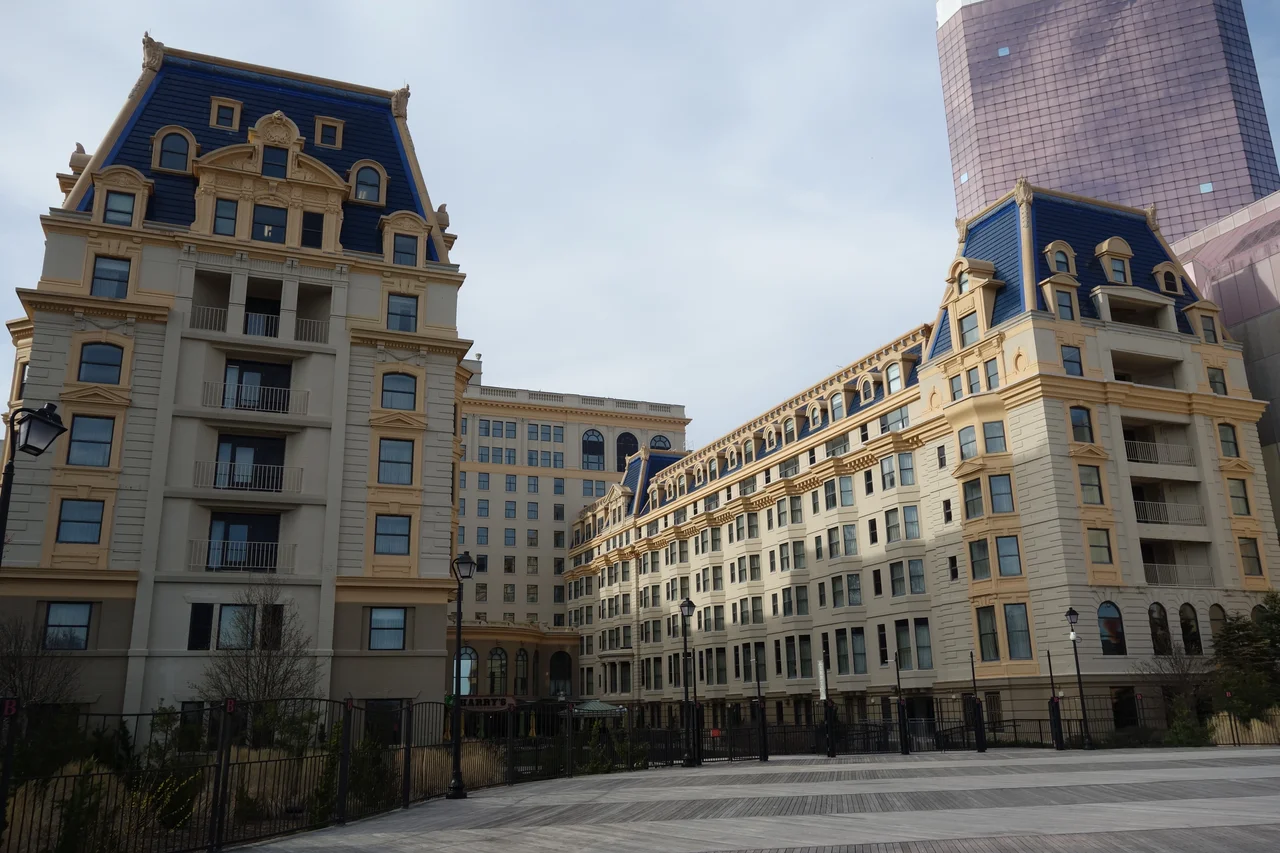

Bally's Atlantic City
If you have ever played Monopoly, you know the address. Park Place. Boardwalk. The two most expensive squares on the board, the deep blue properties that win games when a hotel goes up. Bally's Atlantic City sits at that exact intersection - Park Place and the Boardwalk - and the casino has spent its entire existence trading on a real estate marketing slogan that became the most famous in American board game history. The casino was built on land that once held two of the most architecturally famous hotels of the East Coast resort era: the Marlborough-Blenheim, built between 1900 and 1906, and the Dennis, with origins as a pre-Civil War cottage. Both buildings were partly demolished to make room for the casino. One small fragment of the Dennis Hotel still survives inside Bally's modern complex.
The Marlborough-Blenheim
The Marlborough House opened in 1900 - a Queen Anne style hotel built by Josiah White III between Ohio Avenue and Park Place on the boardwalk. White had inherited a Quaker fortune and used part of it to build one of the early modern Atlantic City resort hotels. In 1905 he commissioned the Philadelphia architectural firm of Price and McLanahan to design a sister wing - an experimental building constructed entirely of poured concrete, then a brand-new technique in American hotel architecture. The Blenheim opened in 1906. The two structures together were renamed the Marlborough-Blenheim. The Blenheim's concrete construction, designed by William Lightfoot Price, was a landmark in American building history - one of the first major commercial uses of reinforced concrete in the United States. The hotel ran successfully for the next sixty-five years, surviving Prohibition, the Depression, the wartime gas rationing that hurt Atlantic City tourism, and the postwar decline.
The Dennis Hotel
Next door, the Dennis Hotel had grown organically since before the Civil War. It began as a cottage built by William Dennis on Michigan Avenue in the 1850s. Joseph H. Borton bought it after the war and extended it. In 1892 Borton built a large French chateau-style addition. Around 1900 the hotel was sold to Walter Buzby, who hired architect Walter Smedley - another Philadelphia Quaker - to design a six-story eastern wing that opened in 1906. The Dennis was a genteel hotel: long stays, regular families returning summer after summer, dining room service that read like Edwardian-era hospitality. By the 1970s it was struggling. The casino legalization referendum of 1976 made the property a target. The casino developers wanted big sites in central Atlantic City, and the Dennis sat on prime ocean-front land.
Reese Palley and the Demolition
On March 14, 1977, the flamboyant New York art dealer Reese Palley and the local attorney Martin Blatt bought the Marlborough-Blenheim from the White family. They planned to spend $35 million on a renovation that would preserve the historic Blenheim concrete wing while replacing the older Marlborough. Palley successfully got the Blenheim placed on the National Register of Historic Places. Three months later they leased the property to Bally Manufacturing - the world's largest slot-machine maker - for forty years with a hundred-year option. Bally bought the adjacent Dennis Hotel for $4 million. Then Bally announced that all three historic structures - the Marlborough, the Blenheim, and the Dennis - would be demolished to make way for an $83 million casino designed by Maxwell Starkman Associates. The historic preservation community objected loudly. Bally proceeded anyway. The Marlborough-Blenheim came down in November 1978.
The Dennis Tower Survives
The Dennis Hotel got a reprieve. To open the casino quickly and offset construction costs, Bally decided to retain the Dennis as a temporary hotel until a new modern tower could be built. The decision was financial rather than historic, but the result was the same: the Dennis Hotel survived as the Dennis Tower of Bally's, and it remains the only piece of pre-casino Atlantic City hotel architecture still in regular hotel use on the boardwalk. The casino opened December 30, 1979, with the renovated Dennis serving as the room block. In 1989 Bally added a 750-room hotel tower in a modern light-pink glass exterior. In 1997 the Wild Wild West Casino opened as Bally's second gambling floor. The Marlborough-Blenheim concrete wing - the building Palley had fought to preserve - was gone. The Dennis - never on any preservation list - had endured.
Through Many Owners
In 2000 Bally's Park Place was renamed Bally's Atlantic City. The neighboring Claridge Hotel and Casino was bought and incorporated as the Claridge Tower in 2003. Harrah's Entertainment - later Caesars Entertainment - bought Bally's along with Caesars Atlantic City in 2005. In 2008 Harrah's spent $38.5 million to purchase the row of small shops between the Dennis Tower and the boardwalk, then $23 million more to demolish them and restore an open plaza in front of the historic facade. The Ridge casino in the Claridge Tower closed in 2012. The Claridge was sold off as an independent hotel in 2013. In 2017 ownership of Bally's was transferred to Vici Properties in a corporate spin-off, with the building leased back to Caesars. In November 2020 Twin River Worldwide Holdings bought the property from Vici, acquired the Bally's name, renamed itself Bally's Corporation, and took the casino back to its founding brand. The Dennis Tower remains. The boardwalk address still reads Park Place.
From the Air
Bally's Atlantic City stands at the intersection of Park Place and the boardwalk at approximately 39.36 degrees north, 74.43 degrees west, in the heart of the Atlantic City casino district. From cruising altitude, look for the distinctive multi-tower complex on the boardwalk - the modern Bally's Tower, the historic Dennis Tower with its turrets, and the adjacent Claridge Tower. Atlantic City International (KACY) lies about 7 nautical miles northwest. The property sits between Caesars Atlantic City and the boardwalk amusement district.
Nearby Stories
- Cape May 8.1 km away
- A. J. Meerwald 14 km away
- The Pine Barrens: Home of America's Oldest Monster 25 km away
- Hereford Inlet Lighthouse 38 km away
- Constitutional Convention (United States) 50 km away
- PS General Slocum 143 km away
- Wardenclyffe Tower 201 km away
- USS Atik 493 km away