
Baltimore, County Cork
The Irish name comes first, before the English one, because the English name is misleading. Baltimore's Irish name is Dún na Séad -- fort of the jewels -- after the O'Driscoll castle that still stands above the harbour. "Baltimore" is an anglicisation of a different place name entirely, Baile an Tí Mhóir, town of the big house. So the visitor who arrives at the southernmost village of Ireland's southernmost parish, who walks down past the cottages to the pier where the ferries leave for Sherkin and Cape Clear, is standing in two places at once: a sleepy West Cork harbour where lobster boats nudge each other in the swell, and the seat of one of the oldest dynasties in Ireland, a place that was already old when Christianity arrived.
Fort of the Jewels
The Corcu Loígde, who held this corner of Cork from somewhere deep in prehistory, were once Kings of Tara and Kings of Munster. Their seat at Dún na Séad sat on the high ground above the bay, where Dunasead Castle still does. The townland is dense with the evidence of long settlement -- ring forts, fulachta fiadh, souterrains, lime kilns, holy wells -- the kind of stratigraphy that comes from people living in one place for several thousand years. In antiquity the fort was associated with the druids and with Bealtaine, the festival of the beginning of summer. The castle that stands today was a fortification from at least the early 13th century, restored in recent decades and now open to visitors, who climb its narrow stair to look out over a harbour the O'Driscolls would still recognise.
Pirates and Puritans
Around 1605, with the blessing of King James I, an English Puritan named Sir Thomas Crooke leased Baltimore from the O'Driscoll chief Sir Fineen and founded a colony there. It was a strange place to plant Puritans. The pilchard fishery was lucrative, but the village was simultaneously running as a pirate base of some local notoriety -- with not only the local justices but reportedly the entire population involved in the trade. Wikipedia's source claims, with what is presumably an inherited Jacobean shrug, that the women of Baltimore in this period were either the wives or the mistresses of pirates. The English crown was nominally opposed and in practice indifferent. In 1607 Baltimore was granted the right to hold a weekly market and two annual fairs, and the pirate village became, officially, a market town.
Lot's Wife
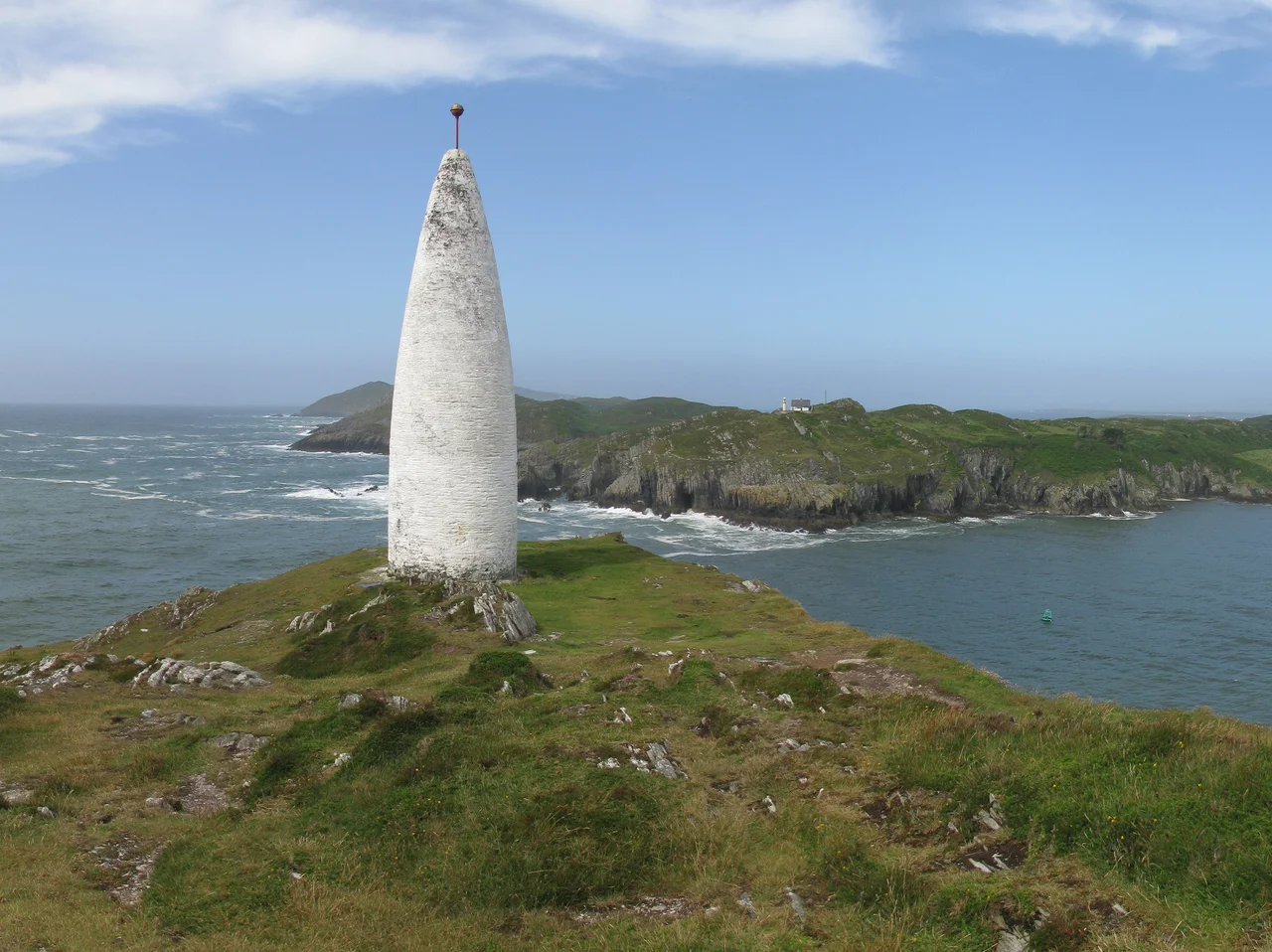
On the eastern point of Baltimore Harbour stands the Beacon, a white conical tower roughly fifteen metres high, locally called Lot's wife or the pillar of salt. The current beacon is the second on the site -- the first was a small, locally built structure that had been vandalised by the time Commander James Wolfe surveyed the harbour in 1847. By 1849 the new beacon was complete, its masonry finished if not yet topped with vane and staff. Today the beacon is one of the most photographed objects on the West Cork coast: a white exclamation mark against blue or grey, depending on the weather, with the open Atlantic behind it and Sherkin lying low in the middle distance. From any boat coming home into Baltimore in poor visibility, it is still the first thing you see.
What the Village Does Now
A few hundred people live here through the winter. In summer the village swells with sailors and divers and visitors heading out to the islands, and the cottages with summer-home shutters get opened up again. Lough Hyne, Ireland's first marine nature reserve, sits a few kilometres inland: an unusually deep saltwater lough with its own restricted ecosystem and a tidal rapid that reverses direction four times a day. The dive sites in the bay include a Second World War German U-boat (U-260) and the bulk carrier Kowloon Bridge, which went aground in 1986 -- one of the largest shipwrecks ever to land on the Irish coast. The local restaurant Dede holds two Michelin stars; Mews held two from 2018 to 2020. The Ilen Rovers GAA club has carried the name of the local river since 1973. The R595 leads back inland to Skibbereen, thirteen kilometres up the road, and the closed Baltimore railway station, which last saw a train in 1961, has been quietly absorbed back into the village fabric.
From the Air
Baltimore lies at approximately 51.48N, 9.37W on the southwest tip of County Cork, marking the southernmost parish in Ireland. Cork Airport (EICK) is roughly 90 km to the east-northeast; Kerry Airport (EIKY) is approximately 95 km north-northwest. From the air, look for the white cone of the Baltimore Beacon on the eastern headland of the harbour, with Sherkin Island lying immediately south across the channel and Carbery's Hundred Isles spreading west through Roaringwater Bay. Lough Hyne, the small dark sea lough, is visible 5 km north-east. Best viewing in clear westerly conditions; Atlantic fronts can close visibility quickly.
Nearby Stories
- Bear (barony) 2.5 km away
- Castle Donovan 2.7 km away
- Bandon, County Cork 8.1 km away
- HMHS Llandovery Castle 14 km away
- The Sinking of the Lusitania: The Torpedo That Changed the War 17 km away
- Wolfpack Prien 61 km away
- SM U-27 111 km away
- 1356 Lisbon Earthquake 1629 km away