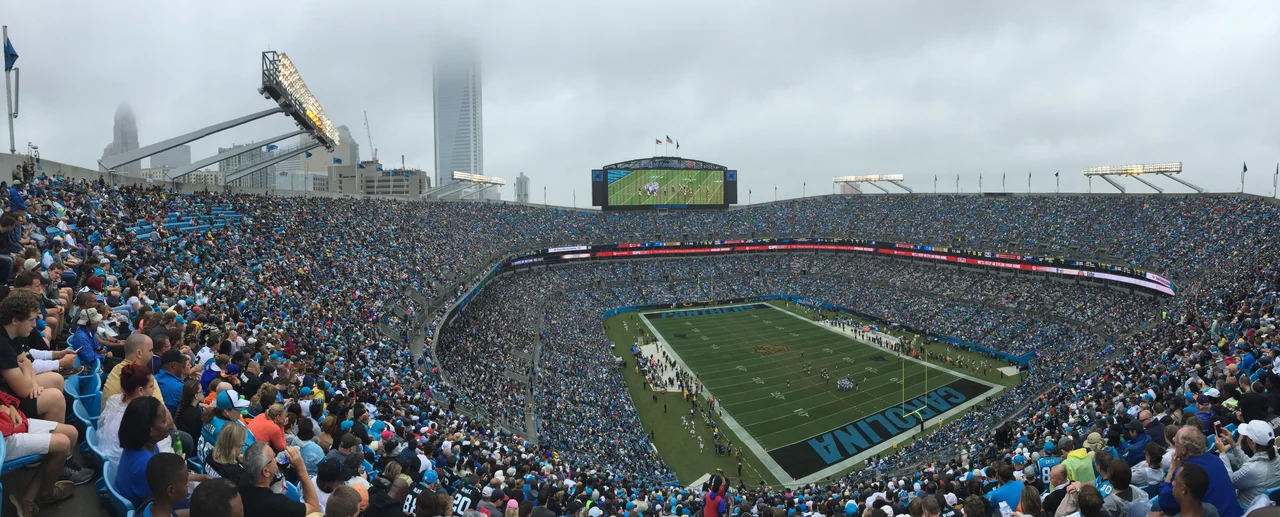

Bank of America Stadium
Six bronze panthers crouch at the entrances of an open-air bowl in Uptown Charlotte. Each is named "Indomitable Spirit," each weighs more than a car, and each has glowing green eyes that, at night, stare down the surrounding skyscrapers like cats with a grudge. They have been there since the stadium opened in 1996 as Ericsson Stadium, since it became Bank of America Stadium in 2004, since the Panthers won an NFC Championship inside it in January 2016 and lost a Super Bowl two weeks later. They will be there for whatever comes next - which, the team has hinted, may involve an $800 million renovation or a brand new building. Charlotte loves and replaces things at roughly the same rate.
How a City Pays for a Stadium
Bank of America Stadium was the first large American venue funded chiefly through Personal Seat Licenses - a then-new idea where fans bought the right to buy season tickets, paying upfront for a piece of plastic that didn't entitle them to anything except the privilege of paying again every August. PSL pledges were strong enough to convince the NFL to grant Charlotte the league's first expansion team in almost two decades. The Panthers played their inaugural 1995 season at Clemson's Memorial Stadium while construction finished, then opened their new home on August 3, 1996 with a preseason win over the Chicago Bears. They have sold out every game since 2002. Whatever else you can say about Charlotte's football fans, they showed up.
The Lynching Beneath the End Zone
When the Panthers chose the Uptown site over alternatives near Charlotte Motor Speedway, Carowinds, or western Gaston County, they bought land that included the footprint of the historic Good Samaritan Hospital - and, as Charlotte historian Michael Moore established during preparation for the 2019 Equal Justice Initiative Community Remembrance Project, the site of the city's first known lynching in 1913. The stadium covers ground that holds a grief most fans walk over without knowing it. This is not a story Charlotte advertises on game days. It is, however, the kind of history a city has to know if it wants to understand the place it built its biggest civic gathering. The 13-foot bronze statue of founder Jerry Richardson that once stood at the north gate was removed in June 2020 during the George Floyd protests. Some monuments are easier to take down than others.
An Open-Air Bowl in a Variable South
Charlotte sits in a climate that can produce both ice and tropical storms in the same calendar year, and the stadium - with its open roof and its half-football arches - has hosted both. The September 2011 "Water Bowl" against Jacksonville saw more than four inches of rain in less than an hour, flooding the field while the Panthers won 16-10. December 24, 2022 produced the coldest home game in Panthers history. In June 2025, a FIFA Club World Cup match between Benfica and Chelsea was suspended in the 86th minute as storms approached, resuming two hours later for Chelsea to win 4-1 in extra time. The stadium has always had a fortress-like exterior; the weather treats it like one anyway.
Two Sports, One Bowl
The field was designed wide enough for soccer from the beginning, but for most of the stadium's first two decades it stayed quiet outside football season. That changed in 2019, when Charlotte was awarded the 30th Major League Soccer franchise. Charlotte FC's home debut on March 5, 2022 drew 74,479 spectators - an MLS record for a stand-alone match. The stadium added new locker rooms, a curved 200-foot video screen at the east gate, and a FieldTurf surface replacing the Bermuda grass that had grown there since 1996. The Panthers still play here. Charlotte FC plays here. The Duke's Mayo Bowl plays here. The ACC Championship Game plays here through at least 2030. For one building, that's a lot of jobs.
The Future, with Cranes
Owner David Tepper - who bought the franchise in 2018 - has at various times suggested demolishing the stadium for a new building, then announced an $800 million renovation instead, scheduled to start in 2026 with completion by 2030. Plans call for new exterior video boards, redesigned concourses, additional seating, and an entertainment district tying the stadium to the future Gateway Station transit hub. Whether the next decade brings replacement or reinvention, the six panthers at the gates will probably stay. Charlotte tears down a lot of things. It does not, generally, tear down its mascots.
From the Air
Located at 35.2258°N, 80.8528°W in the southwest quadrant of Uptown Charlotte, between South Mint Street and South Graham Street. The open bowl is easy to spot from low cruise - a green oval anchored against the cluster of Uptown skyscrapers. Nearest airport is Charlotte/Douglas International (KCLT) about 4 nautical miles west; Concord-Padgett Regional (KJQF) lies northeast. Best viewing altitude 2,500-5,000 feet on game day when the lights are on; the six light domes above the entrances glow Panthers process blue at night.
Nearby Stories
- Battle of Colson's Mill 12 km away
- Kings Mountain Mine 13 km away
- Thyatira Presbyterian Church, Cemetery, and Manse 16 km away
- Andrew Jackson State Park 19 km away
- Charleston Naval Hospital Historic District 22 km away
- Hickory Motor Speedway 22 km away
- North Carolina Aviation Museum 29 km away
- Battle of Fishdam Ford 47 km away