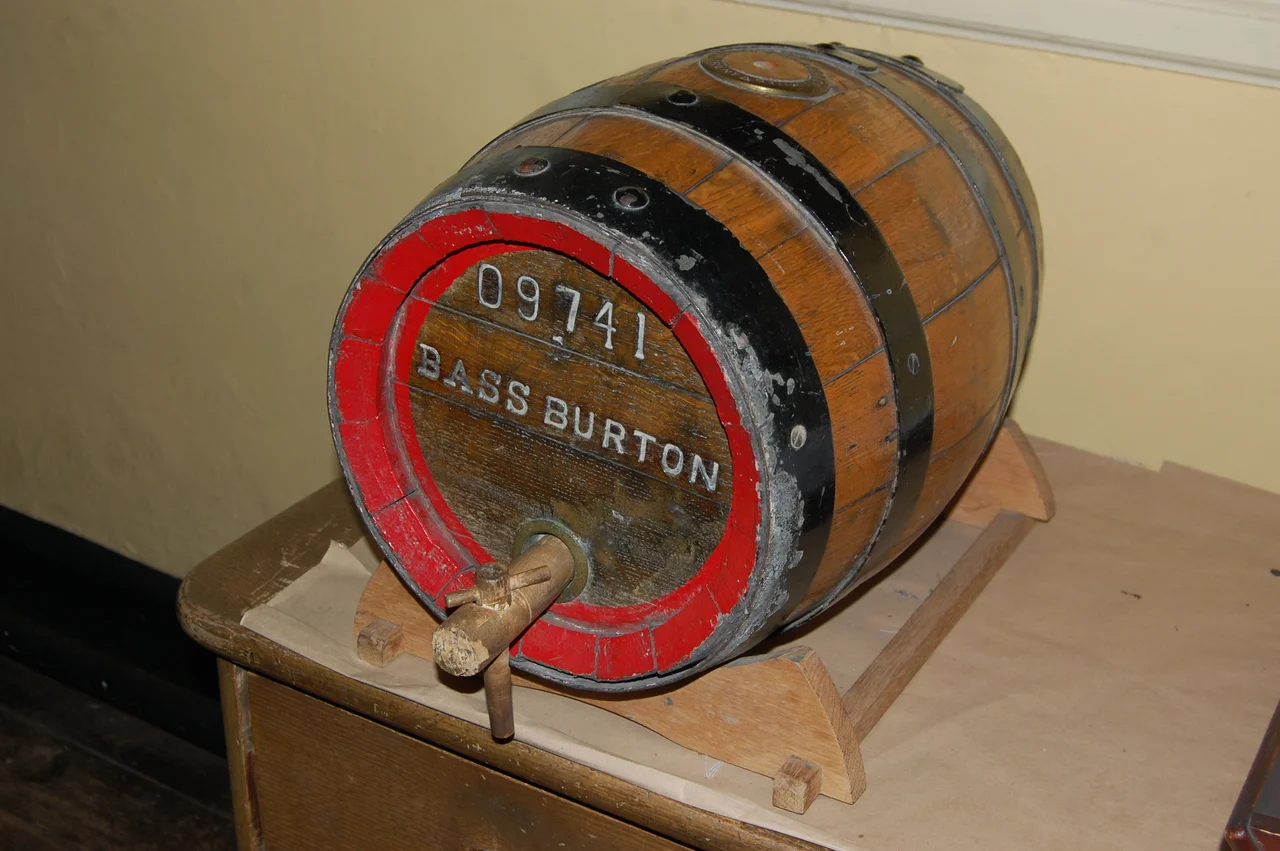

Bass Brewery
On New Year's Eve in 1875, a Bass Brewery employee stood overnight in a queue outside a London registry office. The Trade Marks Registration Act came into effect at midnight on the first of January 1876, and someone had to be first in line. The next morning, when the doors opened, Bass, Ratcliff and Gretton Limited received the first six trade mark registrations issued in the United Kingdom: the red triangle for their pale ale, the red diamond for their strong ale, and four others later abandoned. The triangle is still legally trade mark number one. It has been painted by Manet, sketched into more than 40 Picassos, and observed by Leopold Bloom in the "Oxen of the Sun" episode of James Joyce's Ulysses. None of which the Bass employee queuing in the cold was thinking about.
Why Burton
William Bass started his brewery in 1777, but the reason it succeeded was not him. It was the water. Burton sits on a layer of gypsum-rich rock that gives its well water unusually high mineral content, particularly sulphates, which work magic on pale-malt ales. The result is the Burton snatch, that faintly sulphurous note that marks a real Burton pale ale and that brewers elsewhere tried desperately to imitate. By the mid-19th century, 30 breweries operated in the town, drawing from the same boreholes. Before he founded the brewery, William Bass had transported ale for the brewer Benjamin Printon, and when he sold that carrier business to the Pickford family (the ancestors of the modern Pickfords removals firm), he used the proceeds to set up Bass & Co. Three generations of Michael Thomas Basses then built it into something extraordinary. The 1839 opening of the railway through Burton multiplied the brewery's reach overnight.
The Largest in the World
By the mid-1870s, Bass, Ratcliff and Gretton accounted for one-third of Burton's total beer output. By 1877 the brewery was the largest in the world, producing one million barrels a year and exporting, in the company's own boast, to "every country in the globe." That boast included Baltic ports through Hull, India by the East India Company's old routes, Australia, the Americas. Bass kept its own private rail network within Burton, the largest in the country, linking the various brewery sites. Bass No 1 Ale, marketed from around 1870, was the first beer in Britain to be sold under the name barley wine. Annual Bass excursions, organised for employees and their families, were the largest private excursion operation in the world. When Michael Arthur Bass, later the first Baron Burton, took over after his father's death in 1884, the brewery was already a national institution. Both he and his father made enormous charitable donations to Burton and to Derby, the kind of Victorian philanthropy that built libraries and hospitals.
Fanny Lucy Radmall
Not every Bass story is one of triumph. In the 1880s the brewery received unwelcome publicity through Frederick Gretton, son of the John Gretton who had partnered with the Bass family. Fred had drifted away from the company to develop a stable of racehorses; his Sterling and Isonomy were stars of the Turf. He was also a heavy drinker, and he took as his mistress the teenage Fanny Lucy Radmall, who was barely more than a child when the relationship began. When Fred died of drink in 1883, he left her £6,000 a year, an enormous sum his family bitterly contested. Fanny Lucy went on to make her own life and became a household name as Lucy, Lady Houston, one of the more eccentric and outspoken figures of interwar Britain. The trajectory from teenage mistress of a racing-mad brewer to celebrated patron and political agitator is not a tidy story. But it begins with Fred Gretton's will.
The Beer Orders and What Came After
Through the 20th century Bass acquired Walkers in 1923, Worthington in 1927, then Mitchells and Butlers, Charringtons, William Stones, and many smaller breweries. By the 1960s the merged Bass Charrington was the largest UK brewing company. Then came Margaret Thatcher's 1989 Beer Orders. The Monopolies and Mergers Commission had concluded that the "Big Six" brewers, controlling 75% of UK beer production through tied pubs, constituted a complex monopoly that needed breaking. The unwinding took years. Eventually Bass sold its brewing operations to Interbrew, which was forced by competition regulators to sell the Burton brewery itself along with Carling and Worthington to Coors, now Molson Coors. The Bass company, left with only hotels and pubs, renamed itself Six Continents and split in 2003 into Mitchells & Butlers and InterContinental Hotels Group. The Burton brewery still operates. Marston's brews Bass under licence; AB InBev owns the brand. The historic Bass site was put on the market in 2020 for redevelopment. The National Brewery Centre, which had told this story to visitors since 2010, closed in 2022.
From the Air
Located at 52.81N, 1.63W, in the centre of Burton upon Trent on the River Trent. From the air the brewery complex, the river, and the parallel railway lines form a distinctive industrial pattern stretching along the valley. East Midlands Airport (EGNX) lies 14 nm east-northeast, Birmingham (EGBB) 20 nm south-west, and Tatenhill (EGBM) just 4 nm west. The Trent itself is the clearest landmark, winding through Burton with bridges including the modern replacement for the medieval Burton Bridge that gave its name to two battles four centuries apart.
Nearby Stories
- Broad Eye Windmill 1.9 km away
- Cromford Mill 3.1 km away
- Murder of Naomi Smith 5.5 km away
- Grantham Canal 6.5 km away
- Round Oak Steelworks 8.1 km away
- Nottinghamshire 9.7 km away
- Battle of Naseby 16 km away
- Sandbach Crosses 18 km away