
Battle of Adwalton Moor
On the morning of 30 June 1643, two armies that had not planned to meet found themselves on the same patch of high ground above the Old Roman Road at Adwalton. Lord Fairfax, the Parliamentary commander, had 7,500 men. The Royalist Earl of Newcastle, marching to attack Bradford, had 7,000, including two demi-cannons. Neither side had chosen the location. Both later claimed they had arrived to find the other already drawn up. What followed was an encounter battle, untidy, costly, and decisive enough to bend the course of the First English Civil War.
The Yorkshire Campaign
Yorkshire in the first half of 1643 was a contested chessboard. The Royalists under William Cavendish, Earl of Newcastle, and the Parliamentary Army of the North under Ferdinando Fairfax, second Lord Fairfax, had clashed repeatedly. There had been battles at Leeds, Seacroft Moor, and the capture of Wakefield. The economy at stake was cloth: West Yorkshire's wool towns produced the goods that funded armies, and whoever held them held the north. On 22 June, Newcastle took Howley Hall, the fortified mansion of the Parliamentary supporter Lord Savile, at Batley. He then advanced north with his army and his artillery train, intending the seven and a half miles to unfortified Bradford. Fairfax made a decision that would prove costly. Rather than wait behind walls, he assembled his army and marched out into open country to meet the Royalists head on.
The Battle on the Old Roman Road
The two forces collided at Wisket Hill near Adwalton. Fairfax's men drove back the Royalist skirmishers and took up positions in enclosed fields, using hedges and walls to break Royalist cavalry charges. Lord Fairfax commanded the centre, his son Sir Thomas Fairfax the right wing, and Major General Gifford the left. At first the Parliamentary numbers told. The infantry pushed the Royalists back to the edge of the open moor, then continued advancing toward the Royalist artillery. The battle seemed nearly won. Then a contingent of Royalist pikemen counter-charged and broke the Parliamentary left. Royalist cavalry swung north and took Gifford's troopers in the flank. Gifford's men collapsed and ran. Sir Thomas Fairfax on the right, ordered to retreat, discovered that the Royalist counter-stroke had already cut him off from the main body. The army that had been on the verge of victory disintegrated within an hour.
The Dead and the Captured
An estimated 500 Parliamentary soldiers were killed, most of them as they tried to break back toward Bradford, and another 1,500 were taken prisoner. Royalist losses were lighter: about 200 killed and 300 wounded. These were not abstract numbers. They were Yorkshire men, on both sides, many of them recruited from the same villages, with sons and brothers among the dead and the captured. The Parliamentary survivors fled back to Bradford. Newcastle followed overnight, brought up his artillery, and began bombarding the town on the morning of 1 July. The Parliamentary commanders escaped in small cavalry detachments. The rest surrendered. Within days Leeds had fallen too, and what remained of the Parliamentary army withdrew to Hull, the last northern stronghold.
The Long Consequence
Historians have argued about how important Adwalton Moor really was. Newcastle's victory consolidated Royalist control of Yorkshire, which was significant, but it did not change the broader strategic picture immediately. The deeper consequence emerged slowly. With Parliament cornered at Hull, the leadership in London concluded that they needed the Scottish Covenanters as allies, and the Solemn League and Covenant was signed in September 1643. That alliance brought a Scottish army south, and one year later, on 2 July 1644 on the moor outside York, the combined Parliamentary and Scottish forces destroyed the Royalist northern army at Marston Moor. Newcastle fled into exile. Historic England now ranks Adwalton Moor as second only to Marston Moor in importance among Yorkshire's Civil War battlefields.
What Remains at Adwalton
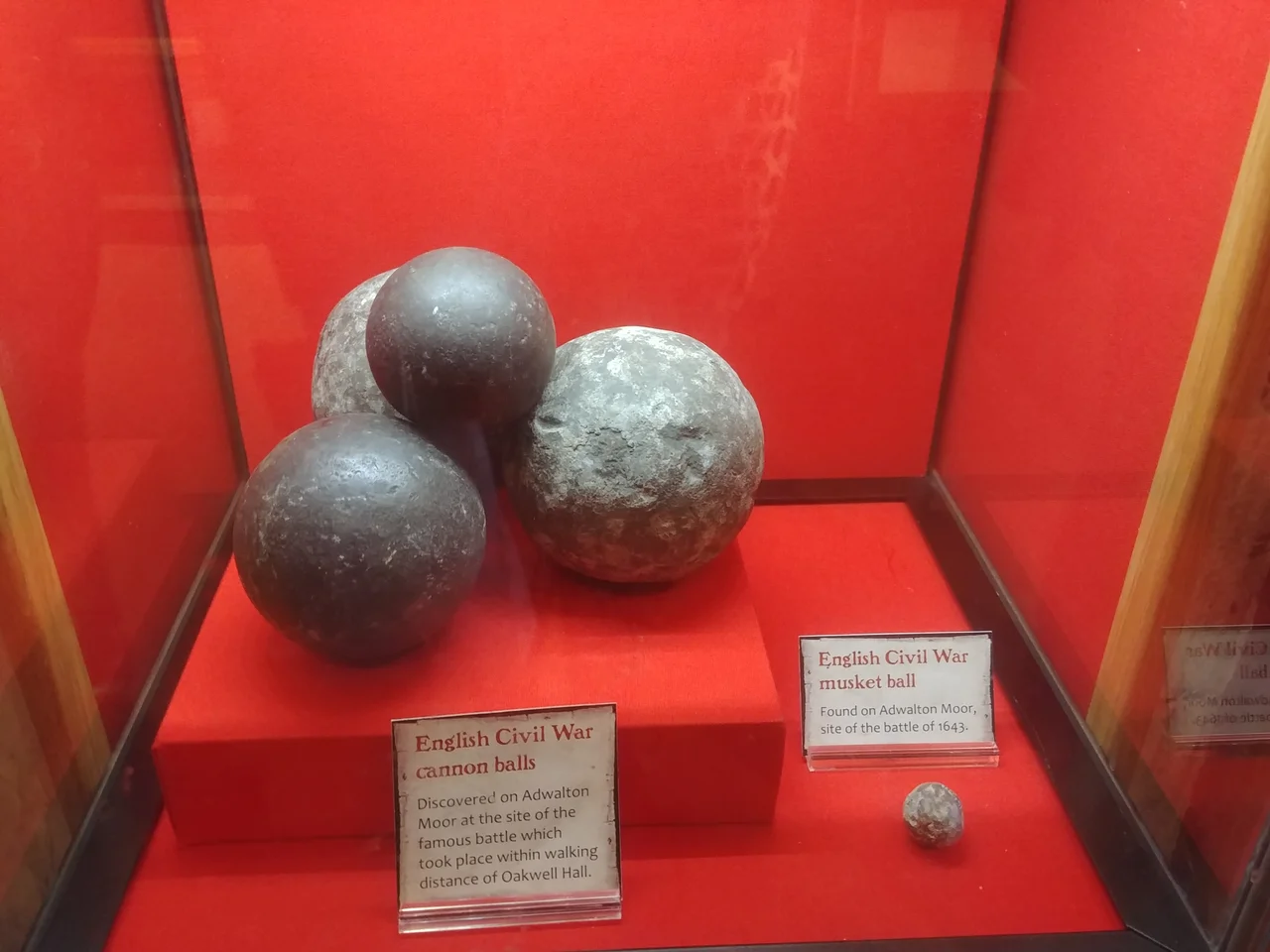
The battlefield today straddles a boundary that no one fighting in 1643 would have recognised. The site is high ground in Adwalton, now generally considered part of Drighlington in the Leeds council area, but it is also the only battlefield recognised by Bradford Council as falling within its district. The A650 road cuts straight through what was once the centre of the fighting. Some of the ground is protected as green belt. There are plaques for visitors. A short drive away at Oakwell Hall, now in Kirklees, and at Bolling Hall in Bradford, museums tell the story with cannon balls and musket balls dug from the field. Bolling Hall was itself a Royalist base during the campaign. The objects survive. The people they killed are remembered as numbers, which is the way most battles are remembered, but the numbers were each of them somebody.
From the Air
Located at 53.751 N, 1.664 W, on the high ground between Bradford and Leeds, with the A650 cutting through what was the centre of the battle. Best viewed from 2,500-4,000 ft AGL; the rural-urban fringe is now extensively built around the field. Nearest airports are Leeds Bradford (EGNM) about 5 nm north-northeast (close to its approach corridor) and Manchester (EGCC) 30 nm southwest. Oakwell Hall lies 1 nm south and Bolling Hall 3 nm west, both of which display battlefield finds. The Pennine edge is visible to the west on clear days.
Nearby Stories
- Stockport Air Disaster 4.5 km away
- Hillsborough Disaster 6.1 km away
- Murder of Sophie Lancaster 6.3 km away
- Battle of Stamford Bridge 9.8 km away
- Wressle Castle 12 km away
- Gordale Scar 12 km away
- Gainsborough Old Hall 19 km away