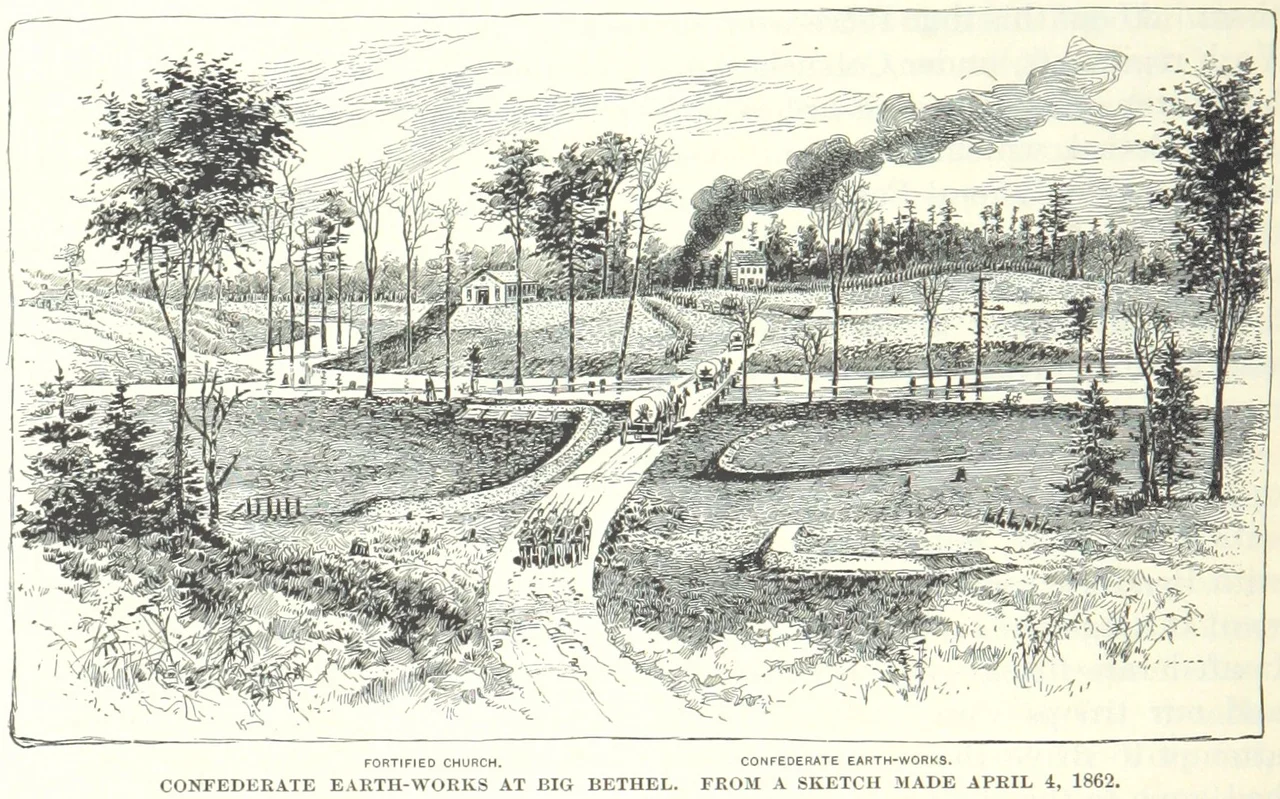

Battle of Big Bethel
Two hours before dawn on June 10, 1861, a Union column wearing gray uniforms walked into another Union column on a dark Virginia road. Colonel John Bendix's German-speaking 7th New York, never given the password or the white-armband recognition signal, mistook the gray-coated 3rd New York ahead of them for Confederates and opened fire. The friendly fire killed three of their own men and shattered any chance of surprise. The Union force kept advancing anyway. By 1:30 that afternoon, Lieutenant John T. Greble lay dead on a Virginia road with a bullet wound to the right temple - the first regular U.S. Army officer killed in the Civil War - and a battle that should have been a footnote had become a sound-and-fury introduction to four years of catastrophe.
The Bait at Big Bethel
Virginia had voted to secede on May 23, 1861. Confederate Colonel John B. Magruder pushed down the Virginia Peninsula to slow any Union advance on Richmond, and Major General Benjamin Butler - a Massachusetts lawyer commanding the Union garrison at Fort Monroe - took the bait Magruder offered. Magruder established forward positions at Big Bethel Church and Little Bethel Church to provoke a premature attack. Butler obliged. He and his aide Major Theodore Winthrop, an accomplished author already, designed a complex night march from Camp Hamilton at Hampton and Camp Butler at Newport News. Two columns of inexperienced volunteers would converge on Little Bethel before dawn, take it, and possibly continue on to Big Bethel. The watchword was 'Boston.' Soldiers were to tie white cloth on their left arms. Butler did not lead the column himself - a decision he was later criticized for - assigning command to Massachusetts militia general Ebenezer Peirce, who had no formal military training and was too ill to ride a horse the day before the operation.
Shooting Each Other in the Dark
The plan unraveled before any Confederate fired a shot. The 3rd New York Infantry wore gray uniforms. The 7th New York, marching behind them, had not been given the password or the armband signal. In the pre-dawn dark Colonel Bendix saw gray-coated men ahead and ordered his regiment to fire. Three of his own men were killed. At least forty more fled back to Fort Monroe convinced their regiment had been cut to pieces. Peirce pulled back over the New Market Bridge to assess, then - over the objections of his colonels - pressed forward anyway. The Confederate outpost at Little Bethel Church, about fifty cavalrymen, heard the gunfire and abandoned it. The 5th New York Infantry (Duryee's Zouaves) burned the Little Bethel church and the homes of several secessionists, then continued toward Big Bethel. Magruder, alerted by an elderly local woman, hurried his roughly 1,500 men back to the fortified position behind Marsh Creek where Colonel Daniel Harvey Hill's 1st North Carolina waited.
Greble and Winthrop
The fight at Big Bethel began at 9 a.m. and lasted four and a half hours. Union skirmishers reported Confederate strength as 3,000 to 5,000 men - the actual number was around 1,500 - but accurately described the position as well fortified. Lieutenant John T. Greble of the 2nd U.S. Artillery brought three guns forward and worked them resolutely against heavy fire. Major Theodore Winthrop, attached to Peirce's staff, led one last assault on the Confederate left, his troops crossing the creek by tying white cloths around their hats to pass as Confederates. They cheered too soon. Two companies of the 1st North Carolina turned to face them. Winthrop jumped onto a log and shouted, 'Come on boys, one charge and the day is ours.' These were his last words; a bullet struck him through the heart. Colonel Hill later praised Winthrop's courage. Greble refused to pull back his guns and kept firing with too few men to work both pieces. A Confederate bullet struck him in the right temple.
First Officer, First Enlisted Man
Henry Lawson Wyatt, a private in the 1st North Carolina Volunteer Infantry, volunteered with three others to burn a house on the field that Union skirmishers were using for cover. They were turned back by fire from the road. Wyatt did not get up. He was the only Confederate killed in the battle - eight Confederate casualties in total - and is often called the first Confederate soldier killed in combat in the Civil War, though Captain John Quincy Marr had died at Fairfax Court House nine days earlier. Wyatt is best described as the first Confederate enlisted man killed. The Union forces suffered 76 casualties total, 18 of them killed. Lt. Greble was the first U.S. Regular Army officer to die in the war and the first graduate of West Point. Major Winthrop's brother came under a flag of truce to recover the body; Magruder's men returned it with a respectful escort.
What Was Left Behind
Magruder withdrew to Yorktown within hours of the victory. The Union forces did not attempt another peninsula advance until McClellan's Peninsula Campaign of 1862. Southern newspapers exaggerated the win until it sounded like a war-deciding blow; six weeks later the Confederate victory at First Bull Run reinforced the dangerous Southern conviction that this war would be short. Most of the Big Bethel battlefield has not been preserved. Marsh Creek - now Brick Kiln Creek - was dammed into the Big Bethel Reservoir, drowning the ground where Winthrop fell. The site of Lt. Greble's death is now a convenience store. Local preservationists have proposed protecting fragments inside Langley Air Force Base, including the memorial to Henry Lawson Wyatt and a surviving stretch of earthwork. The first land battle of the Civil War, in any meaningful sense, is mostly under water and pavement now.
From the Air
The Battle of Big Bethel site (now largely beneath the Big Bethel Reservoir) sits at approximately 37.10 N, 76.42 W, on the boundary between Hampton and Newport News on the Virginia Peninsula. Most of the surviving ground lies inside Langley Air Force Base (KLFI), an active fighter base; do not overfly the surface area without clearance. From 3,000 feet, the reservoir is visible 4 nm west of KLFI between Big Bethel Road and the Langley AFB northern boundary. Newport News/Williamsburg International (KPHF) is 6 nm northwest. Norfolk International (KORF) Class C is 10 nm south. Standard contact procedures apply.
Nearby Stories
- Hungars Church 1.3 km away
- Cape Charles Lighthouse 6.7 km away
- CSS Virginia 11 km away
- White House (plantation) 12 km away
- Flowerdew Hundred Plantation 17 km away
- Battle of Gwynn's Island 17 km away
- Nat Turner's Rebellion 22 km away
- False Cape State Park 37 km away