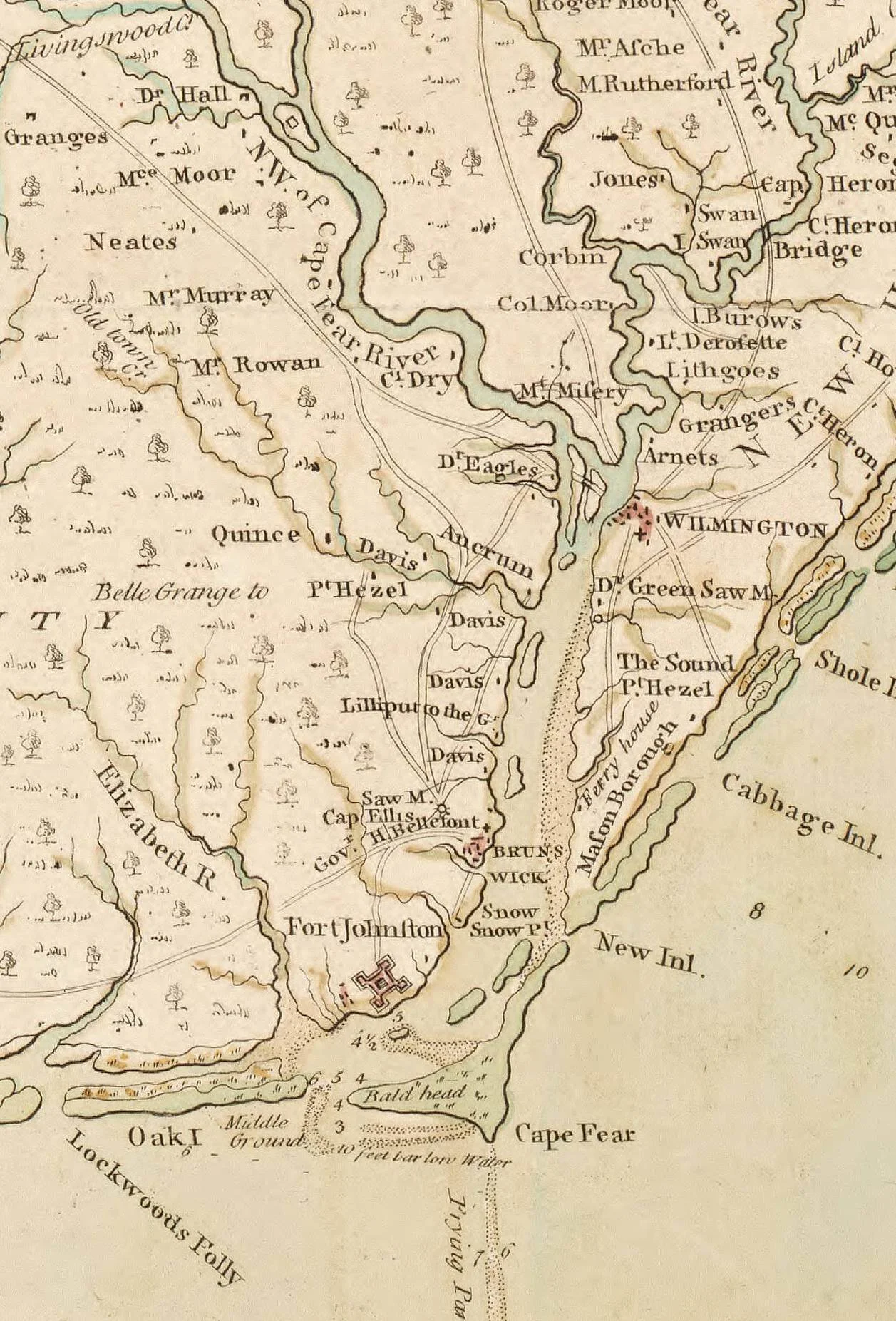

Battle of Cape Fear River
Stede Bonnet was not supposed to be a pirate. He was a Barbadian planter with a wife, a fortune, and what one contemporary called a disordered mind. Yet in September 1718, he was hiding three armed sloops in the Cape Fear estuary, repairing his flagship with timber salvaged from a captured shallop, when two Carolina sloops appeared at the river mouth. What followed was a five-to-six-hour gun duel stuck on sandbars in shallow water, and it became one of the last great battles of the Golden Age of Piracy.
The Gentleman Pirate's Refuge
Bonnet had sailed up from the Delaware Bay in August 1718. His flagship was the Royal James, his own sloop renamed from its original name Revenge, mounting eight cannons. Two other sloops, Francis and Fortune, carried similar armament. Forty-six pirates crewed the squadron. The Royal James needed careening, hurricane season was bearing down, and the Cape Fear estuary offered shelter and timber. Bonnet's men spent weeks repairing the hull with material stripped from a captured shallop. They thought the Carolinas were far enough from the Royal Navy to be quiet. They were not. Reports of the pirate sloops reached South Carolina governor Robert Johnson before the work was finished.
Colonel Rhett's Hunt
Johnson did not have Royal Navy crews at his disposal. He had Colonel William Rhett, two eight-gun sloops named Henry and Sea Nymph, and 130 locally raised sailors from Charleston. They reached the Cape Fear River estuary on the night of September 26, 1718. The pirates spotted them and, mistaking the silhouettes for merchant ships, lowered three canoes to investigate. Then Rhett's flagship Henry ran aground on a sandbar. The canoes drifted close enough to see what they were dealing with, turned around, and paddled back to warn Bonnet. The night gave way to morning, and Bonnet made his choice: he would fight his way back to the open sea.
Six Hours on the Sandbars
At daylight, Bonnet raised his colors and attacked. The pirates sailed within range, then opened fire with cannon and muskets. The Carolinians returned fire and tried to maneuver. Both sides ran aground. Bonnet steered close to the western shore and his ships also went hard onto sand. Only Henry and Royal James lay within range of each other. For five to six hours, they dueled in place, neither able to move. Henry's grounding left her crew exposed to plunging fire. The Royal James, listing the right way, used her hull as a wall. Bonnet stood on deck with his pistol drawn and warned that he would shoot any man who flinched. His pirates jeered the Carolinians and dared them to board.
When the Tide Came In
Casualties mounted on Henry. After five hours the Carolinians had suffered 30 casualties to the pirates' nine killed or wounded. Then the water came back. Rhett's sloops, downstream, floated free first while Bonnet's ships stayed stranded. The Carolinians repaired their rigging, raised sail, and worked Henry into a position where she could fire her starboard guns directly down onto Royal James's deck. Bonnet surrendered. He was taken to Charleston, escaped briefly, was recaptured after a skirmish on Sullivan's Island, and was hanged on December 10, 1718. A monument in Charleston still marks the spot.
The End of an Era
Stede Bonnet's hanging closed a chapter that Blackbeard's death at Ocracoke a month earlier had also helped end. The Royal Navy and colonial militias had spent years chasing pirates across the Caribbean and the American coast, and the Battle of Cape Fear River, sometimes called the Battle of the Sandbars, was one of the campaign's decisive engagements. The estuary that hid Bonnet's squadron now looks different. Frying Pan Shoals still reaches out from Cape Fear, and the same sandbars that grounded Henry and Royal James still shift with every storm. But the pirates are gone. The river belongs to ferries, fishing boats, and the slow procession of pleasure craft up the Intracoastal Waterway.
From the Air
The battle was fought at the mouth of the Cape Fear River, near 33.89 degrees N, 78.01 degrees W, in waters now adjacent to Southport, Bald Head Island, and Oak Island. Cape Fear Regional Jetport (KSUT) at Oak Island is the nearest GA airport; Wilmington International (KILM) lies 25 miles north. From low altitude, the estuary's complex sandbar patterns are still visible at low tide, and the bend in the river where Bonnet's sloops were trapped can be inferred from the curve of the western shore. Frying Pan Shoals extends offshore and remains a notable maritime hazard.
Nearby Stories
- Ocean Isle Beach house fire 6.5 km away
- New Hanover County, North Carolina 8.8 km away
- Lake Waccamaw, North Carolina 26 km away
- Marine Corps Base Camp Lejeune 55 km away
- Huntington Beach State Park 62 km away
- HMT Bedfordshire 71 km away
- Atalaya Castle 111 km away
- Mercury-Redstone 4 688 km away