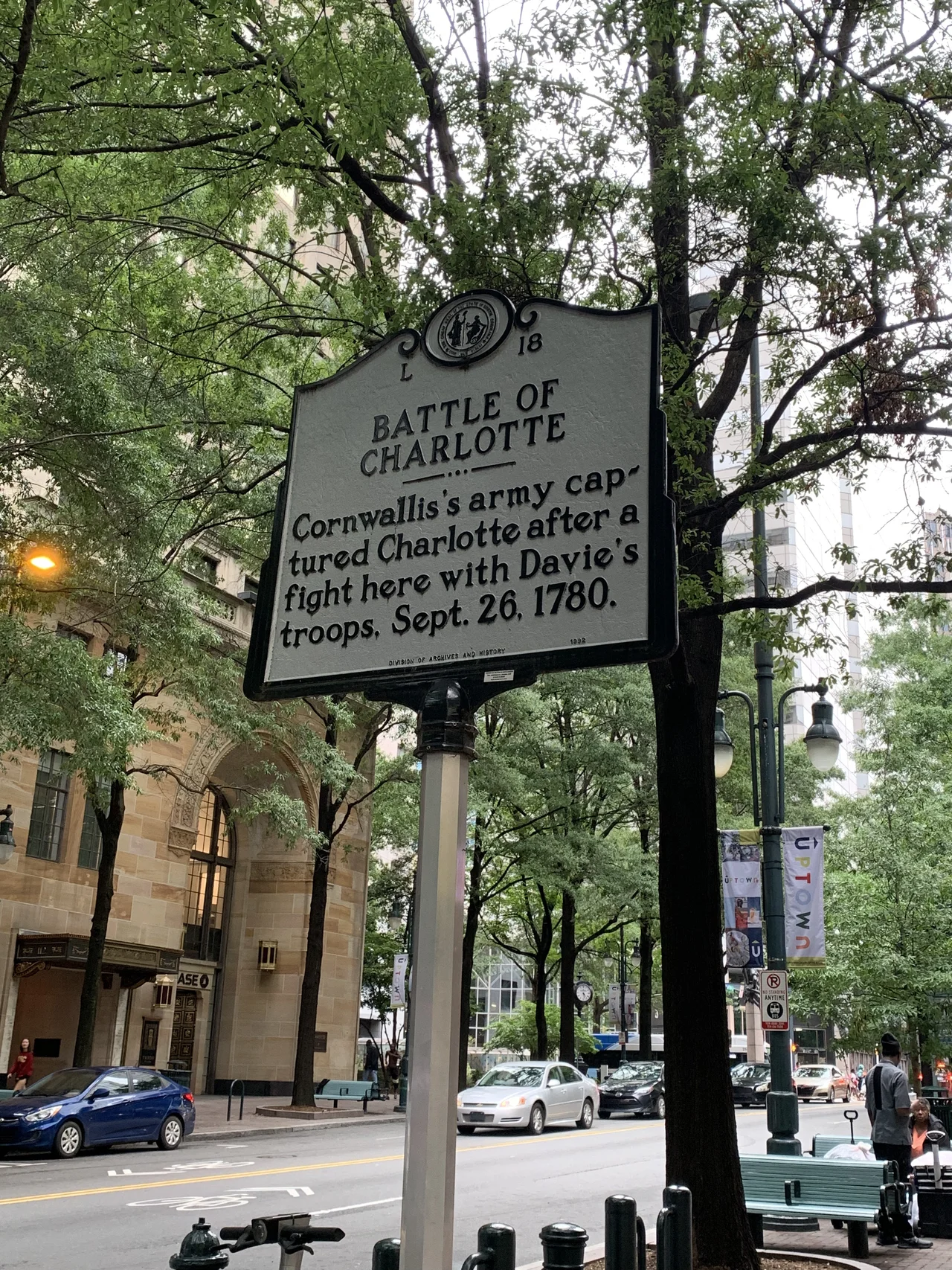

Battle of Charlotte
Cornwallis did not expect to be shot at in Charlotte. He had just routed the Continental Army at Camden a month earlier; he had Charleston, he had most of South Carolina, and he was moving north through the Carolina backcountry toward Continental remnants in North Carolina with the confidence of a man whose maps were finally working. Then his cavalry trotted into the small crossroads at Trade and Tryon Streets on September 26, 1780, and ran straight into a low stone wall, three rows of militia, and a Patriot ambush organized by a 24-year-old colonel named William Richardson Davie. The skirmish that followed lasted only minutes. Its consequences lasted years.
A Town Built on a Crossroads
Charlotte in 1780 was small enough to draw on a napkin. Two roads met at the town center, and the Mecklenburg County Court House dominated the intersection. The southern side of the courthouse was lined with pillars connected by a stone wall about three and a half feet high - low enough to vault, tall enough to crouch behind. The wall enclosed the local market, where farmers sold produce and gossip. Davie saw a market wall and read it as a defensive position. He stationed militia behind it, posted cavalry on the east and west sides of the courthouse, and hid twenty men behind a house on the southern road, where the British would come from. The Patriots had no intention of stopping Cornwallis's army. They wanted to bloody his nose.
George Hanger's Bad Afternoon
George Hanger - later the 4th Baron Coleraine, then an aggressive young cavalry officer in Tarleton's British Legion - led the advance into town. He moved fast, he moved boldly, and he moved without his infantry. When the twenty men behind the southern house opened fire, Hanger kept his cavalry charging until heavy fire from the militia behind the stone wall caught him. He was wounded. His men hesitated. Cornwallis, hearing the firing, rode forward and shouted at the Legion to charge again: "Legion, remember you have everything to lose, but nothing to gain." Hanger, when the dust settled, called the encounter "a trifling insignificant skirmish." The casualty estimates depend on whose history you read, but no version of the count is small enough to make his dismissal convincing.
The Hornet's Nest
Davie's small force withdrew north toward Salisbury, but Charlotte itself did not stop fighting. Patriot militia harassed the British presence so persistently after the battle that Cornwallis is said to have called the area "a hornet's nest of rebellion" - a phrase Charlotte adopted and has not let go of. The minor-league hockey team is the Charlotte Checkers. The earlier basketball team was the Hornets, then the Bobcats, then the Hornets again. The metaphor stuck because it was accurate. Cornwallis could occupy Charlotte; he could not pacify it. His communication lines were never secure. The countryside was, to use the military euphemism, "unfriendly."
What the Skirmish Set in Motion
Eleven days after Charlotte, on October 7, 1780, the British left flank under Major Patrick Ferguson was destroyed at the Battle of Kings Mountain - over-mountain men hunting Loyalists into a hilltop kill zone. The Carolina campaign that Cornwallis thought he was winning was actually unraveling. He withdrew from Charlotte to Winnsboro, South Carolina in November, and by the following autumn he was trapped at Yorktown. The skirmish at Trade and Tryon did not change the course of the Revolution by itself. It changed something subtler: it told Cornwallis that the country ahead was going to fight him for every mile. He had been right about Camden. He had been wrong about North Carolina.
The Site Today
Where Davie's militia crouched behind a stone market wall, the Bank of America Corporate Center now rises sixty stories above Trade and Tryon Streets. The intersection is still the geographic center of Charlotte, still the busiest crossroads in Mecklenburg County, still the place tourists ask directions from. There is no courthouse, no stone wall, and no obvious sign of a battle - just office workers crossing in the crosswalks and light rail trains hissing past. But the city named itself for a queen, kept the British king's mother-in-law's name even after independence, and adopted as its mascot the buzz of insects defending a colony. Charlotte does layered identity well.
From the Air
The battle site is at Trade and Tryon Streets in Uptown Charlotte, 35.2269°N, 80.8433°W - the foot of the Bank of America Corporate Center. From the air it is the geographic dead center of Uptown, where the city's tallest cluster of buildings rises. Nearest airport is Charlotte/Douglas International (KCLT) about 5 nautical miles west. Best viewing altitude 3,000-6,000 feet; on a clear day the Uptown towers are visible from 30 miles. Concord-Padgett Regional (KJQF) lies about 12 nautical miles northeast.
Nearby Stories
- Battle of Colson's Mill 12 km away
- Kings Mountain Mine 13 km away
- Thyatira Presbyterian Church, Cemetery, and Manse 16 km away
- Andrew Jackson State Park 19 km away
- Charleston Naval Hospital Historic District 22 km away
- Hickory Motor Speedway 22 km away
- North Carolina Aviation Museum 29 km away
- Battle of Fishdam Ford 47 km away