
Battle of Corrichie
He got up late on the morning of the battle. John Knox thought this detail mattered enough to record it: that George Gordon, 4th Earl of Huntly, chief of Clan Gordon, did not rise early on 28 October 1562. Outside, somewhere on the slopes of the Hill of Fare in Aberdeenshire, two thousand men under James Stewart, Earl of Moray, were closing on his encampment. He had seven hundred. Within hours he would be a captive, mounted on a horse for the ride to Aberdeen, and then — suddenly, soundlessly, before they could leave the battlefield — he would be dead.
Why Mary Came North
Mary Stuart was nineteen and just home from France, where she had been queen consort, and where Scotland had become a place she barely remembered. The Gordons of Huntly were the most powerful Catholic dynasty in the north, and Huntly considered the earldoms of Moray and Mar his rightful inheritance. The new Earl of Moray was Mary's half-brother — Protestant, ambitious, the kind of man who would not let Huntly forget who held real power now. The flashpoint was a young Gordon named John, Huntly's son, who had wounded a man called James Ogilvie in Edinburgh and refused to be locked up in Stirling Castle as the Queen demanded. Mary travelled north in August 1562 to settle the matter herself. She came within four miles of Huntly Castle and turned back rather than enter it. The English diplomat Thomas Randolph went in instead, and reported that the house was 'fayer, beste furnishede of anye howse that I have seen in thys countrie.' The Countess of Huntly tried diplomacy. The Earl tried evasion. By 17 October, he was a declared rebel.
Marsh and Pike
Huntly marched towards Aberdeen with seven hundred men and, according to Randolph, intentions to seize the Queen. Moray, with two thousand, encircled him on 28 October. The Gordons camped on a small hill where cavalry could not reach them, but the Queen's arquebusiers drove them down into marshy ground at the foot of the Hill of Fare — a place George Buchanan later described as 'surrounded by marshes, fortified by nature,' which suddenly became a trap. At first the Queen's vanguard lost its nerve. Many of them were friends or kin of the Gordons; some pinned heather on their bonnets — a Highland sign of allegiance — and threw away their spears. Moray forced them back into the fight. His second line, led by John Wishart of Pitarrow, the Master of Lindsay, and the Tutor of Pitcur, held firm with extended pikes. The Gordons charged with swords, expecting a rout, and found themselves unable to close the distance. The battle, Randolph wrote, ended 'incontinent' — straight away. About 120 Gordons died. About 100 were captured.
A Soundless Death
Huntly himself was taken alive. Men lifted him onto a horse to ride him to Aberdeen as the Queen's prisoner. He was a heavy man, by all accounts, and the day had been long. Before they could leave the battlefield, he died — apparently of a stroke, what the sixteenth century called apoplexy, with no warning and no sound. His body was preserved and sent to Edinburgh for trial, a strange Scottish ritual in which the dead were arraigned alongside the living. Three days after the battle, his eldest son Sir John Gordon — the young man whose case had started all of this — was executed in Aberdeen. A younger son, Adam Gordon of Auchindoun, was spared. Huntly's cousin John Gordon, 11th Earl of Sutherland, fled to Louvain in Flanders. At the Parliament of Scotland on 28 May 1563, with Mary herself in attendance, Huntly, Sutherland, and as John Knox carefully noted, eleven other Earls and Barons of the name Gordon were forfeited.
The Queen's Chair and the Heather
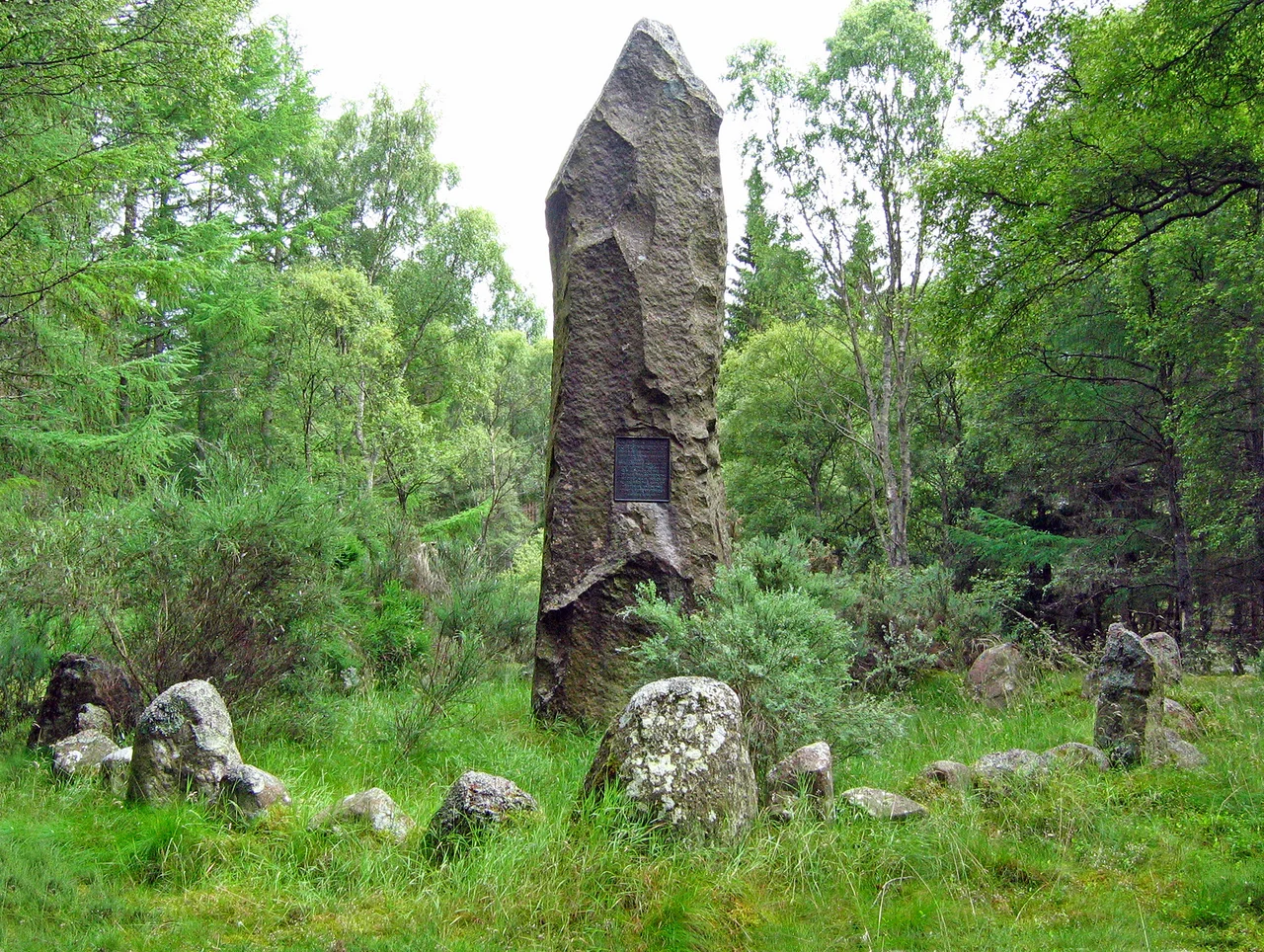
Local tradition long held that Mary, Queen of Scots watched the battle from a granite outcrop above the field, ever since called the Queen's Chair. Historians doubt it. By all reliable accounts, she was in Aberdeen when Corrichie was fought. But the chair is real, and people still walk to it. The monument by Corrichie Burn — a small stone marker between the Black Moss and the Red Moss — names this as the place where the Gordons' Catholic north was broken. In 1565 Mary restored the forfeited Gordons; the family would rise and fall and rise again across the religious wars of the next century. The marsh at the foot of the Hill of Fare is quiet now, sometimes purple with heather, and gives no sign that anything once ended here.
From the Air
Corrichie battlefield lies at approximately 57.102°N, 2.444°W, on the south-east slopes of the Hill of Fare in Aberdeenshire, about 12 nautical miles west of Aberdeen. Recommended viewing altitude is 3,000–5,000 feet AGL. The Hill of Fare is a distinctive heather-covered moor; the battlefield itself is a shallow marshy basin on its southern side, between Black Moss and Red Moss. EGPD (Aberdeen International) lies east; the Cairngorms rise to the west. Clear viewing requires a settled day — autumn often brings the same heavy cloud the Gordons would have known.
Nearby Stories
- Battle of Inverurie (1308) 3.9 km away
- Tomnaverie Stone Circle 9 km away
- Montrose Air Station Museum 12 km away
- Restenneth Priory 14 km away
- Auchindoun Castle 21 km away
- German submarine U-58 (1938) 104 km away
- Longstone Lighthouse 126 km away
- Farne Islands 158 km away