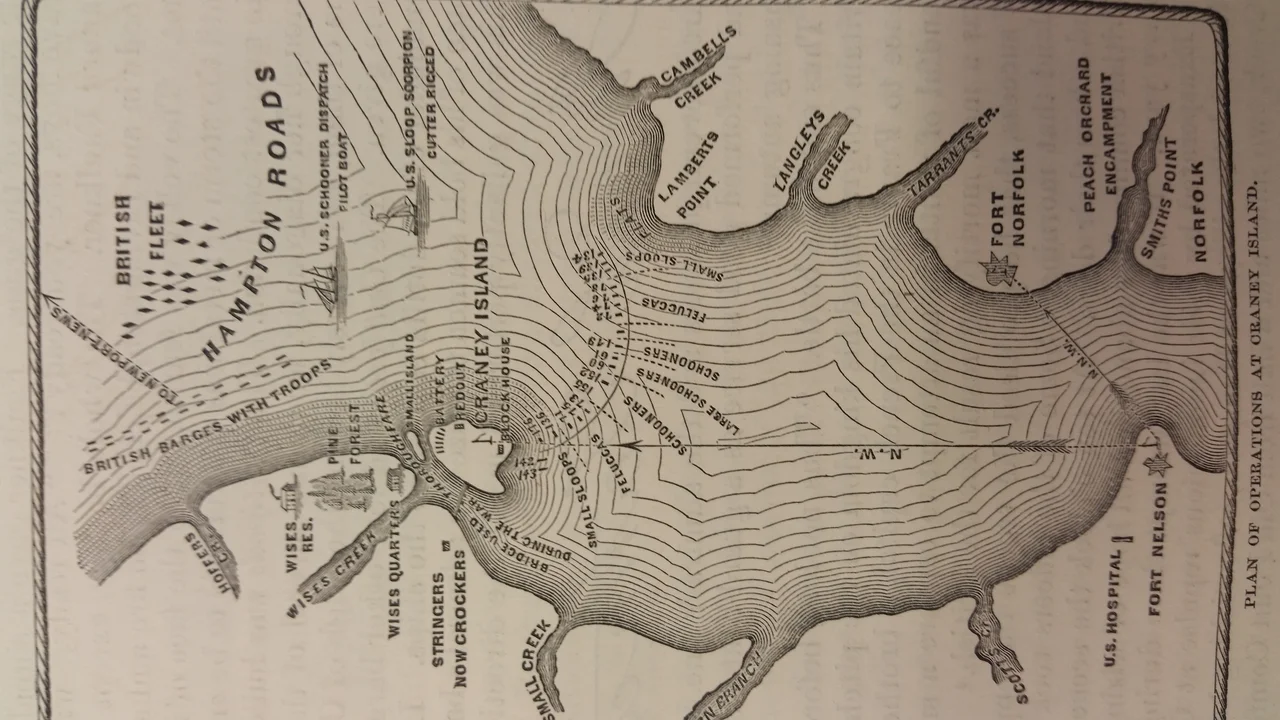

Battle of Craney Island
The British commander was the illegitimate son of King George III, and on the morning of June 22, 1813, Sir John Hanchett led a 24-oar barge called the Centipede toward a low spit of marsh and sand at the mouth of the Elizabeth River. Behind him came fifteen more barges and an escort fleet. The British had spent weeks blockading Chesapeake Bay, and now they wanted the prize: the Gosport Navy Yard at Portsmouth and the frigate USS Constellation penned inside it. Standing between them and that prize were 596 Americans dug in on Craney Island, a place most maps barely bothered to name, and a captain of light artillery named Arthur Emmerson who had told his gunners to hold their fire.
The Trap
Admiral Sir George Cockburn had been making the Chesapeake miserable for American shipping since the spring. With Admiral Sir John Borlase Warren, he planned to walk straight into Norfolk and Portsmouth, the twin commercial hubs at the mouth of the Elizabeth River, take the navy yard, and burn the Constellation at her moorings. Brigadier General Robert B. Taylor of the Virginia Militia had other plans. He stretched a chain barrier across the Elizabeth between Fort Norfolk and Fort Nelson. He pulled the Constellation's crew off the ship and put them on the island that controlled the river's mouth. Then he built breastworks on Craney Island and packed it with cannon. The British arrived expecting amateurs. They found a fortress.
Hold Your Fire
Seven hundred Royal Marines and soldiers of the 102nd Regiment came ashore at Hoffler's Creek on the mainland, planning to wade across the Thoroughfare channel and storm the island from behind. The water was deeper than they thought and the American fire was hotter. They fell back. Then came the barges. The Centipede led a wave of boats packed with sailors and soldiers of the Independent Companies of Foreigners, a unit of former French prisoners-of-war serving the Crown. Captain Emmerson watched them row in. He waited. He waited again. When the barges were point-blank, his gunners opened fire. The Centipede splintered. Hanchett went down with a wound that would kill him. Other barges shattered. The survivors retreated to their ships, and the captured Centipede became an American trophy. Not a single defender died.
What Followed
Norfolk was saved. The Gosport yard kept its frigate. But the war was not gentle in its aftermath. Two days later, British forces crossed Hampton Roads and attacked Hampton, Virginia, where the Independent Foreigners, enraged by stories that Americans had massacred their stranded comrades at Craney Island, broke discipline and tore through the town. A British officer wrote in his diary of "every horror perpetrated with impunity - rape, murder, pillage - and not a single man was punished." The Americans denied the massacre; twenty-two of the Foreigners were brought home as prisoners, which suggested the truth was somewhere uglier than either side wanted to admit. Wars rarely end where their battles do.
The Larger Lesson
Craney Island held. The British, denied Norfolk, sailed north up the Chesapeake the next summer. With no fort guarding the bay's mouth, they had a clear road to Washington, which they burned in August 1814. The lesson was not lost on Congress. Construction on Fort Monroe began in 1819 at Old Point Comfort, the southern jaw of the bay, expressly to make sure no enemy fleet ever again sailed unopposed into the Chesapeake. In that sense, the modest victory at Craney Island wrote its real legacy in stone a decade later, in the largest fort America would ever build.
What Remains
Today there is no island anymore, not really. Decades of dredge spoil from Norfolk's harbor have welded Craney Island onto the mainland as an industrial peninsula north of Portsmouth. The marshes where the militia held the line are mostly fill. But Virginia Historical Marker K-258 stands at the entrance to Hoffler Creek Wildlife Preserve, naming the battle and the place where the British landing party first came ashore. Three active battalions of the U.S. Army's 4th Infantry Regiment still carry the campaign credit for Craney Island in their lineage. The frigate Constellation, the prize the British never got, survived to fight pirates, suppress the slave trade off Africa, and eventually become a museum ship in Baltimore harbor.
From the Air
Battle of Craney Island site at 36.95°N, 76.35°W, north of Portsmouth at the mouth of the Elizabeth River. The original marshy island is now part of the Craney Island Dredged Material Management Area, a large rectangular peninsula visible just east of the I-664 Monitor-Merrimac Memorial Bridge-Tunnel. Best viewed from 2,000-3,000 ft AGL. Nearby airports: KNGU (Norfolk Naval Station, 4 nm E), KORF (Norfolk International, 8 nm E), KPHF (Newport News/Williamsburg, 9 nm N), KLFI (Langley AFB, 9 nm NE). Heavy port and military traffic; coordinate with Norfolk approach.
Nearby Stories
- Battle of Gloucester Point (1861) 3 km away
- Coast Guard Station Cobb Island 3 km away
- Flowerdew Hundred Plantation 11 km away
- Great Dismal Swamp 11 km away
- Cape Charles Lighthouse 14 km away
- False Cape State Park 17 km away
- Cactus Hill 29 km away
- Chowan University 35 km away