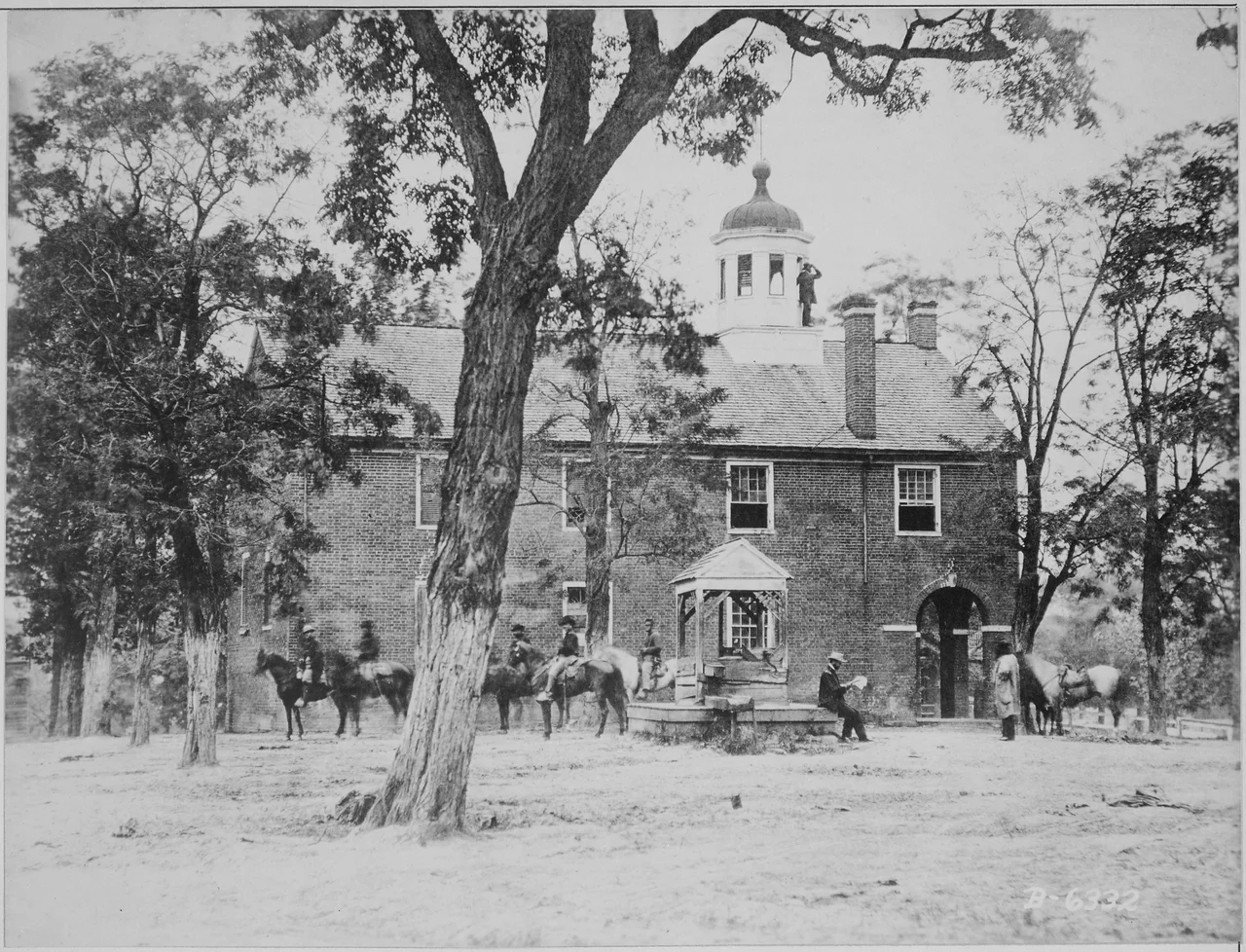

Battle of Fairfax Court House (1861)
It was after three in the morning and the night was so dark that Captain John Quincy Marr lost sight of his own company. The Confederate cavalry pickets had just come tearing into Fairfax Court House, shouting that Union horsemen were on the road. Marr, commanding the small Warrenton Rifles infantry company in the town, ran out into the clover field beyond the courthouse to look for a better defensive position. A few minutes later somebody fired a shot. Marr fell in the dense grass and no one saw him go down. By the time his men realized he was missing it was too late to look. He had become the first Confederate soldier killed in action in the American Civil War. The date was June 1, 1861. The Battle of Bull Run was still six weeks away. The war's name for itself was not yet decided.
A Vague Order
The day before the action, Brigadier General David Hunter at Union headquarters in Washington gave verbal orders to Lieutenant Charles Henry Tompkins of the 2nd U.S. Cavalry Regiment to gather information about Confederate strength south of the Potomac. Hunter's instructions about Fairfax Court House itself were vague but seemed to encourage a probe into the town. Fairfax was the county seat of Fairfax County and had about three hundred inhabitants. Three Confederate units occupied the village: about sixty cavalrymen of the Prince William troop, another sixty of the Rappahannock troop, and roughly ninety infantry of the Warrenton Rifles under Captain John Q. Marr. The overall area command belonged to Lieutenant Colonel Richard S. Ewell, who had resigned a U.S. Army captaincy only weeks before. Ewell was at Fairfax Station, two miles south of the village, when Tompkins came in. He had to ride hard through the dark to reach the fight.
Three Charges Through the Town
Tompkins's cavalry hit the Falls Church Road into Fairfax around three a.m. on June 1. Most of the Prince William troop scattered without much resistance, leaving four of their own to be captured in the street. Tompkins's horsemen rode west through the town, firing at random as they went. Somewhere in the confusion they wounded Ewell - the first Confederate field-grade officer wounded in the war. The Warrenton Rifles, leaderless because Marr had vanished into the field and both of his lieutenants were on leave, were still standing on their original ground when Ewell arrived. The men did not know him by sight. The former Virginia governor William Smith - a civilian in his sixties who happened to be in Fairfax that night - vouched for Ewell, who took command and positioned the rifles at the edge of the clover field between the courthouse hotel and the Episcopal Church. When Tompkins's cavalry came back through town a few minutes later, the rifles fired one volley that turned them around.
Civilians at the Fence
Ewell then went to find a courier to send for reinforcements. William Smith, ex-governor and now self-appointed tactical commander, moved the Warrenton company about 100 yards to a more defensible position behind a line of rail fences closer to the turnpike. Civilians from the houses along the road - men sheltering inside but armed - joined in, firing from windows and doorways at the Federal cavalry. This may explain why Tompkins later claimed in his report to have faced 1,500 men. Tompkins's troopers tried twice more to ride back through town. Both times the Warrenton Rifles and the armed civilians stopped them with rifle fire. After the third failed attempt, the Federal column broke off the engagement, rode north out of town through fields toward Flint Hill - in present-day Oakton - and returned to Camp Union near the Potomac by a longer route. The Confederate cavalry that had scattered in panic at the start were already trying to slip back into formation.
What Followed
When the Confederates finally searched the clover field after dawn, they found Marr lying dead. He had been shot through the chest by a ball that nobody could be sure had been aimed at him. He was thirty-five years old, a Virginia Military Institute graduate, and the first of more than 750,000 Americans who would die in the four years to come. A monument to him was erected at the Fairfax courthouse on June 1, 1904, exactly forty-three years after his death, and still stands. The Union force had lost one killed - Private Saintclair - and four wounded including Tompkins himself. Nine cavalry horses had been killed and four wounded. Tompkins was praised for gallantry, criticized for exceeding his orders, and criticized again for talking to newspapers before he filed an official report. In 1893, thirty-two years after the fact, he became the first Union army officer to receive the Medal of Honor for a Civil War action. The intelligence Hunter had wanted was never gathered. Tompkins's wildly inflated report of Confederate strength helped slow the Union advance on Manassas. Six weeks later that delay would matter. The Confederates spent the time building up at Manassas Junction. On July 21 the larger war began in earnest at the First Battle of Bull Run, eighteen miles to the west. The skirmish at Fairfax Court House never became famous. Historian Charles Poland called it not the first land battle of the war but the first of thousands like it - a small action that foreshadowed all the small actions to come.
From the Air
The old Fairfax Court House sits at roughly 38.85 degrees N, 77.31 degrees W, at the heart of present-day Fairfax City, Virginia, near the intersection of Routes 123 and 236. The courthouse and the Marr monument still stand on the original ground. From 3,000 to 4,500 feet AGL the historic core of Fairfax, the rolling country toward Manassas to the west, and the suburban grid spreading east toward Washington are clearly visible. Nearby airports include Manassas Regional (KHEF) 10 miles west and Washington Dulles (KIAD) 18 miles northwest. The whole area lies inside Class B airspace - coordinate with Potomac TRACON.
Nearby Stories
- Crownsville Hospital Center 3.5 km away
- Battle of Thoroughfare Gap 7.4 km away
- Battle of Unison 8.6 km away
- Mallows Bay-Potomac River National Marine Sanctuary 9.1 km away
- Murders of Katherine and Sheila Lyon 9.9 km away
- Germanna 15 km away
- Capital Gazette Shooting 27 km away
- St. Mary's City, Maryland 39 km away