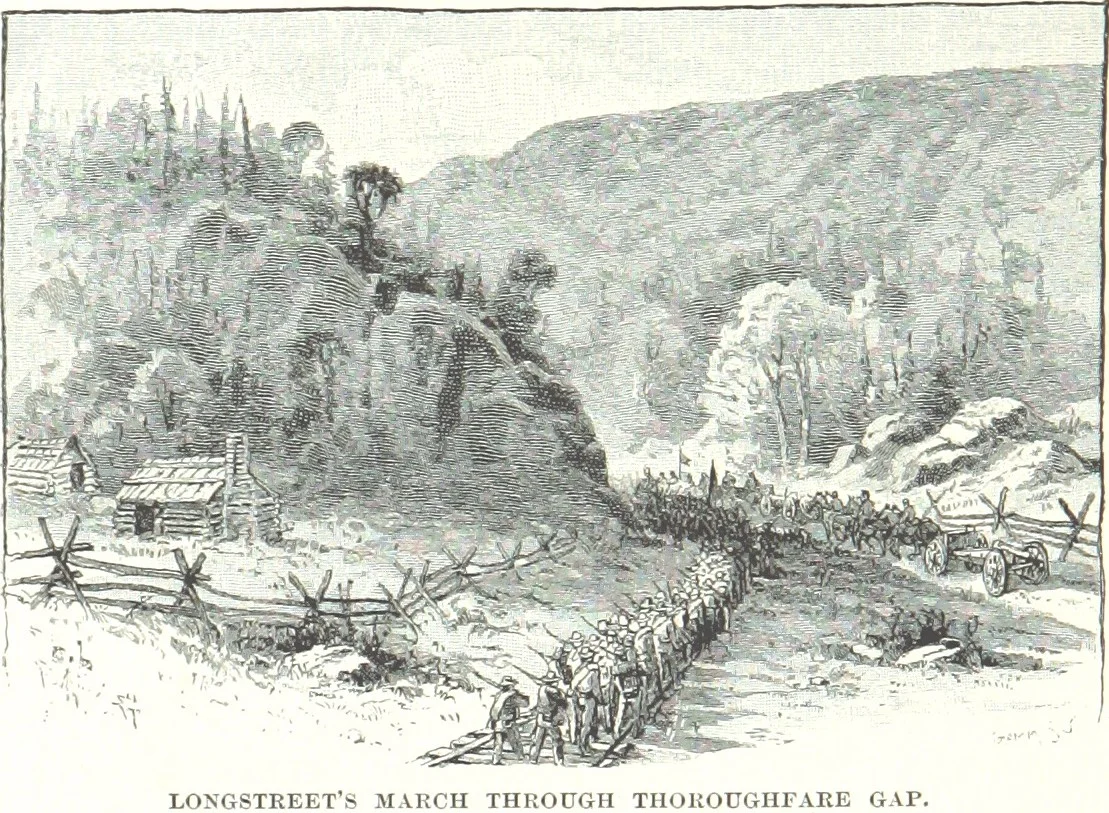

Battle of Thoroughfare Gap
Sometimes the smallest battles of the Civil War decided the largest. On August 28, 1862, fewer than 100 men became casualties at the Battle of Thoroughfare Gap, a narrow notch in the Bull Run Mountains about 35 miles west of Washington. What happened there decided the Second Battle of Bull Run the next day, and what happened at Second Bull Run helped open the road for Lee's first invasion of the North. Brigadier General James Ricketts of the Union army made a defensive choice at the Gap that should have been made by his cavalry instead. The mistake cost the Union almost everything that month.
Why the Gap Mattered
Thoroughfare Gap is a narrow defile through the Bull Run Mountains, the easternmost ridge of the Blue Ridge foothills west of Manassas. Two days earlier, on August 26, Stonewall Jackson had marched his half of Lee's army through the Gap and swept down on the massive Union supply depot at Manassas Junction, destroying everything his men could not carry. Union General John Pope, commanding the Army of Virginia, swung his troops around to deal with Jackson. James Longstreet's wing of Lee's army - the rest of the Confederate force - was marching to join Jackson via the same route. If Longstreet could reach Jackson, Lee would have his whole army back together for the coming battle. If Longstreet could be stopped at Thoroughfare Gap, Pope might be able to destroy Jackson alone before Longstreet arrived. The geography turned the narrow notch into the most strategically important square mile in Virginia that week.
Wyndham at the Gap
Union Major General Irvin McDowell understood the situation. He sent James Ricketts's infantry brigade and the 1st New Jersey Cavalry under Sir Percy Wyndham toward the Gap to block Longstreet's approach. Wyndham, a British soldier who had served in the Crimean War before crossing the Atlantic, took his cavalry forward to the Gap itself. Ricketts stopped six miles east at Gainesville, where he watched the railroad. By the morning of August 28, Wyndham's troopers were felling trees across the road in the Gap when Longstreet's vanguard arrived. Wyndham sent a courier back to Ricketts and fought as long as he could. By 2 p.m. Wyndham had been driven from the Gap, and Longstreet's lead division was through. Ricketts only reached Haymarket - still three miles east of the Gap - at the same hour. The Gap was already lost. The strong defensive ridges east of it might still have held Longstreet long enough for Pope to crush Jackson at Manassas.
Chapman's Mill and the Climbing Georgians
Longstreet's plan was to take the high ground on both sides of the Gap and then outflank the Union position on the eastern ridge. The 9th Georgia was sent to Chapman's Mill on the east side of the Gap - a five-and-a-half-story stone gristmill that had been operating since 1742 - to repulse a Federal attack by the 11th Pennsylvania, who had to remove the same trees Wyndham's men had felled that morning before they could even approach. Sharpshooters fired from the mill's upper windows. To the south of the Gap, the 2nd and 20th Georgia regiments raced up the steep western slopes against the 13th Massachusetts climbing the eastern side; the Georgians won the race and drove the Massachusetts men back down. Evander Law's brigade was sent over the ridge north of the Gap to flank the Union right. Three more Confederate brigades under Cadmus Wilcox were sent six miles further north through Hopewell Gap to come in behind Ricketts entirely. Faced with that, Ricketts withdrew to Gainesville. He had probably saved his force, but he had given up the position.
Why the Battle Was Small but Decisive
Total casualties came to about 100 men - tiny by Civil War standards. But the strategic consequences were enormous. With Longstreet through the Gap, the two wings of Lee's army reunited at Manassas late on August 28 and through the morning of August 29. Pope had spent the entire day of August 29 attacking Jackson's wing alone, expecting that Longstreet was still being held at Thoroughfare Gap. By the time Pope realized Longstreet's whole corps was on his left flank, it was too late. On the afternoon of August 30, Longstreet launched what may have been the largest single mass assault of the war - 25,000 men in five lines crashing into Pope's exposed left flank. The Union army broke and fled toward Washington. The Confederate path was open to invade Maryland, which Lee did on September 4. The Battle of Antietam followed on September 17. All of it traced back to Ricketts's choice on August 27 to put his cavalry at the Gap and his infantry six miles away.
What Remains in the Gap
Chapman's Mill still stands, partially. Built in 1742, the five-and-a-half-story stone gristmill operated continuously until a fire in 1998 left it a roofless shell. Restoration efforts have stabilized the walls. The mill is the visual anchor of the preserved Thoroughfare Gap Battlefield, listed on the National Register of Historic Places in 1972. The American Battlefield Trust and its partners have acquired 109 acres of the battlefield. A walking trail runs from the mill into the Gap, with interpretive markers along Virginia Route 55 just south. From the air the Gap reads as a narrow notch in the Bull Run Mountains, with Interstate 66 now running through the same gap the Georgians fought to control. The town of Haymarket sits a few miles east. The Manassas battlefield lies about ten miles east-southeast. The five-and-a-half-story stone walls of Chapman's Mill catch the sun on a clear morning, the only structure in the Gap older than the battle.
From the Air
The Battle of Thoroughfare Gap battlefield sits at 38.824 N, 77.715 W, at the notch in the Bull Run Mountains where Interstate 66 now passes between Haymarket and Marshall, Virginia. Recommended viewing altitude is 2,500 to 4,000 feet AGL for the best look at the narrow gap, the five-and-a-half-story Chapman's Mill ruins, and the surrounding low ridges. The nearest airport is Warrenton-Fauquier (KHWY), about 8 nautical miles southwest. Manassas Regional (KHEF) lies 10 nm east-southeast. Interstate 66 runs through the Gap. The Manassas Battlefield is visible 10 nm to the east-southeast - the two sites should be visited together. Best light is mid-morning for the stone mill ruins. Watch for traffic on the busy I-66 corridor.
Nearby Stories
- Rapidan Camp 2 km away
- Mount Weather Emergency Operations Center 4.7 km away
- Mallows Bay-Potomac River National Marine Sanctuary 7 km away
- Battle of Fairfax Court House (1861) 9.9 km away
- A. P. Hill Boyhood Home 11 km away
- Luray Caverns: The Cave Where Rocks Make Music 13 km away
- Murders of Katherine and Sheila Lyon 25 km away
- Battle of the Trough 45 km away