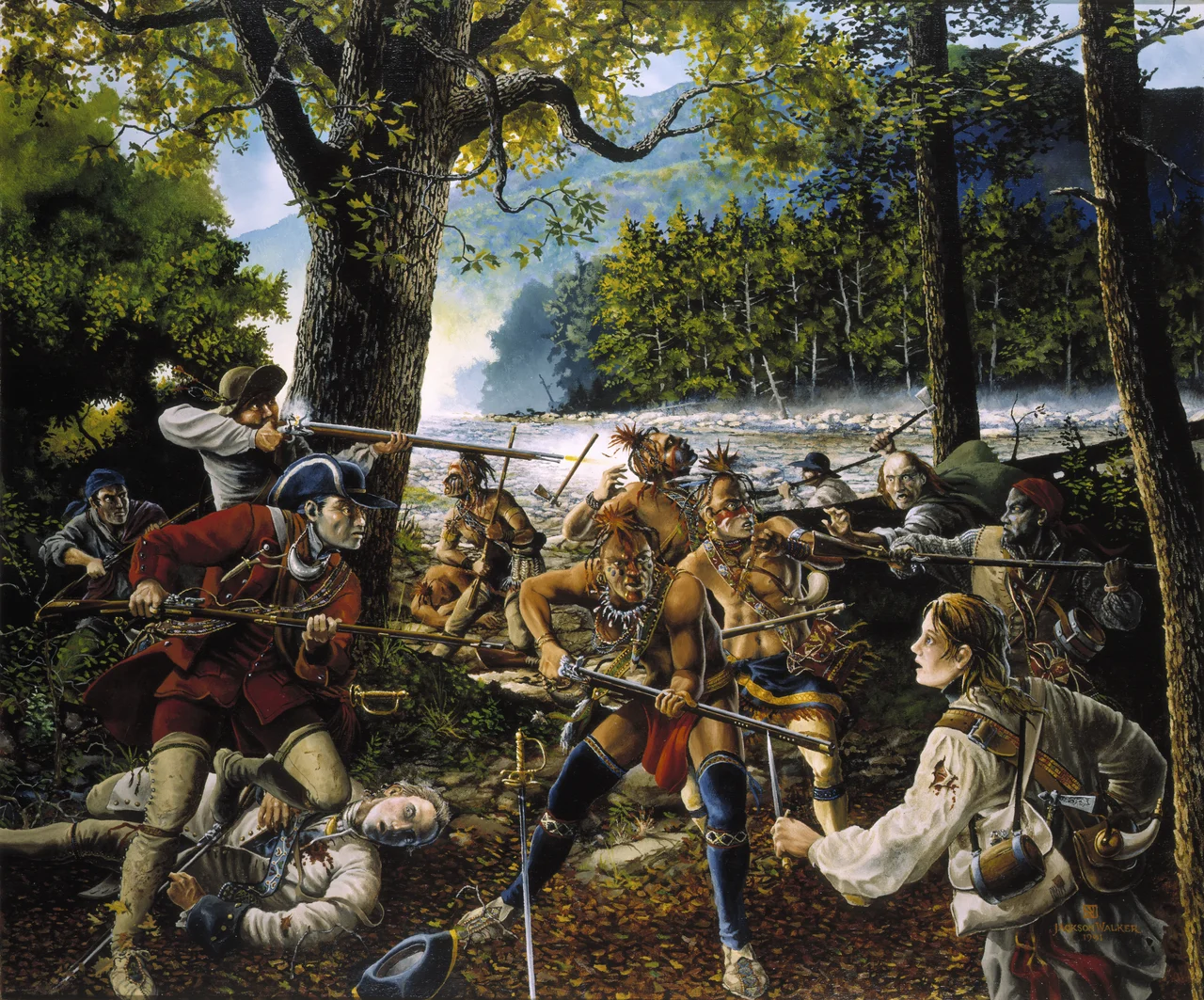

Battle of the Trough
In the spring of 1756, sixteen or eighteen well-armed men rode out of Fort Pleasant after two Indians they thought they were chasing. They never saw the trap. Sixty or seventy Lenape warriors under chief Killbuck had divided into small groups, made themselves visible in a tiny number, drawn the pursuit, and arranged to meet at a spring deep inside The Trough - the seven-mile gorge of the South Branch Potomac where steep walls and a flood-swollen river left no room to maneuver. By the time the white men realized what had happened, the Lenape were behind them, between them and their horses, and well above them on both sides.
Backdrop: After Braddock's Defeat
On July 9, 1755, the British General Edward Braddock had been killed at the Battle of the Monongahela when a small French and allied Native American force destroyed his army on the way to Fort Duquesne. With Braddock dead, the Allegheny frontier collapsed. Shawnee and Lenape war parties moved freely across the mountains. The settlers of the upper Potomac watershed were essentially undefended. In October 1755 two forts went up in the South Branch Valley. By January 1756 the 24-year-old Colonel George Washington, newly in command of the Virginia Regiment, ordered Captain Thomas Waggener up from Fort Cumberland to build two more forts above The Trough and to garrison detachments to protect the valley. Fort Pleasant, on the Van Meter property at present-day Old Fields, was the lower of the two.
The Bait
That spring, a small Lenape party - remnants of a force recently defeated near the head of the Cacapon - was moving through the upper South Branch when it encountered two settler women. Mrs. Brake was killed. Mrs. Neff was taken prisoner. The party encamped near Fort Pleasant. That night Mrs. Neff escaped and reached the fort. One account holds that the Lenape deliberately let her go, to draw the white men out. Whether by design or accident, the bait worked. The next morning a small Lenape group appeared in plain sight of Fort Pleasant, fired a few shots, and walked off down the valley. Sixteen to eighteen experienced fighters from Fort Pleasant and Buttermilk Fort (Waggener's upper fort five miles upstream) mounted up to pursue them. Scouts had reported no other tracks. There were tracks. They were arranged.
The Trap
The pursuers crossed the river above a spring where the trail usually stopped. They dismounted, divided into two parties for a pincer movement, and started up a small branch entering the Potomac below the spring. There were two ridges flanking the small valley. The white men chose the right-hand ridge as easier ground. Killbuck's warriors had already placed scouts. The moment the choice was made, part of the Lenape force slipped down the opposite ridge and got between the white party and their horses. Killbuck's main body of 60 or 70 warriors closed from above. The pursuers, now pinned between a steep mountainside on the east and the flood-swollen South Branch on the west, found themselves outmaneuvered as much as outnumbered. The fight that followed was brief, furious, and one-sided. The Virginia force broke. Survivors had to fight rearward through the encircling warriors. Many were killed. Many were wounded. Those who escaped reached the river and swam, or scrambled along the bottom land of the gorge.
Memory, and the Long Reckoning
One account holds that British regulars under Captain Waggener were quartered at Fort Pleasant a mile and a half away and refused to come to the survivors' aid. After being called a coward, the story goes, Waggener had several of the survivors pursued and whipped. The truth of the charge is debated. What is not debated is that Killbuck's next major action - the Battle of Great Cacapon on April 18, 1756 - was another devastating ambush of Virginia forces. The Lenape were defending land they considered theirs against a relentless settler tide; the settlers were trying to survive on a frontier that they had crossed without authorization or treaty. Decades later, Felix Renick, who recorded a teenage participant's account, wrote that his earlier sympathies had shifted - he had come to fear that the white settlers had a great debt on this score that must at some time and in some fearful way be cancelled, unless we make them proper amends. The battle is now studied as a clear-eyed example of indigenous tactical sophistication against numerically and technologically advantaged settlers, in a war that the Lenape, Shawnee, and other nations would ultimately lose.
From the Air
Located near 39.22 degrees north, 78.86 degrees west, in The Trough gorge of the South Branch Potomac between Old Fields and the river's lower valley, in Hardy County, West Virginia. From 4,000 to 6,000 feet AGL The Trough reads clearly as a sharp slot through Branch Mountain, the river running in a single narrow channel between vertical rock walls. The same gorge is now traversed by the Potomac Eagle scenic railroad. Nearest airports include Hardy County (W22) at Moorefield and Grant County (W99) at Petersburg.
Nearby Stories
- Allegheny Mountains 4.8 km away
- Hardy County, West Virginia 5.9 km away
- Hoye-Crest 6.2 km away
- Willa Cather Birthplace 6.8 km away
- Belle Grove Plantation 8.2 km away
- Battle of Fort Necessity 32 km away
- United Airlines Flight 93 56 km away
- Camp David: Where Presidents Escape and History Gets Made 81 km away