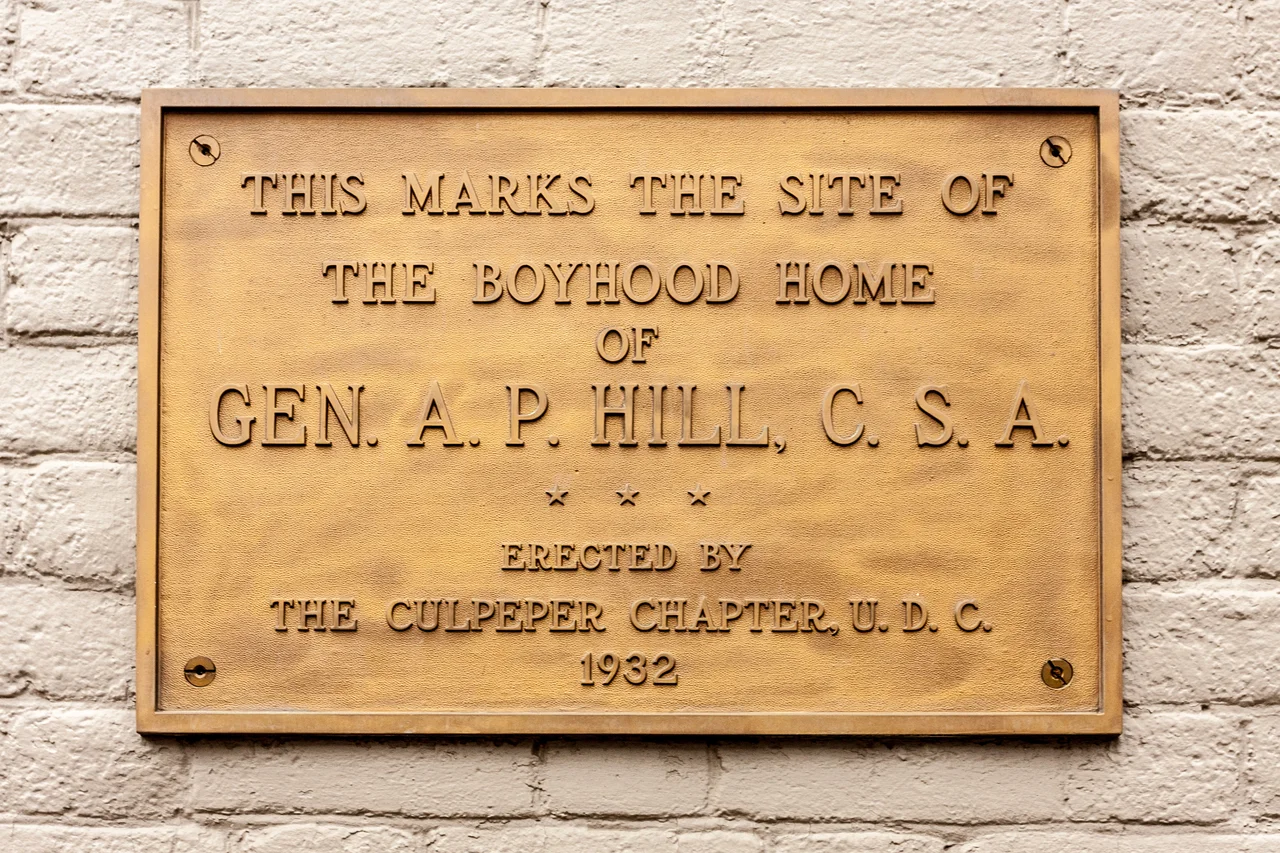

A. P. Hill Boyhood Home
The same brick walls in downtown Culpeper, Virginia, raised two American soldiers separated by sixty years and one civil war. The first was Edward Stevens, the Revolutionary War general who built the original portion of the house around 1820. The second was Ambrose Powell Hill, the Confederate lieutenant general known as A. P. Hill, who grew up there after his father bought the house in 1832 and ran a store from its ground floor. Hill went on to command the Third Corps of the Army of Northern Virginia. He was shot dead by a Union corporal at Petersburg on April 2, 1865 - one week before Lee surrendered at Appomattox.
The General Who Built It
Edward Stevens served as a brigadier general in the Continental Army during the American Revolution and was one of the senior Virginia militia commanders at the Battles of Camden and Guilford Courthouse. After the war he settled in Culpeper, the county seat of the Virginia Piedmont county where he had been born. Around 1820 he built the original section of the brick townhouse on Main Street - three stories, three bays deep, a working dwelling for a man who had risen through the war that made the country. He died in 1820. The house outlived him.
The Hill Family Years
In 1832, Thomas Hill of Culpeper bought the property and made it the home of his growing family. His son Ambrose Powell Hill was seven years old at the time. The Hills used the house as both residence and store - retail commerce on the ground floor, family quarters above. Young A. P. Hill grew up there before leaving for West Point, where he graduated in 1847 and served in the Mexican-American War and the Third Seminole War. The family expanded the house substantially just before the Civil War, around 1860 - adding bays to push the footprint to five-by-seven, transforming the modest townhouse into a substantial Tuscan villa style brick building. Two years later, in 1862, the Hill family sold the property. Hill himself was by then a major general in Confederate service.
Hill the General
A. P. Hill commanded what was known as the Light Division at the Seven Days, Second Manassas, and Antietam - where his last-minute arrival from Harpers Ferry helped save Lee's army from destruction in the war's bloodiest single day. He was promoted to lieutenant general and given command of the Third Corps of the Army of Northern Virginia after Stonewall Jackson's death in 1863. He fought at Gettysburg, the Wilderness, Spotsylvania, the North Anna, Cold Harbor, and the long siege of Petersburg. His health deteriorated during the siege. On the morning of April 2, 1865, as Union forces broke through the Petersburg defenses, Hill rode forward to rally his men and encountered two Union soldiers from the 138th Pennsylvania. They opened fire. He died instantly, struck in the chest. Lee, hearing the news, said He is at rest now, and we who are left are the ones to suffer. Seven days later Lee surrendered at Appomattox.
What the Building Holds
The Hill house still stands on North Main Street at the corner of West Davis Street in Culpeper's historic downtown. It is three stories, brick, in the Italianate or Tuscan villa style, with the five-by-seven proportions added before the Civil War. The shop space the Hill family ran on the ground floor has long since been adapted. The original 1820 portion - the building Edward Stevens raised - forms the rear of the present structure. The 1860 expansion forms the public facade. The building was listed on the National Register of Historic Places in 1973 and is a contributing property within the larger Culpeper Historic District. Culpeper itself sits at the foot of the Blue Ridge in Virginia's central Piedmont, on the rail line that connected Richmond to Washington during the war - a town fought over repeatedly between 1862 and 1864.
Where It Stands Now
From the air the A. P. Hill Boyhood Home sits in the dense brick grid of downtown Culpeper, two blocks west of the railroad tracks that still carry CSX freight through town. The building reads as one rectangular brick three-story unit among many along Main Street and Davis Street. Culpeper is small enough that the entire historic district fits in a single low-altitude photograph. The Blue Ridge rises about 15 miles to the west. The Rappahannock River winds about 8 miles to the east. Cedar Mountain Battlefield, where Jackson defeated Banks in August 1862, is just south of town. Brandy Station, the largest cavalry battle of the war, is just north. The Hill house was bought, expanded, fought past, and now stands as a private residence in the middle of a town that history rolled through more than once - including during the lieutenant generalcy of the man who grew up inside its walls.
From the Air
The A. P. Hill Boyhood Home sits at 38.4733 N, 77.9964 W in downtown Culpeper, Virginia, within the Culpeper Historic District. Recommended viewing altitude is 1,500 to 2,500 feet AGL for the best look at the brick townhouse and its position within the small historic downtown grid. The nearest airport is Culpeper Regional (KCJR), about 3 nm to the south. Madison County (W94) is about 12 nm west. The Blue Ridge rises about 15 nm to the west. Cedar Mountain Battlefield lies about 6 nm south; Brandy Station Battlefield about 6 nm north. CSX rail traffic uses the line through downtown. Best light is mid-morning, when the brick facade catches the sun cleanly.
Nearby Stories
- Battle of Aquia Creek 3.2 km away
- Warrenton Training Center 7.7 km away
- Lorton Reformatory 8.2 km away
- Battle of Rio Hill 9.2 km away
- Rapidan Camp 9.4 km away
- John Wilkes Booth 10 km away
- Bryce Resort 36 km away