
Battle of Rio Hill
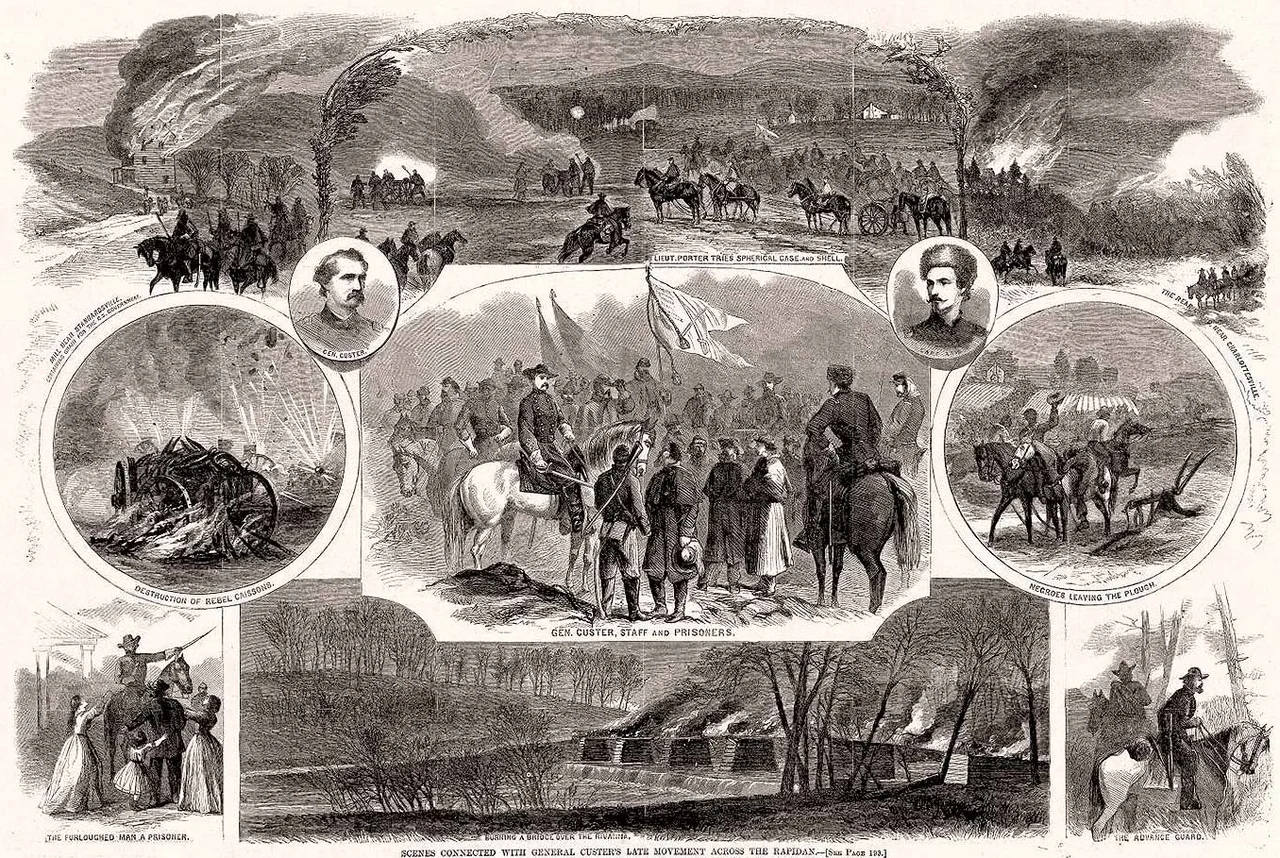
Confederate Captain Marcellus Moorman watched George Armstrong Custer's cavalry approach his camp on February 29, 1864, and made a desperate decision. His artillerymen had warning. They had time. They had not used it. With Union horsemen already in his camp, Moorman ordered his gunners to mount their battery horses, arm themselves with pistols and sticks they picked up from the ground, and pretend to be cavalry. The ruse worked. Custer's men, seeing what appeared to be substantial Confederate reinforcements, stalled. Then a caisson exploded. The Union troopers panicked, fired into each other in confusion, and broke for the bridge. The only significant Civil War engagement in Albemarle County was fought, more than anything else, with sticks.
Diversion for a Failed Raid
In late February 1864, Union commanders devised a multi-objective raid against Richmond. Brigadier General Judson Kilpatrick would lead the main effort - a failed raid that included the controversial Dahlgren Affair. The newly minted Brigadier General George Armstrong Custer, 24 years old, was given a diversionary mission. With about 1,500 cavalry from at least two Army of the Potomac divisions and a section of Parrott rifles, Custer was to advance through the Blue Ridge foothills toward Charlottesville and destroy the Virginia Central Railroad bridge over the Rivanna River - the supply line from the Shenandoah Valley to Lee's army. Custer left Mount Pony at 2:00 p.m. on February 28 and moved through Madison Court House, Stanardsville, and Earlysville. Along the way he was misinformed that Fitzhugh Lee's full cavalry division was waiting at Charlottesville. It was not.
Caught at the Winter Camp
The Confederate force in Custer's path was four batteries of J.E.B. Stuart's horse artillery battalion - 16 cannons and roughly 200 artillerymen, commanded by Captains Marcellus Moorman, Roger Preston Chew, James Breathed, and William McGregor. They were in winter quarters about four miles north of Charlottesville on Rio Hill, near the South Fork of the Rivanna. Moorman first learned of the approaching Federals at 12:30 p.m. on February 29. He sent pickets to guard the Rio Mills bridge over the Rivanna. The pickets found the bridge already in Union hands, and Moorman either did not believe their report or was slow to act. By 3:00 p.m., when Custer's main column reached the bridge and crossed, Moorman's batteries were still largely unprepared. Captain Joseph Ash with 60 men of the 5th U.S. Cavalry crossed downstream at Cook's Ford to attack from the east while Custer's main force pressed in from the north.
Artillerymen Pretending to be Cavalry
Moorman bought time the hard way. He ordered some guns to engage Custer's main column on Earlysville Road while others limbered up and withdrew. He deployed four cannons on a ridge south of the camp to fire into his own camp now overrun with Union troopers. A thin skirmish line, armed only with pistols, defended the guns. Then Moorman tried his most desperate move. He ordered his unmounted artillerymen to climb onto the battery's draft horses, split into two groups under Chew and Breathed, and parade around the battery position as if they were cavalry reinforcements. They carried pistols and sticks. The Union cavalry stopped. Just as Custer's main force came face to face with Ash's detachment riding in from the east, the two Union groups - confused, disoriented, with poor visibility through the smoke - opened fire on each other. A Confederate caisson left behind in the camp then exploded. Custer ordered a full withdrawal.
What Was Lost, What Was Built
The Union troopers burned the Rio Mills bridge behind them as they retreated to delay a pursuit that, given Moorman's actual numbers, would never have come. They also burned the namesake mill. The whole engagement, from crossing to bridge-burning, lasted barely an hour. Casualties were extraordinarily light. One Union trooper was slightly wounded; two Confederates were captured along with two horses. Both sides reported large quantities of looted or destroyed equipment - tents, harness, saddles, axle grease, curry-combs - but no significant human loss. Custer reported destroying three flour mills, capturing 50 prisoners and about 500 horses, and bringing away over 100 enslaved people who had escaped to the Union lines along the route. The Confederate camp was rebuilt within days. Custer and Sheridan would return to Charlottesville in March 1865 and occupy the town for four days, a month before Appomattox. In 1988 a shopping center was built directly on top of the Rio Hill battlefield. A 1989 Virginia state highway marker, and a display case erected by the Albemarle Charlottesville Historical Society, are now the only visible commemoration.
From the Air
Located at 38.09 degrees north, 78.47 degrees west, about four miles north of Charlottesville, Virginia, near the South Fork of the Rivanna River. From 3,000 to 5,000 feet AGL the area reads as suburban commercial development at the northern edge of Charlottesville. The Rivanna River and U.S. Route 29 are the most distinct features. Nearest airports include Charlottesville-Albemarle (KCHO) just north and Shenandoah Valley Regional (KSHD) west across the Blue Ridge.
Nearby Stories
- Augusta County Training School 10 km away
- A. P. Hill Boyhood Home 18 km away
- Reddish Knob 20 km away
- Amherst County, Virginia 21 km away
- Appalachian Trail 21 km away
- Fork Union Military Academy 28 km away
- Huguenot Memorial Chapel and Monument 39 km away