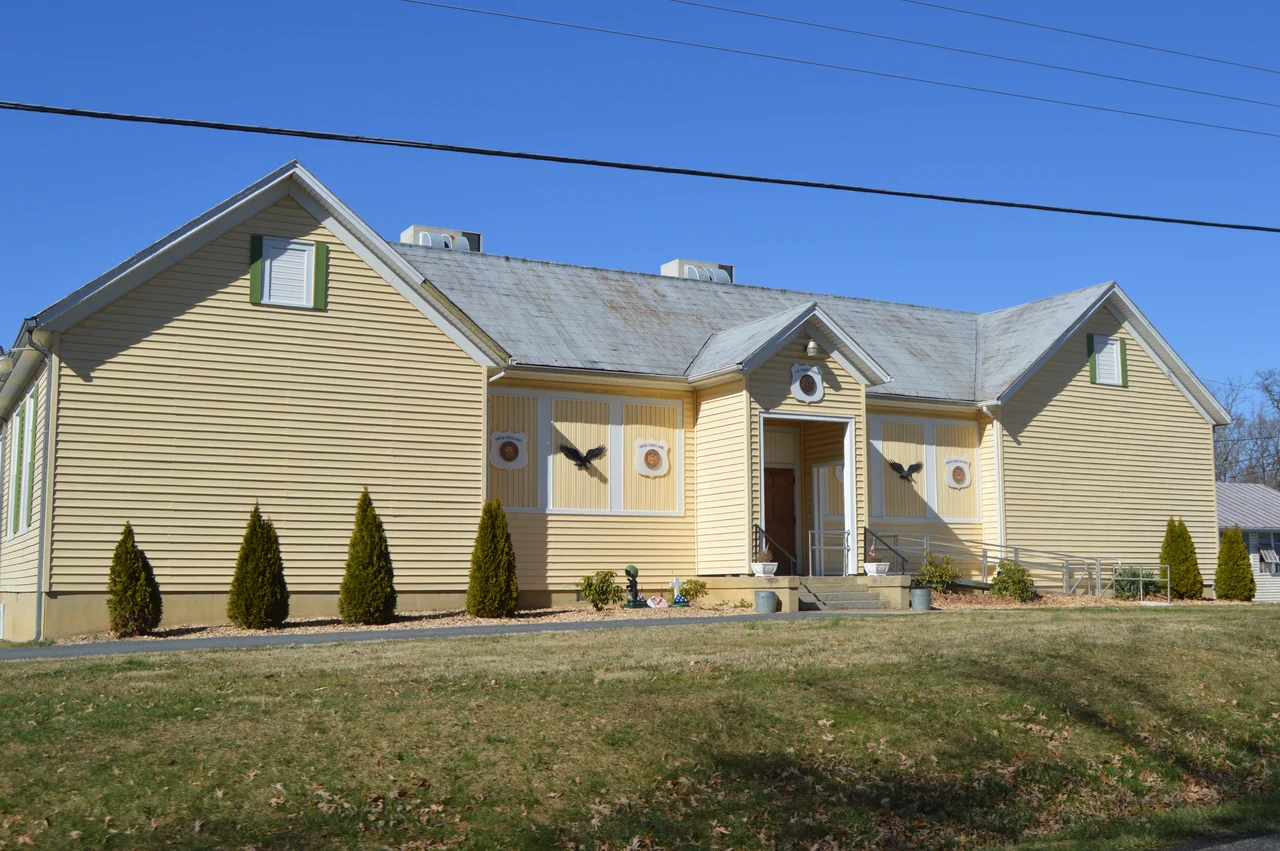

Augusta County Training School
In 1938, Augusta County, Virginia opened a one-story frame school building at Cedar Green and called it the Augusta County Training School. The name itself was a Jim Crow euphemism - across the segregated South, white school boards labeled new Black schools as "training schools," implying vocational instruction rather than full academic curricula. The Cedar Green Training School was, in fact, simply an elementary school. But it was a milestone of a kind: the first consolidated Black school in the county larger than two rooms. The Black children of Augusta County had previously been taught, when they were taught at all, in scattered one- and two-room schools spread across the rural landscape. Cedar Green gave them a building with a central auditorium, classroom wings, and a proper portico - architecture that announced their education mattered, even within a system designed to keep that education limited.
What "Training School" Meant
The phrase "training school," applied to Black schools across the segregated South in the 1920s and 1930s, was a piece of institutional language with a specific implication. White children attended high schools. Black children, according to the assumptions baked into the language, attended training schools - facilities focused on vocational and trade education rather than college preparation. The actual curriculum at most training schools was broader than the name suggested. Teachers covered reading, writing, mathematics, history, and the standard subjects. But the resources were always smaller. Class sizes were larger. Textbooks were often hand-me-downs from the white schools. The buildings themselves were smaller, with fewer amenities. The Cedar Green building, modest as it was by white-school standards, was a substantial step up from what Black children in Augusta County had previously had access to.
The Architecture of a Modest Improvement
The Augusta County Training School is a one-story frame building with a central auditorium plan - the auditorium recessed in the middle, with projecting classroom wings on either side. The entrance has a projecting portico. The roof is steeply pitched in a vernacular Neo-Classical style - a stripped-down, locally adapted version of the Greek Revival idiom that had dominated American institutional architecture for over a century. The design was modest but dignified. The classroom wings provided proper separated learning spaces rather than the all-purpose single room that had characterized earlier Black schools in the county. The auditorium allowed for school-wide assemblies, plays, and community gatherings. The building was small by 1938 white-school standards. By the standards of what had been available before, it was significant.
From Training School to Elementary
Over time, the building's official designation shifted from "Training School" to elementary school. The change reflected partly the gradual reduction of euphemism in school nomenclature, partly the reality that the building had always functioned as a regular elementary school. Black children in Augusta County continued to attend the Cedar Green building through the 1940s and 1950s. Brown v. Board of Education in 1954 ordered the desegregation of American public schools. Virginia responded with the Massive Resistance program, attempting to delay or prevent integration. Some Virginia school districts closed entirely rather than integrate. Augusta County's process was slower and more grudging than the Supreme Court had ordered, but the system eventually did integrate. The Cedar Green Training School ceased to function as a school. In 1966, the American Legion purchased the building and remodeled it for use as their lodge.
Why the Building Still Matters
The Augusta County Training School was added to the National Register of Historic Places in 1986 - listed not for architectural distinction (the building is plain) but for its significance in the history of African American education in rural Virginia. Most of the Black schools built across the segregated South in the 1920s and 1930s have been demolished or lost to neglect. The ones that survive document a chapter of American history that the segregated school system tried to keep small and invisible. The Cedar Green building stands now as a small Neo-Classical frame structure on a rural Virginia road. To passers-by who do not know its history, it looks like one of countless small rural buildings across the state. To those who do know its history, it represents the hard-won educational opportunities of a generation of Augusta County Black children, taught in a building that the system had been reluctant to build for them, and that they made the most of for nearly three decades.
From the Air
Located at 38.15 degrees north, 79.13 degrees west, at Cedar Green in Augusta County, Virginia, in the Shenandoah Valley. The school building is a small one-story structure - identifiable mainly by the location rather than the structure itself. Best viewed from VFR altitudes of 3,500 to 5,500 feet AGL where the rural Shenandoah Valley terrain spreads out below. The closest airports are Shenandoah Valley Regional (KSHD) about 7 nautical miles east at Weyers Cave and Eagles Nest Airport (W13) about 12 nautical miles southeast. The Blue Ridge Mountains rise to the east, the Alleghenies to the west. The area is within the U.S. National Radio Quiet Zone - check NOTAMs.
Nearby Stories
- Durbin and Greenbrier Valley Railroad 5.9 km away
- Murder of Hannah Graham 13 km away
- 2023 Virginia Cessna Citation Crash 16 km away
- Fort Dinwiddie 17 km away
- Jackson's Valley Campaign 19 km away
- Pendleton County, West Virginia 22 km away
- Albemarle Barracks 26 km away
- Alleghany County, Virginia 28 km away