.jpg)
Durbin and Greenbrier Valley Railroad
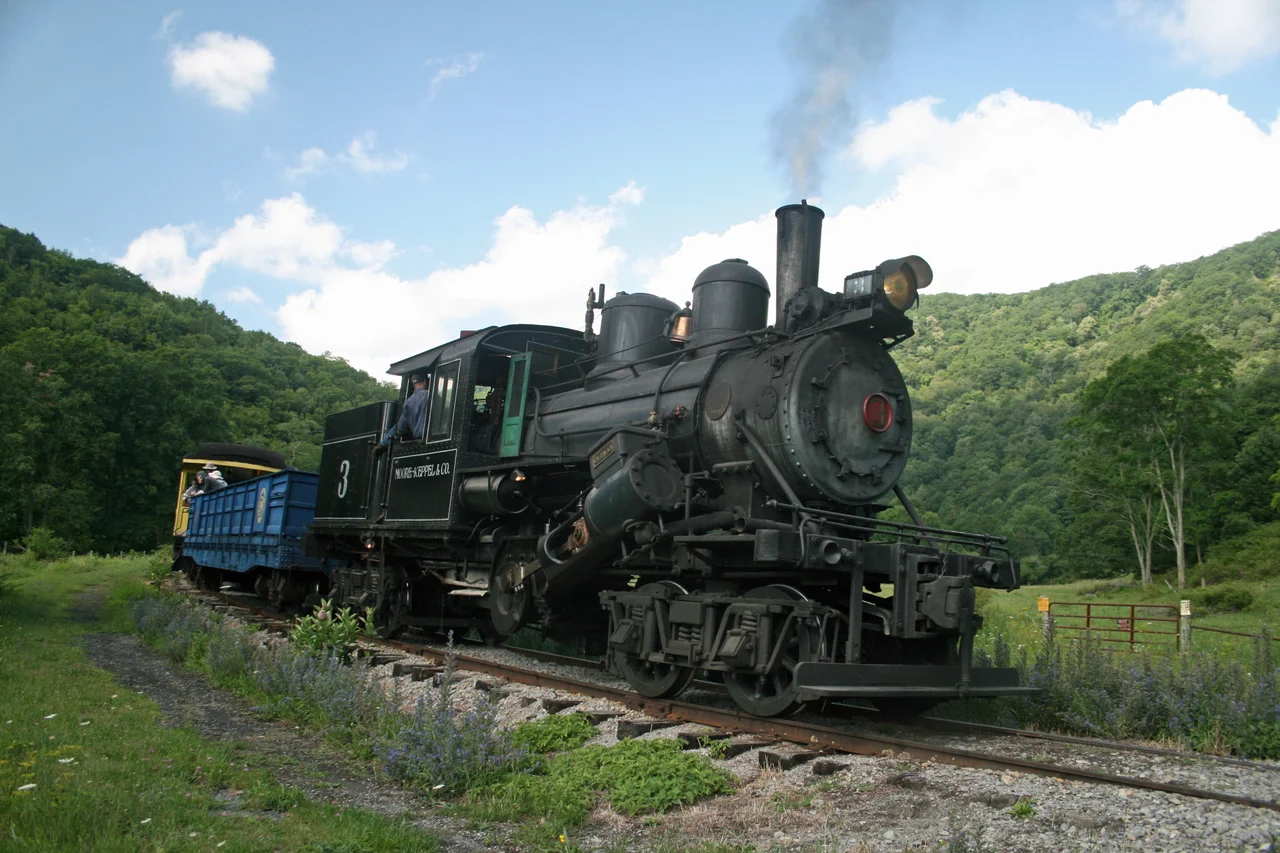
The locomotives that pull the Durbin and Greenbrier Valley Railroad's excursion trains are not ordinary steam engines. They are Shays, Climaxes, and Heislers - geared logging locomotives designed for steep grades and tight curves, the workhorses that once hauled timber down the West Virginia mountains when the great spruce forests were being cut. Most of those engines were scrapped after the lumber boom ended. A few survived in tourist operations. Today, on the same tracks the loggers laid, the Durbin and Greenbrier Valley Railroad runs five different excursion trains using preserved Shays, Heislers, and Climaxes - one of the largest concentrations of geared steam locomotives still operating in the world.
Tracks Built for Timber
The railroad operates two state-owned routes - the Durbin Railroad and the West Virginia Central Railroad - that were originally laid by the lumber companies that worked the central West Virginia high country in the late 19th and early 20th centuries. When the lumber operations wound down, the tracks remained. The West Virginia State Rail Authority eventually took ownership to preserve them as a tourist and freight resource. The DGVR was created to run trains on those rails. In 2015, the DGVR also took over operation of the historic Cass Scenic Railroad from the West Virginia Division of Natural Resources, which had been running it as part of the Cass Scenic Railroad State Park since 1963. The DGVR also runs the Shenandoah Valley Railroad over the line in Virginia.
Five Trains, Five Experiences
The DGVR operates five distinct excursion trains in West Virginia. The New Tygart Flyer runs out of Elkins, the largest town in the area, and uses diesel power for a mid-day mountain-valley sightseeing trip. The Durbin Rocket runs out of Durbin, the small town a few miles east, powered by a Climax or Heisler geared logging locomotive - the only Climax locomotive in regular tourist service anywhere in North America. The Cheat Mountain Salamander, named for the endemic species found nowhere else, runs out of Elkins on the West Virginia Central Railroad. The Mountain Explorer Dinner Train also leaves from Elkins, combining the ride with a meal served at the table. The Cass Scenic Railroad is the most famous of the five - five Shay locomotives, all preserved from the original West Virginia Pulp and Paper Company operation, climbing the mountain from Cass to Whittaker Station, Bald Knob, and on to Durbin, Spruce, and Walnes on special schedules.
The Geared Logging Locomotive
Shays, Heislers, and Climaxes are technically wonderful machines. Ordinary steam locomotives use direct rod drive from the pistons to the wheels, which limits them to grades of about three percent before the rod stresses become unmanageable. Logging railroads needed to climb mountains, often on grades of seven percent or steeper, with sharp curves and uneven track. The solution was to drive the wheels through gears rather than rods - which traded speed for torque and let the locomotives chug up almost anything. Ephraim Shay's design used a vertical steam cylinder turning a longitudinal shaft that ran the length of the locomotive, geared to all the wheels. Climax and Heisler had different geometries but the same principle. None of the three was ever fast - 25 miles per hour was a sprint - but all three could climb a mountain with a string of loaded log cars behind them. The same characteristics that made them useful for logging make them great for tourist trains: slow speeds, dramatic exhaust, and the visible mechanical drama of all the gears turning.
Why a Country Railroad Still Matters
There are not many places in the United States where you can still ride a geared steam logging locomotive up a real mountain over real timber-era tracks. Cass Scenic Railroad State Park is probably the most famous, but the entire DGVR system offers a similar experience extended across more terrain and more locomotive types. The railroad supports the tourism economy of remote Pocahontas and Randolph counties, where the lumber economy collapsed two generations ago and the population has been shrinking since. The Durbin and Greenbrier Valley draws visitors who would otherwise have no reason to drive into the central West Virginia high country. It also keeps the locomotives running. Steam engines that sit in museums slowly rust into unusability. Locomotives that pull excursion trains stay in operating condition because they have to. The Shays, Climaxes, and Heislers on the DGVR will likely outlive everyone reading this story, as long as someone keeps buying tickets.
From the Air
The Durbin and Greenbrier Valley Railroad operates lines across eastern Randolph and Pocahontas counties, West Virginia. The coordinates given (38.54 degrees north, 79.83 degrees west) point near Durbin, where one of the railroad's bases sits. Other major stations are at Elkins to the north and Cass to the south. The track network is visible from VFR altitudes of 5,500 to 7,500 feet AGL as a winding rail line through forested valleys. The closest airport is Elkins-Randolph County (KEKN). Marlinton (W99) is to the south. The southern portion of the rail network is within the U.S. National Radio Quiet Zone affecting Green Bank Observatory - check NOTAMs. Watch for mountain wave and rotor activity.
Nearby Stories
- Pocahontas County, West Virginia 2.6 km away
- Battle of Rich Mountain 4.5 km away
- Fort Edward Johnson 5.8 km away
- Potomac Highlands 7.8 km away
- North Fork Mountain 9.4 km away
- Richwood, West Virginia 11 km away
- Mountains and Lakes Country 19 km away
- Glenville State University 30 km away