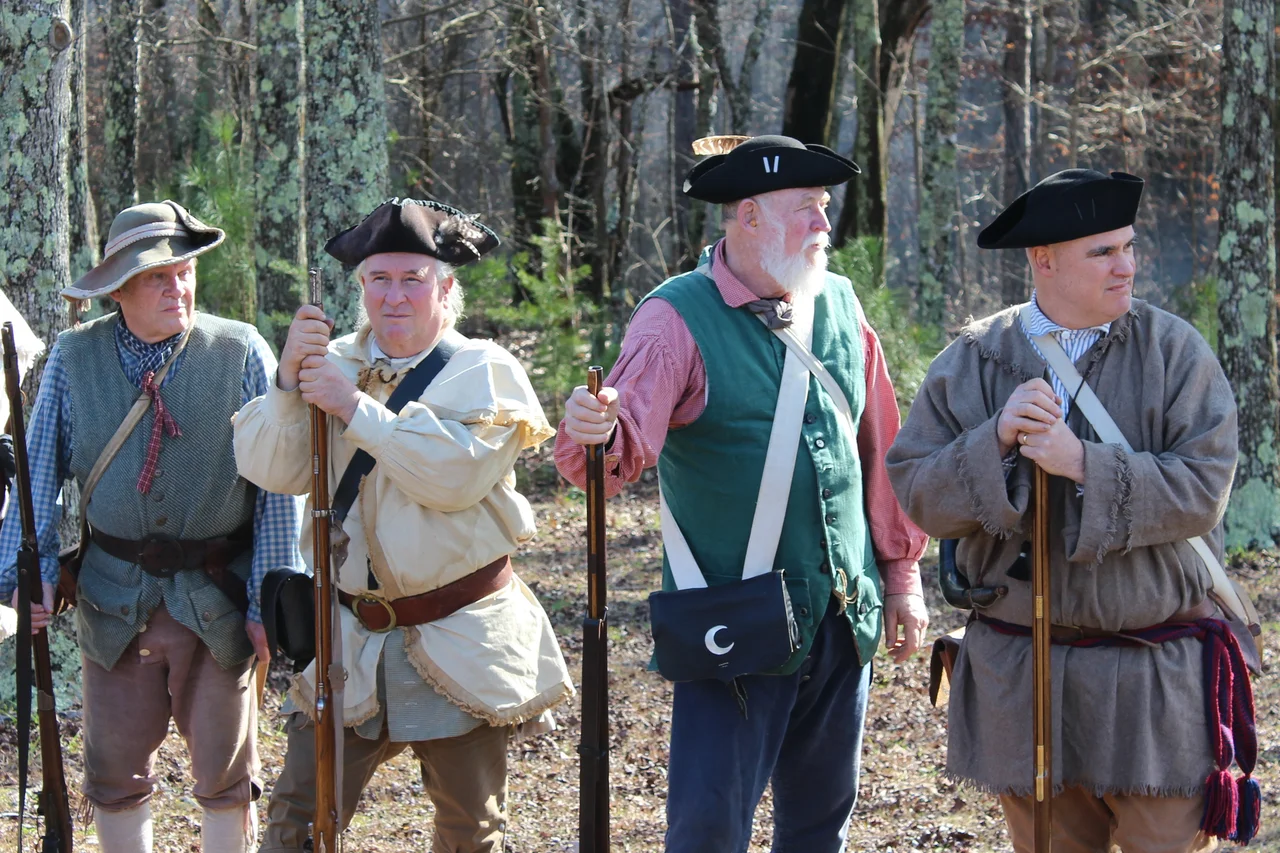

Battle of Great Cane Brake
Patrick Cunningham escaped on an unsaddled horse, without his breeches, shouting for every man to shift for himself. That detail alone tells you most of what you need to know about the Battle of Great Cane Brake. The patriots had marched twenty-five miles through cold rain to reach this stand of bamboo-like cane along the Reedy River, and they nearly walked into the camp undetected. The loyalists had been burning cane stalks to keep warm. The stalks popped and crackled as they exploded in the fire, drowning out the sound of approaching boots.
A War Within a War
Most Americans picture the Revolution as redcoats versus minutemen, but in the South Carolina upcountry of 1775, the war was a civil war within a civil war. The patriot Council of Safety in Charles Town controlled the lowcountry. The upcountry, lawless and scattered, was thick with 'King's men' who saw no reason to rebel against a Crown that had given them land. Both sides wanted the Cherokees on their side. Both promised gunpowder and lead. In October, the patriots sent 1,000 pounds of powder and 2,000 pounds of lead westward as a gift. A loyalist force under Patrick Cunningham intercepted the wagon train and took the lot. The shipment was meant for hunting, the patriots said. The loyalists believed otherwise.
The Snow Campaign
Colonel Richard Richardson raised an overwhelming force in response, perhaps 5,000 militiamen, and marched them up-country to break loyalist strength. By late December most of the loyalist leaders had been captured. Cunningham and the last holdouts retreated into Cherokee territory near what is now Greenville County. On December 21, Richardson sent 1,300 men under Major William 'Danger' Thomson to finish the job. Thomson marched through the night, twenty-five miles in cold rain mixed with snow flurries, and at dawn on December 22 his men nearly encircled the camp before the loyalists realized what was happening. The fight was brief. Only five or six loyalists were killed. The patriots took 130 prisoners and recovered the stolen munitions. What followed turned the engagement into legend: an unusual heavy snowstorm rolled in the next day, catching militiamen who had been called up on short notice without tents or warm clothing. Some men were permanently injured by frostbite. Soldiers afterward simply called the whole episode the Snow Campaign.
The Unmarked Battlefield
Richardson believed the upcountry was now pacified. He was wrong. The Cherokees, watching the patriots seize munitions promised to them, soon joined the loyalists in a brutal frontier war that would scar South Carolina for the next eight years. The exact site of the cane brake skirmish has been lost to time, though it is known to lie near the Reedy River, roughly seven miles southwest of Simpsonville. A state historical marker on Fork Shoals Road points to the general area. The cane brakes themselves are gone. So is the trail Thomson's men marched through the freezing rain. What remains is the story of an old man without his breeches, a column of soldiers betrayed by burning bamboo, and a snowstorm that did more damage than the battle itself.
From the Air
Located at 34.66 degrees North, 82.32 degrees West, roughly seven miles southwest of Simpsonville, South Carolina, in Greenville County. The site lies near the Reedy River in flat to gently rolling Piedmont terrain. Nearest airports: Greenville Downtown (KGMU) about 10 nm north, Greenville-Spartanburg International (KGSP) about 15 nm northeast, Donaldson Center (KGYH) about 5 nm west. Best viewed from 2,500 to 4,000 feet AGL on clear days; the historical marker and Reedy River corridor are visible but the precise battle site is unmarked from the air.
Nearby Stories
- Chiquola Mill Massacre 4.5 km away
- Battle of Hammond's Store 4.6 km away
- Battle of Blackstock's Farm 10 km away
- Stumphouse Mountain Tunnel 18 km away
- Battle of Cowpens 20 km away
- Chattooga River 21 km away
- Caesars Head State Park 21 km away
- Tree That Owns Itself 67 km away