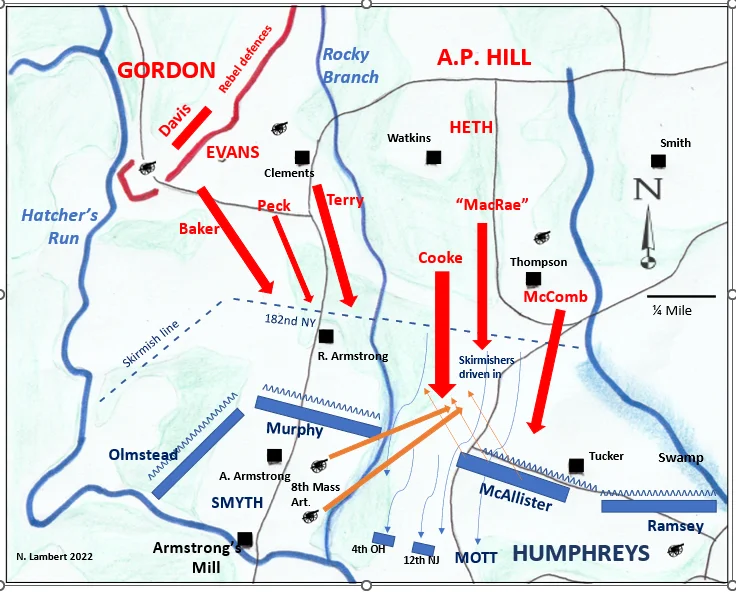

Battle of Hatcher's Run
The only Civil War battle fought in Virginia during a February happened on a sawdust pile. The mill was long gone, burned or abandoned, only the mound of accumulated sawdust still rising out of a clearing in dense woods near Dabney's Mill. For three days starting February 5, 1865, men of the Union Army of the Potomac and the Confederate Army of Northern Virginia fought back and forth across that clearing, in mud and freezing rain and finally a winter storm with gale-force winds, snow, hail, and sleet that left wounded men to freeze in place where they fell.
It was the eighth in a series of Union offensives around Petersburg that winter, designed to stretch Confederate defenses thinner and to cut their dwindling supply lines. By the time the storm broke and the fighting stopped, the Union line had extended four miles further west and General Lee's army had a problem that would not be solvable. Two months later he would surrender at Appomattox.
Grant's Eighth Offensive
Ulysses S. Grant had been pinning Robert E. Lee against Petersburg and Richmond since June 1864, slowly extending his lines westward to force the Confederates to spread their dwindling forces. In early February, intelligence reached him that Confederate supply wagons were running up the Boydton Plank Road through Dinwiddie Court House. Grant proposed a cavalry raid to intercept them. George Meade, his Army of the Potomac commander, suggested a modified plan that kept Union forces closer together: a cavalry probe to Dinwiddie, with infantry along Vaughan Road to support. Grant agreed. The cavalry would move at 3 a.m., the infantry at 7. On February 5, David McMurtrie Gregg's cavalry rode west and discovered that the supply route was effectively abandoned. The intelligence had been outdated. The offensive, as originally conceived, was already pointless. The fighting that followed was not about the supplies. It was about the ground.
The Confederates Attack
Lee learned of the Union movement while attending Sunday church in Petersburg. He rode back to his lines and met with John B. Gordon and A. P. Hill. The threat was Humphreys' Union II Corps entrenching about 1,000 yards south of the main Confederate works near Armstrong's Mill, on Hatcher's Run. Three Confederate brigades from Henry Heth's division, around 4,000 men, attacked east of Rocky Branch. West of the stream, Clement Evans's division of 2,600 advanced. The Union picket line held. Federal artillery firing across the stream raked the Confederate flanks. Three times the Confederates charged. Three times they were thrown back. The 8th New Jersey, exposed on the Union right, stood resolute under fire. Confederate sharpshooters wounded the Union brigade commander Colonel Mathew Murphy in the leg; it seemed not severe, but complications developed, and Murphy died on April 16. He was the most senior Union officer killed by this battle. As night fell, the Confederates withdrew to their works.
The Sawdust Pile
The next day, February 6, Meade ordered Warren's V Corps to advance up Dabney's Mill Road. Pegram's Confederate division had unaccountably split, sending two brigades south while leaving one in the works around the Crow house. Around 1:30 p.m. the Union cavalry under David Gregg ran into Pegram's two brigades on Vaughan Road and was driven back, losing more than 100 men including two brigade commanders wounded. Four Federal troopers earned the Medal of Honor in the rout. Meanwhile, five Union brigades pushed up Dabney's Mill Road toward the small Confederate brigade under Colonel John Lea, called Gimlet Lea. The clearing around the old mill was dominated by a massive pile of sawdust left from when the mill had operated. Soldiers in their memoirs would remember the sawdust pile for the rest of their lives. The Confederates dug into the pile and used it for cover. The 11th Pennsylvania's beloved mascot dog Sallie, who had been with the regiment since Gettysburg, was killed early in the fighting; she was later memorialized in bronze at Gettysburg. Reinforcements arrived for both sides. The line surged forward and back across the sawdust pile for three hours. Then John Pegram arrived with his two brigades from the Vaughan Road fight, and the Confederates broke the Union line. Pegram himself died in a hail of bullets at the moment of his own attack. He had married the Southern belle Hetty Cary just three weeks before.
The Great Skedaddle
What the Union soldiers called the great skedaddle followed. The Federal line buckled, then broke. Panic-stricken men ran back through the woods toward the safety of the Union earthworks at Hatcher's Run, chased by jubilant Confederates for more than a mile. Many of the Union soldiers were inexperienced. Many were out of ammunition. Friendly fire in the dense woods enhanced the panic. The bluecoats made it back to their lines as night fell. Overnight, the winter storm hit. Freezing winds, snow, hail, sleet. The wounded left behind on the battlefield froze where they had fallen. Both sides had men out there. Both sides understood by morning what the storm had done. The next day, February 7, the Union attempted one more assault on the Confederate earthworks around the sawdust pile. It failed. The Federals withdrew overnight. The battle was over.
What It Cost, What It Won
Union casualties at Hatcher's Run numbered around 1,500. Confederate casualties were approximately 1,000, including a brigadier general, John Pegram, killed at the head of his men. Hetty Cary was a widow at 28, having buried her husband three weeks after their wedding. Pegram was the most senior Confederate officer to die in the battle. The Union had not captured the Boydton Plank Road supply route, but it had extended its line four miles further west, the last extension before the war ended. This was the line from which, two months later, Grant launched the final offensive that took Petersburg, took Richmond, and ran Lee to Appomattox. Hatcher's Run did not look at the time like the beginning of the end. The men who froze that night were not thinking about the end of the war. They were thinking about being warm. About being found. About being remembered.
From the Air
The battlefield lies in Dinwiddie County southwest of Petersburg, Virginia at approximately 37.18 degrees north, 77.50 degrees west. Petersburg National Battlefield preserves portions of the larger siege lines, with Hatcher's Run flowing south through the area. Dinwiddie County Airport (KPTB) lies 6 nm north and Richmond International (KRIC) is 30 nm northeast. Best viewed at 2,500 to 4,500 feet AGL. The battlefield itself is wooded today, but the road grid of Vaughan Road and Boydton Plank Road remains in modern alignments and is visible from the air.
Nearby Stories
- Francisco's Fight 4.2 km away
- Southside (Richmond, Virginia) 6.5 km away
- Surry County, Virginia 11 km away
- Nat Turner's Rebellion 36 km away
- Suffolk, Virginia 39 km away
- Fork Union Military Academy 40 km away
- Long Grass Plantation 48 km away
- Battle of Gwynn's Island 63 km away