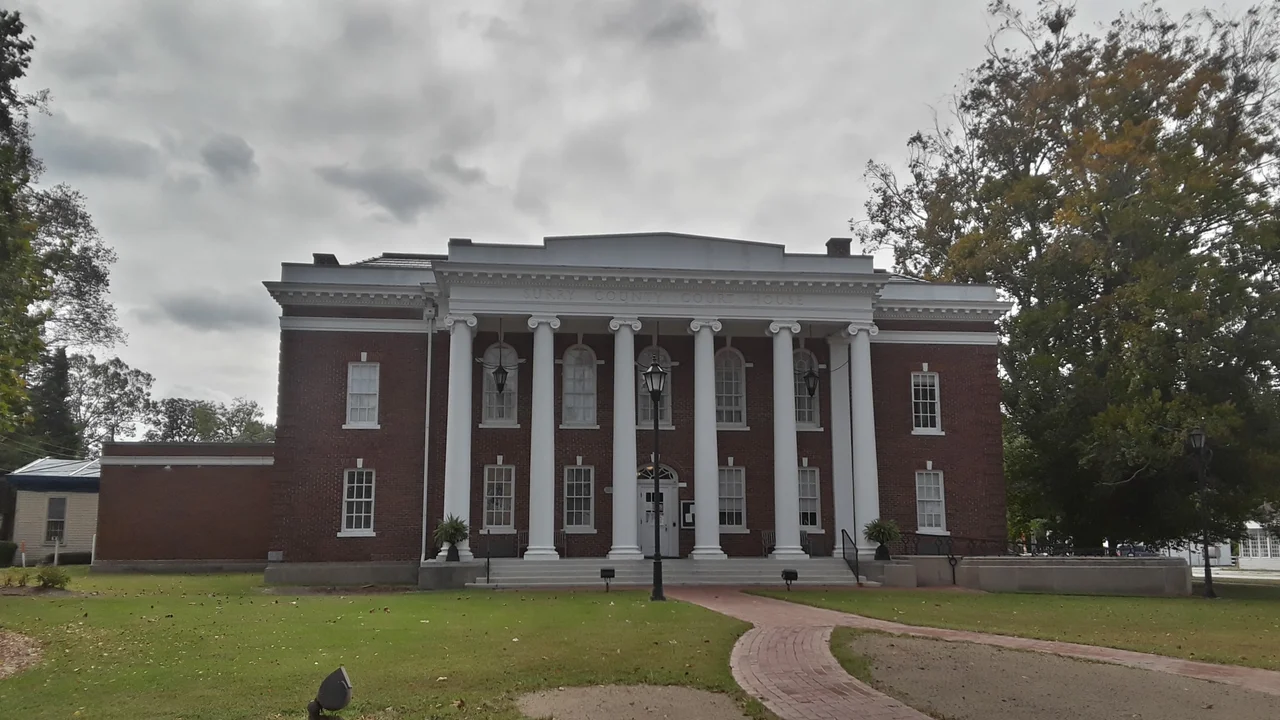

Surry County, Virginia
To reach Surry County, you take the Jamestown-Scotland Ferry across the James River, the way colonial Virginians did. Cars roll on at Glasshouse Point on the north shore and roll off at Scotland Wharf on the south, where the road bends inland through pine forests and tobacco fields. Surry has 6,561 residents according to the 2020 census, which means there are still more deer in some townships than people. It was formed in 1652 from the southern half of James City County and named for the English county of Surrey. For more than 350 years its economy has run on agriculture - corn, peanuts, soybeans, pine timber, and the smoked Virginia hams for which the area is famous. It contains nineteen sites on the National Register, including Bacon's Castle and Chippokes Plantation. It is a place where the past has not retreated, only quieted down.
Two Parishes and a Castle
Surry County was created in 1652 from a portion of James City County south of the James River - one of the original eight Virginia counties formed in 1634. Its first two parishes of the Church of England were Lawne's Creek and Southwark. In 1665, Arthur Allen built a Jacobean brick house with cross-shaped chimneys and Flemish-bond walls that is now one of the oldest brick dwellings in English North America. A decade later, during Bacon's Rebellion against Royal Governor William Berkeley, rebels occupied the house as a fort. They held it for several months until loyalist forces drove them out. The structure has been known ever since as Bacon's Castle - even though Nathaniel Bacon himself never lived there. He lived at Curles Neck Plantation, about thirty miles upriver on the north bank. The Castle's walls still rise above the Surry fields, and the house is open to tourists year-round.
Cobham, Cobblers, and Cavalry
Surry's first town, Cobham, was established in 1691 at the mouth of Gray's Creek where it flows into the James. Sussex County was carved from the southwestern end of Surry in 1754. During the American Revolutionary War, Banastre Tarleton's British Legion looted the county. During the Civil War, the Confederate Army included a Surry Light Artillery unit and a Surry Cavalry, organized from local volunteers. The county largely escaped direct Civil War combat. Most of the Peninsula Campaign happened on the north bank of the James, and Union and Confederate cavalry forces ranged through but did not engage in major battles here. Local plantations - including Chippokes, where 47 enslaved people worked on the eve of the war - were spared the worst of the destruction that struck the north-bank Virginia plantation country.
The Lumber Town That Disappeared
In 1873, a New Jersey timberman named David Steele began a lumber business in Surry County with Baltimore financing. He went bankrupt within a decade. Baltimore investors Waters and Company then incorporated the Surry Lumber Company in 1885, and in 1886 they built the Surry, Sussex, and Southampton Railway to haul cut lumber to Scotland Wharf on the James - the wharf that is now the Jamestown Ferry terminal. By 1920 the company and its railroad were at their peak. But the operators never replanted the old-growth pine they cut, and after 1925 further logging in the area became difficult. In 1927, the mills at Dendron closed, putting much of the county's population out of work. The railway went bankrupt in 1930. Gray Lumber Company of Waverly - which did replant - bought 15,000 acres of the failed Surry Lumber Company's holdings in 1941, and other companies absorbed the rest. The old-growth pine that built Surry's economy was gone. The county's tax base shrank to what farms and ferries could carry.
Massive Resistance
After the 1954 Brown v. Board of Education decision, Virginia's response, called Massive Resistance, closed public schools across the state rather than integrate them. Surry County participated. The county closed its white public schools so that Black students could not attend them, then funded a private whites-only school called Foundation's School with grants and other provisions that effectively used public money to maintain segregated education. The closures meant that some Black children in Surry went years without formal schooling. The Temperance, Industrial and Collegiate Institute had served as a school for Black Americans in the county from 1892 to 1928 - a Virginia State Historic Marker in Claremont commemorates the campus, and a memorial to its founder, John Jefferson Smallwood, stands at the Abundant Life Church Cemetery in Spring Grove. These histories - the Institute, the Massive Resistance closures, the school finally reopened to all students years later - sit beside Bacon's Castle and Chippokes in the county's National Register of Historic Places listings.
Reactors and Fields
The two-unit Surry Nuclear Power Plant was commissioned in 1972 and 1973 on a peninsula in the James River, the largest single piece of industrial infrastructure in the county. It is licensed to operate through 2053. From the air, its cooling towers and containment domes are visible for miles - the most modern thing in a landscape otherwise made of farms and forest. The county is known for curing Virginia ham, a tradition that has survived industrial pork-processing changes and still draws tourists to specialty smokehouses. Surry pine - Virginia pine, the same species the Surry Lumber Company hauled to the river - still grows everywhere the soil allows. Ferries from Surry to Jamestown run free, day and night, every twenty minutes. They are the same line of work the river has called for since 1925 - moving people, slowly, between worlds.
From the Air
Coordinates 37.1169°N, 76.8883°W. Surry County is on the south side of the James River, opposite Jamestown Island and stretching south to the Sussex County line. From the air, look for the open agricultural fields and pine forests on the south bank, the Surry Nuclear Power Plant cooling towers on the river peninsula north of the county seat, and the Jamestown-Scotland Ferry crossing. Best viewed 2,000-4,000 feet AGL. Nearest airports: Williamsburg-Jamestown (KJGG) about 8 nm north across the river, Newport News/Williamsburg International (KPHF) about 18 nm east-northeast.
Nearby Stories
- Siege of Petersburg 5.4 km away
- Battle of Gwynn's Island 7 km away
- Norfolk: The Navy's Capital Where the Fleet Calls Home 7 km away
- Southside (Richmond, Virginia) 11 km away
- Chesapeake Bay Bridge-Tunnel 24 km away
- White House (plantation) 25 km away
- Suffolk, Virginia 27 km away
- Fort Christanna 52 km away