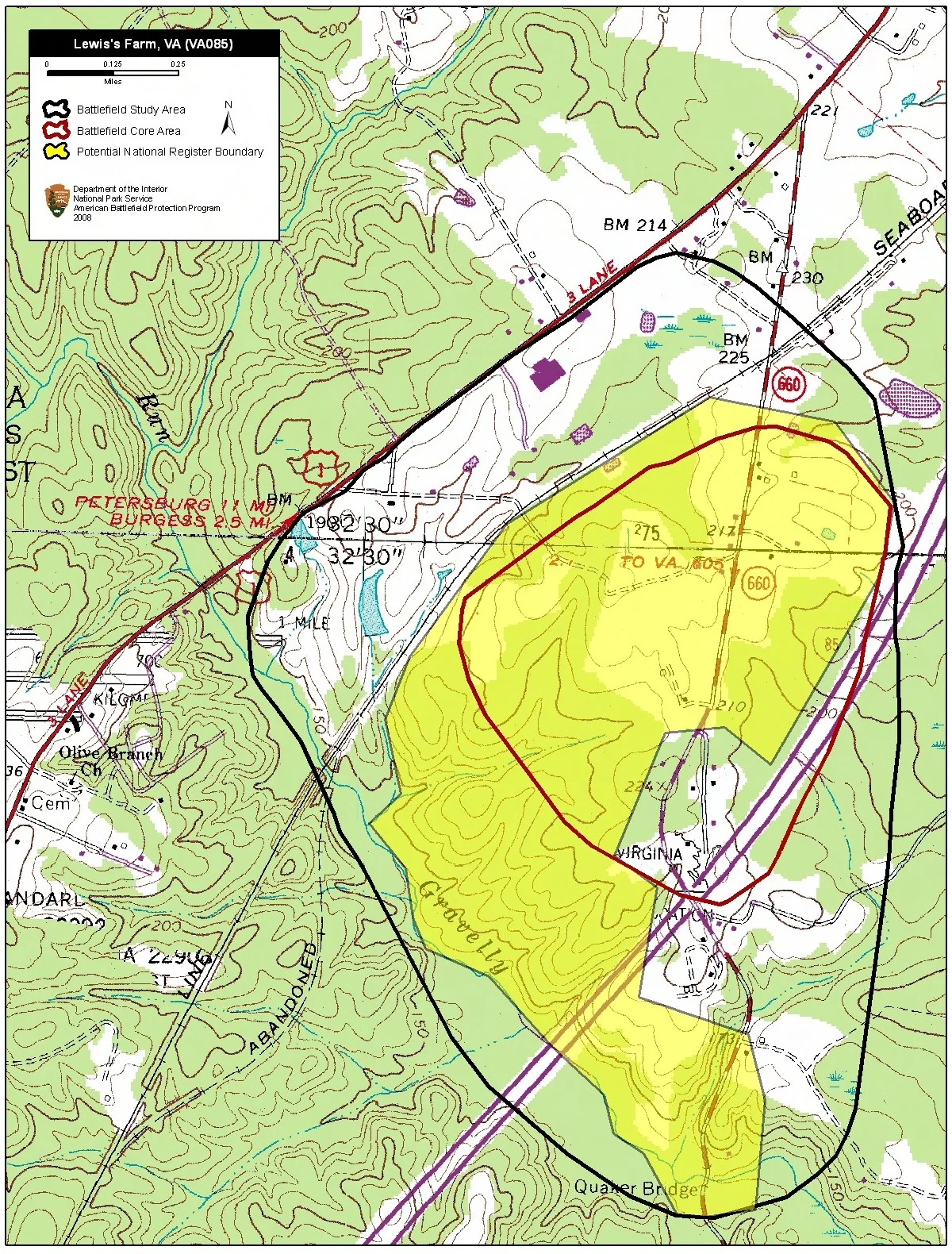

Battle of Lewis's Farm
Joshua Chamberlain's horse was bleeding to death under him when a Confederate soldier came out of the brush and ordered his surrender. The brigadier general from Maine was already wounded, a Minie ball having passed through his sleeve, hit his bridle hand, struck his chest, and lodged in the lining of his coat without quite breaking the skin. He had been knocked off the horse, climbed back on, and kept moving forward.
Lewis's Farm was the opening fight of what is now called the Appomattox Campaign. The National Park Service considers it the start of the eleven days of running combat that ended with Lee's surrender. It happened on a muddy farm clearing on March 29, 1865, on the Quaker Road south of Petersburg, and most of what you need to know about how the war was about to end is contained in the way it began.
Grant's Last Move
Ulysses Grant had been trying for nine months to cut Robert E. Lee's supply lines around Petersburg. On March 24, 1865, he issued the orders for the offensive that would do it. Two Union infantry corps, Warren's V and Humphreys' II, would move southwest to support Phil Sheridan's cavalry as it threatened the Confederate right flank near Five Forks. Sheridan's mission was to wreck the railroads. The infantry's job was to keep the Confederates pinned in their defenses so they could not interfere. The whole thing was to begin in the predawn hours of March 29. Four days before the offensive, John Gordon's Confederates had attacked Fort Stedman in a desperate attempt to break the Union lines and force Grant to shorten his front. The attack failed, costing Lee 4,000 men he could not replace. Lee now understood that he could not detach part of his army to escape; he barely had enough to hold the line. Grant understood it too. Lewis's Farm was the first piece of the answer.
Chamberlain on the Quaker Road
Warren's V Corps of 17,000 men moved at 3 a.m. and headed west to the Quaker Road intersection. From his immediate orders, Warren initially sent only Chamberlain's brigade up the Quaker Road. They marched 1.5 miles north and reached Gravelly Run, where the bridge had been destroyed and Confederates were entrenched on the far bank under Bushrod Johnson. Chamberlain placed the 198th Pennsylvania on the road as a diversion and led the 185th New York Volunteer Infantry across the stream to attack the Confederate right. Both regiments were oversized for late-war units, about 1,000 men each. A hand-to-hand fight developed. The rest of the brigade crossed behind. The Confederates pulled back about a mile north to the Lewis farmhouse clearing on the Quaker Road and dug in again.
The Wound
Major General Charles Griffin, Chamberlain's division commander, rode up and told him the Confederate position had to be taken. Chamberlain's Pennsylvania regiment was already falling back from a Confederate counter-charge. He rallied them, then his horse was hit. He went forward on foot. Several Confederate soldiers appeared from the brush and demanded his surrender. He talked his way out of it, somehow, while the New York regiment was being driven back from another attempt on the Confederate works. He and the regimental officers steadied the men and pushed the Confederates back until Lieutenant John Mitchell's four-gun Union battery came up to support them. Despite the artillery fire, the Confederates tried to outflank and charge again. Chamberlain's men, nearly out of ammunition, began a slow retreat. This was when Chamberlain was actually shot, the ball traveling through his sleeve and hand and the lining of his coat. He kept his feet.
Pearson and the Sawdust Pile
Reinforcements arrived. The 188th New York and the 155th Pennsylvania Zouaves of Colonel Edgar Gregory's brigade came up. Colonel Alfred L. Pearson led the Pennsylvanians toward the sawdust pile the Confederates were using for cover, grabbed the regimental colors, and charged. His men followed him, passing through the ranks of Chamberlain's exhausted First Brigade. The Confederates retreated to their main entrenchments along White Oak Road, abandoning the Boydton Plank Road and leaving behind their wounded. Thirty-two years later, in 1897, Pearson was awarded the Medal of Honor for his actions on that day. Casualties were nearly even: 381 Union, 371 Confederate. The numbers themselves are small by the standards of the war. What they bought was not.
What Lewis's Farm Bought
By the end of the day, Warren held the junction of the Quaker Road and the Boydton Plank Road. That road had been one of the last Confederate supply routes into Petersburg. Sheridan's cavalry reached Dinwiddie Court House at about 5 p.m. and severed it further. The Confederate flank was now exposed, the road junction at Five Forks within reach, the railroads that still ran to Petersburg and Richmond about to be cut. Grant, encouraged by the day's results, wrote to Sheridan that night: "I now feel like ending the matter." Within five days the Confederates would lose Five Forks. Within six they would evacuate Petersburg and Richmond. Within twelve days, on April 9 at Appomattox Court House, Lee would surrender his army. Lewis's Farm was not, by itself, a battle that changed the war. It was the battle that proved the war was over and just had to play itself out. Chamberlain, the wounded brigadier who had refused to fall, would be the officer Grant chose to receive the formal Confederate surrender of arms at Appomattox. He would order his men to salute the surrendering Confederates as they laid down their flags. The war was a long time going down. The man who had been shot through a coat seam at the start of it was still standing at the end.
From the Air
The Lewis's Farm battlefield lies in Dinwiddie County southwest of Petersburg, Virginia at approximately 37.13 degrees north, 77.53 degrees west. Petersburg National Battlefield preserves portions of the larger Appomattox Campaign battlefields. Dinwiddie County Airport (KPTB) lies 4 nm northeast and Richmond International (KRIC) is 32 nm northeast. Best viewed at 2,000 to 4,500 feet AGL. The terrain is gently rolling farmland and woodland with the Quaker Road still visible as a county road; Gravelly Run still flows where Chamberlain's New Yorkers crossed it under fire.
Nearby Stories
- Francisco's Fight 4.2 km away
- Southside (Richmond, Virginia) 6.5 km away
- Surry County, Virginia 11 km away
- Nat Turner's Rebellion 36 km away
- Suffolk, Virginia 39 km away
- Fork Union Military Academy 40 km away
- Long Grass Plantation 48 km away
- Battle of Gwynn's Island 63 km away