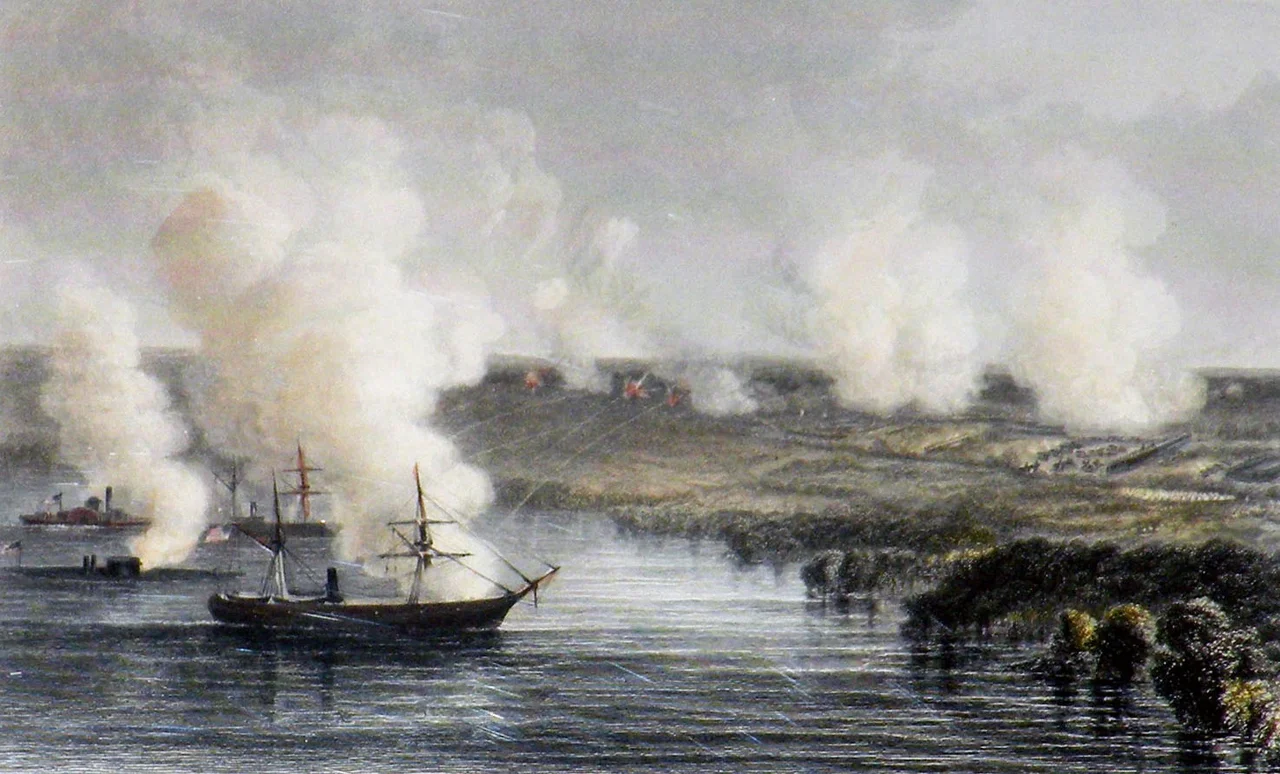

Battle of Malvern Hill
'It was not war,' Confederate General D.H. Hill wrote after the war. 'It was murder.' He was talking about July 1, 1862, the day his soldiers walked uphill toward 250 Union cannons firing at point-blank range. Five and a half thousand Confederates fell at Malvern Hill — most cut down by artillery before they got within musket range of the Union line. The dead boy in the famous photograph, the haunted-eyed seventeen-year-old Edwin Francis Jemison of the 2nd Louisiana, was killed here. Robert E. Lee won the campaign that day, in the sense that he saved Richmond. But what happened at Malvern Hill was something else entirely.
Seven Days, and Then One More
Union Major General George B. McClellan had spent the spring inching the Army of the Potomac up the Virginia Peninsula toward Richmond. By late June, his 100,000 men were within sight of the Confederate capital's church steeples. Then Lee struck. Six days of relentless attacks — Mechanicsville, Gaines's Mill, Savage's Station, White Oak Swamp, Glendale — pushed McClellan back toward the James River. The cautious Union commander decided to retreat to a defensive position at Harrison's Landing. Malvern Hill stood in the way: a 130-foot rise, gentle on its open northern slope, steep on the south where the James River cut a bluff. McClellan's artillerist, Colonel Henry J. Hunt, looked at the ground and saw what Lee would also see: a perfect killing field. McClellan put his guns on the crest.
What the Artillery Did
More than 250 Union cannons crowned Malvern Hill. They could fire across the entire approach. Behind them, on the James, gunboats added thirteen-inch shells from the river — explosions so large they sounded like locomotives passing overhead. Lee, looking for one more victory to crush McClellan completely, attacked anyway. Confederate batteries tried to suppress the Union guns; they were silenced in minutes. Confusion in Confederate orders sent brigades forward piecemeal, attacking across open ground without artillery support. Magruder's men, Huger's men, D.H. Hill's North Carolinians — wave after wave climbed the slope. Hunt's gunners switched to canister at close range: tin cans filled with iron balls turning each cannon into a shotgun. One of Hill's brigades lost 41 percent of its strength in the assault. The infantry barely fired.
The Cost
Confederate casualties totaled 5,650 — killed, wounded, captured. Union losses came to about 3,000. The Confederate dead lay in windrows on the slope, more than half killed by artillery. Among them was Edwin Jemison, a seventeen-year-old private from Louisiana whose pre-war portrait — wide-eyed, almost smiling — became one of the most haunting images of the war after his death. Two Confederate brigadier generals were wounded. No Union officer above the regimental level was hit. After dark D.H. Hill's men collected the bodies in pouring rain, digging graves they could not dig fast enough. Richmond's hospitals overflowed; volunteers from across the Confederacy came to nurse the wounded. Some of the wounded lay on the field for two days before being recovered.
What Lee Said, What Hill Said
Lee called it 'deeply, bitterly disappointed.' In his official report he wrote: 'Under ordinary circumstances, the Federal Army should have been destroyed.' D.H. Hill, who lost so many North Carolinians, was less reserved. 'The blood of North Carolina poured like water,' he wrote his wife — and later in print, the harder verdict: 'It was not war; it was murder.' Strategically, the Seven Days saved Richmond. McClellan retreated to Harrison's Landing and his Peninsula Campaign collapsed. Lincoln lost faith in him; the Army of Virginia was formed under John Pope; the war moved north. But the Confederate army never again attempted the kind of head-on uphill assault that broke against Malvern Hill, and Lee restructured his command into two wings — Stonewall Jackson's and James Longstreet's — partly because the chaos of July 1 demanded clearer lines of authority.
The Best-Preserved Field
The National Park Service calls Malvern Hill 'the best preserved Civil War battlefield in central or southern Virginia.' The American Battlefield Trust and partners have preserved 1,441 acres since 1994. The Willis Church Parsonage ruins, where Confederate assaults began, are still visible. Twelve replica Napoleon cannons sit along the Union line, pointing across the cornfield exactly where they did at dusk on July 1, 1862. Herman Melville wrote a poem about it — Malvern Hill — asking the elms if they 'recall the haggard beards of blood.' They do. The trees that lined the field that day are mostly gone now, but their descendants stand on the same ground, and the slope is unchanged.
From the Air
The Malvern Hill battlefield is centered at 37.41°N, 77.25°W in Henrico County, Virginia, about thirteen miles southeast of Richmond. From 2,500 to 3,500 feet AGL the high ground is visible as a wide, gently sloping plateau above the James River bluffs, with the preserved Union artillery line marked by walking-trail tracks and the dark rectangle of the Willis Church Parsonage ruins. Nearest airports: Richmond International (KRIC) about 13 nm northwest, Hummel Field (W75) about 25 nm east. The site lies just south of Class C airspace around KRIC; contact Richmond Approach (118.92) for transition. Best viewing on a north-to-south pass at 3,000 feet, ideally late afternoon when the slope shadows reveal the topography that determined the battle.
Nearby Stories
- Rosewell Plantation 6.4 km away
- Christopher Newport University 13 km away
- Cactus Hill 18 km away
- Huguenot Memorial Chapel and Monument 24 km away
- Lewis Ginter Botanical Garden 27 km away
- Fort Christanna 44 km away
- USS Texas (1892) 50 km away