
Battle of Moorefield
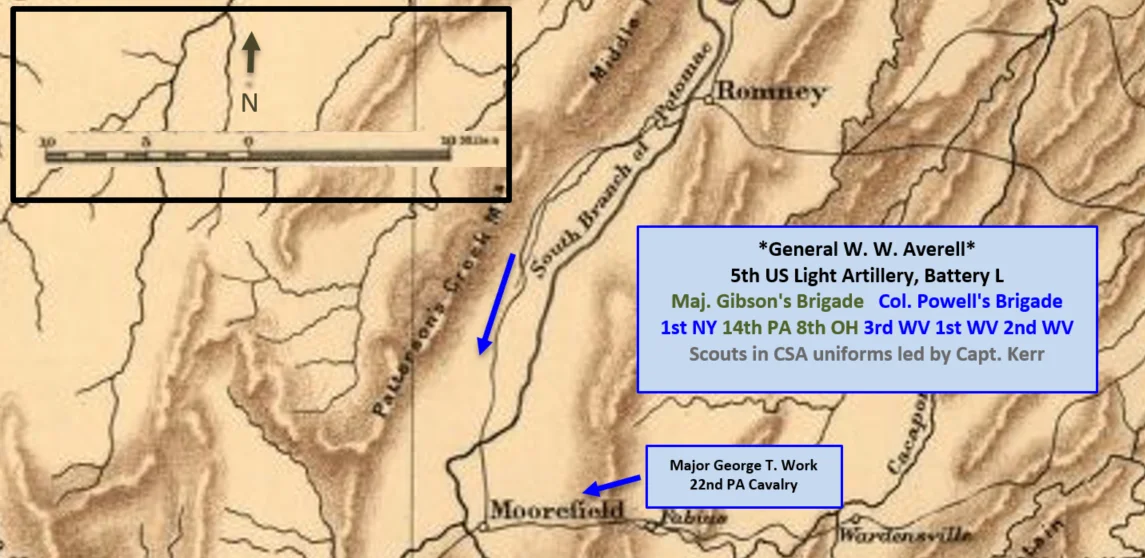
Just over a week earlier, the Confederate cavalry now sleeping in fields along the South Branch Potomac had burned the town of Chambersburg, Pennsylvania, when its residents refused to pay a ransom. Now, near dawn on August 7, 1864, Union Brigadier General William Averell's troopers found them strung out in a poorly-guarded bivouac near Moorefield, West Virginia. The attack that followed was less a battle than a punishment - and it effectively ended the offensive power of Confederate cavalry in the Shenandoah Valley.
After the Burning
On July 30, 1864, Confederate Brigadier General John McCausland led a cavalry raid into Pennsylvania under orders from Lieutenant General Jubal Early. When the town of Chambersburg could not produce a $100,000 gold or $500,000 greenback ransom, McCausland's men burned much of the town. The raid had been Early's response to Union destruction of Virginia Military Institute and the homes of leading Confederates in the Shenandoah Valley earlier that summer. McCausland turned south with his raiders, including Brigadier General Bradley T. Johnson's brigade of Maryland and Virginia cavalry, looking to return through the Allegheny Mountains to the Confederate lines. By the night of August 6 they were camped along the South Branch Potomac near Moorefield, West Virginia, exhausted from days of hard riding and apparently confident enough to neglect their pickets.
Averell's Pre-Dawn Strike
Brigadier General William W. Averell, commanding a Union cavalry division in the Department of West Virginia, had been pursuing McCausland for days. On the morning of August 7, his advance scouts under Captain Robert Kerr crossed the South Branch in the dark and rode directly into the Confederate camps. The 8th Virginia Cavalry, alerted by the commotion, had time to order its men to horse and form a line of battle. After a close fight the 8th Virginia was overwhelmed and joined other Confederates fleeing toward the river. During the fight Captain Kerr was shot in the face and thigh; his horse was killed. He survived. The Confederates did not regroup.
Sabers Against Long Enfields
After the battle General Bradley Johnson wrote one of the war's more revealing reports about why his men were broken. Besides the First and Second Maryland regiments and a squadron of the Eighth Virginia, he noted, there was not a saber in the command. In the press of close cavalry combat, his men carried long Pattern 1853 Enfield muskets - rifled infantry weapons, accurate and powerful at range but slow to reload. As Johnson put it, the long Enfield musket, once discharged, could not be reloaded and lay helpless before the charging saber. Union cavalry crashed in with edged weapons and revolvers among Confederates who had fired and could not fire again. Johnson performed creditably himself, leading portions of his regiment to slow the federal advance on the south side of the river. But the unequal weapons meant the outcome was largely decided by the morning's first volley.
The Cost and Consequence
Averell reported capturing about 400 Confederate prisoners along with 400 horses and four cannons. McCausland's and Johnson's brigades, the same units that had burned Chambersburg eight days earlier, were no longer a functioning cavalry force. The battle marked the end of significant Confederate offensive cavalry operations in the Shenandoah Valley. The very specific tactical lesson - long-range muskets cannot replace sabers in cavalry combat - had been delivered in the most direct way possible. Within months the Valley would belong to Philip Sheridan's Union army, and the war on this front would end at Appomattox the following spring. The Battle of Moorefield was small in numbers compared to Gettysburg or the Wilderness, but in the local Civil War history of the South Branch valley, it remains one of the most decisive single engagements ever fought.
From the Air
Located at 39.09 degrees north, 78.96 degrees west, along the South Branch Potomac River near Moorefield in Hardy County, West Virginia. From 4,000 to 6,000 feet AGL the broad fertile valley of the South Branch, framed by South Branch Mountain to the east and South Fork Mountain to the west, is the clear visual reference. Nearest airports are Hardy County (W22) at Moorefield and Grant County (W99) at Petersburg. The 1985 flood plain extends along the same valley.
Nearby Stories
- Davis 2.5 km away
- Orkney Springs Hotel 11 km away
- Belle Grove Plantation 13 km away
- Sinks of Gandy 22 km away
- The Inn at Little Washington 26 km away
- Battle of Fort Necessity 50 km away
- Antietam: The Day America Lost 23,000 Men 57 km away
- Fallingwater 75 km away