
Battle of Sewell's Point
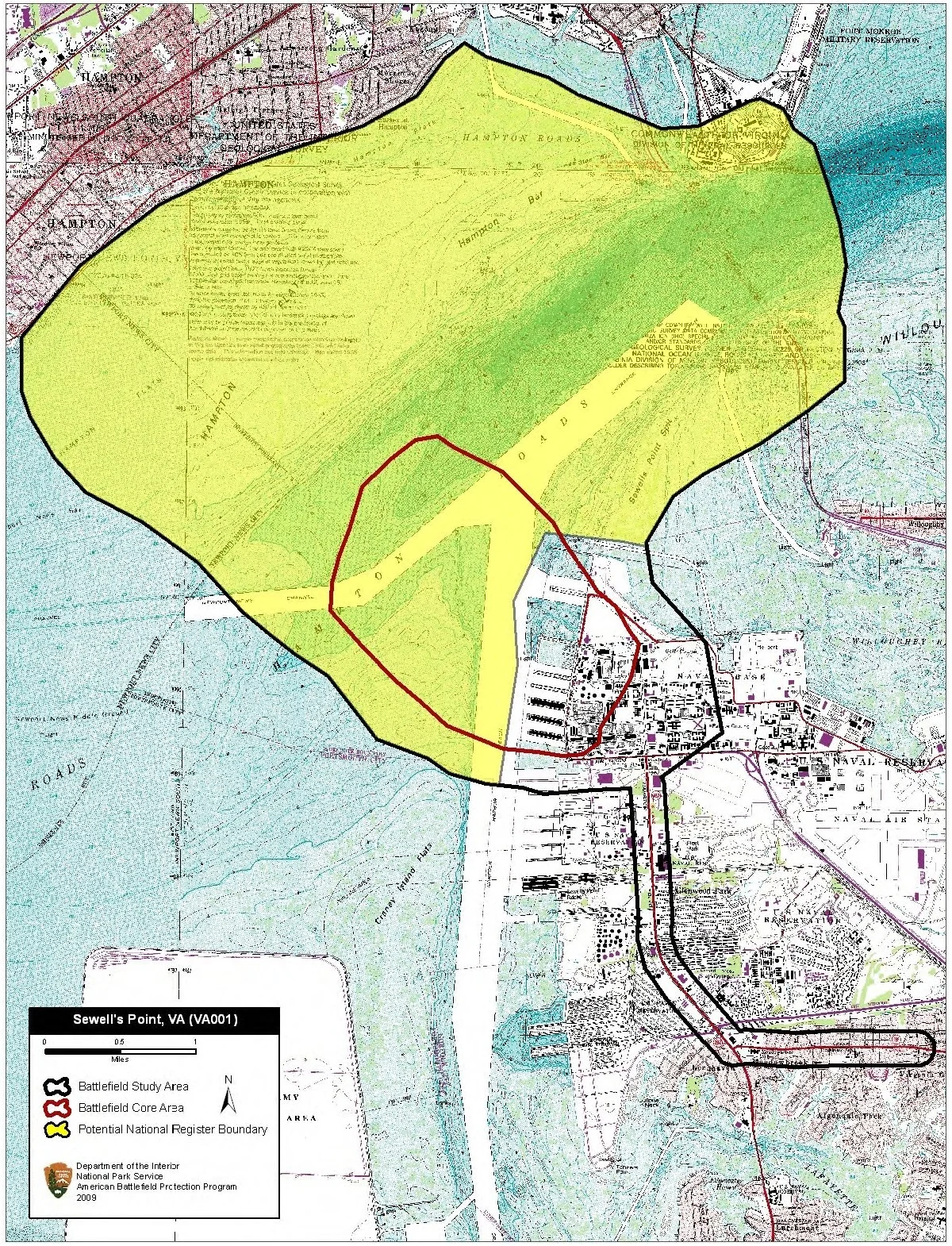
The Confederate gunners at Sewell's Point did not have a Confederate flag. So when the USS Monticello began firing on their battery at 5:30 p.m. on May 19, 1861, Captain Peyton H. Colquitt of the Columbus Light Guard ran up what he did have: the flag of the state of Georgia. Three 32-pound guns answered the Monticello, and the Union gunboat broke off the exchange. Almost nothing was hit. Almost nobody was hurt. And yet this small, inconclusive duel over a sandy peninsula in Norfolk County was one of the first times the United States Navy fired its guns at Confederate forces in the war that had just begun.
A Yard, Burning
On the night of April 20, 1861, Commodore Charles S. McCauley made one of the most consequential decisions in early Civil War history without orders. As Virginia tipped toward secession, McCauley convinced himself he could not hold the Gosport Navy Yard against the rebels. He gave the order to burn what could not be sailed away, including the steam frigate USS Merrimack, which Confederate workers would soon raise from the river bottom and transform into the CSS Virginia, the ironclad. The Union evacuation handed Norfolk and Portsmouth to the Confederacy without a fight and removed any Union land force from the south side of Hampton Roads for over a year. Sewell's Point, the sandy peninsula commanding the entrance to the Elizabeth River and the harbor at Norfolk, became prime Confederate real estate.
Building a Battery
Walter Gwynn had been a U.S. Army engineering officer and a railroad surveyor before the war. In late April and early May 1861, the Virginia Militia made him a brigadier general and put him in charge of building Norfolk's defenses. He chose Sewell's Point for one of his batteries. By May 18 the works existed; the guns did not. When the Union gunboat USS Monticello arrived that day under Captain Henry Eagle and his second-in-command, Lieutenant Daniel L. Braine, Eagle opened fire on the unfinished position and accomplished essentially nothing. Overnight Gwynn's men installed three 32-pound guns. By 5 p.m. on May 19 the battery could shoot back.
An Inconclusive Duel
The exchange that followed was brief, loud, and largely ineffective. The Monticello fired. The battery returned fire under Captain Colquitt and his improvised Georgia flag. The Monticello broke off, having taken little damage and inflicted less. Two days later, on May 21, the ships fired again. Same result. No one died on either side. By the end of the week, regular Confederate forces had relieved Gwynn, and the Sewell's Point battery had become a fixed feature of Hampton Roads, a Confederate gun position staring at Union Fort Monroe across two miles of water for the next year.
The Battery That Watched the Ironclads
Sewell's Point was almost a witness more than a participant in the most famous naval battle of the war. On March 8 and 9, 1862, the CSS Virginia steamed out of the Elizabeth River and into Hampton Roads. The first day she destroyed the wooden USS Cumberland and Congress. The second day she met the USS Monitor, the Union's strange cheesebox ironclad, and the two ships pounded each other to a standstill that ended wooden naval warfare forever. The Sewell's Point batteries supported their ironclad from the shore, firing at Union ships in the roads. Two months later, with Norfolk untenable as the Peninsula Campaign closed in, the Confederates evacuated. Union troops occupied Norfolk and Portsmouth on May 10, 1862, and found the Sewell's Point works abandoned.
Built Over
There is nothing left of the Confederate battery at Sewell's Point. Nothing visible, anyway. The peninsula became, in stages, one of the largest concentrations of military power in the world. The 1907 Jamestown Exposition was held here, and after it closed the Navy bought the land and built what became Naval Station Norfolk, today the largest naval base on earth. The ground where Colquitt raised his Georgia flag is now somewhere under a pier, a hangar, a parking lot, the home port of an aircraft carrier. The flag of the United States flies over all of it. The exchange of May 18, 19, and 21, 1861, sits in the historical record as an early shot of a war whose ending the men who fired it could not have imagined.
From the Air
Battle of Sewell's Point at 36.95°N, 76.33°W, on the peninsula that today holds Naval Station Norfolk, the world's largest naval base. The peninsula juts south from the mainland between the mouth of the Elizabeth River and Hampton Roads. From the air you will see carriers, destroyers, and amphibious ships at the piers. Restricted airspace surrounds the base. Best viewed from offshore at 2,000-4,000 ft AGL. Nearby airports: KNGU (Norfolk Naval Station, on site - restricted), KORF (Norfolk International, 6 nm SE), KLFI (Langley AFB, 8 nm NNE), KPHF (Newport News/Williamsburg, 11 nm NW). Strict prohibited area around the base itself; observe TFRs and Norfolk approach instructions.
Nearby Stories
- Battle of Gloucester Point (1861) 3 km away
- Coast Guard Station Cobb Island 3 km away
- Flowerdew Hundred Plantation 11 km away
- Great Dismal Swamp 11 km away
- Cape Charles Lighthouse 14 km away
- False Cape State Park 17 km away
- Cactus Hill 29 km away
- Chowan University 35 km away