.png)
Battle of Spotsylvania Court House
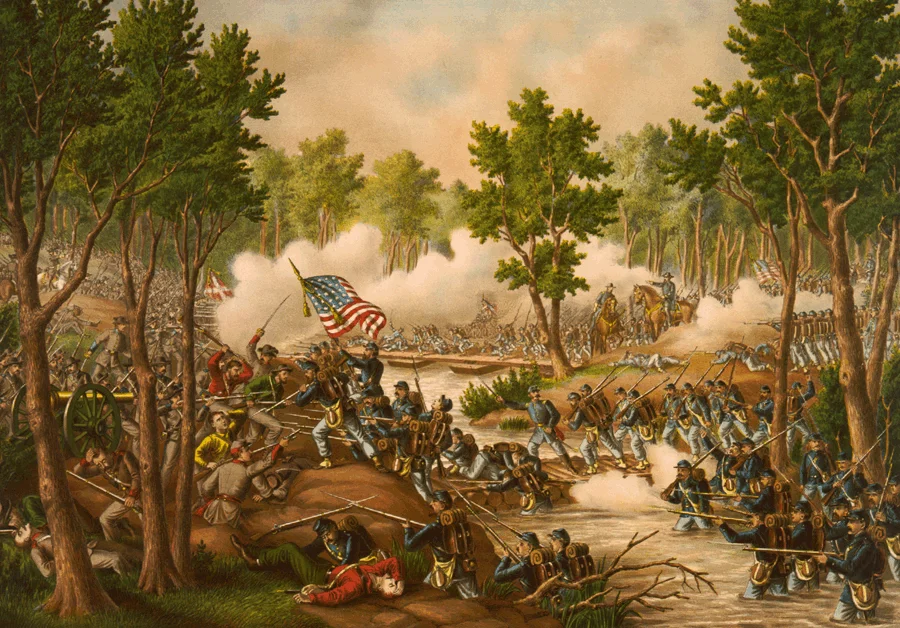
An oak tree about two feet thick stood in the Confederate earthworks at Spotsylvania Court House on the morning of May 12, 1864. By the afternoon of May 13, it was lying on the ground, cut down not by an axe but by the steady whittling of small-arms fire. A piece of that stump is now in the Smithsonian. The tree fell during what came to be called the Bloody Angle, a single twenty-four-hour stretch in which the fighting was so close and so continuous that Confederate soldiers had to pause to throw their own dead over the parapet to make room to shoot.
The Mule Shoe
After the inconclusive Battle of the Wilderness on May 5-7, Ulysses S. Grant did what no Union commander had done before. He did not retreat. He marched south, around Lee's right flank, toward the crossroads of Spotsylvania Court House - the next obstacle on the road to Richmond. Lee got there first by hours and ordered his men to dig in. The Confederate line bowed northward in a long convex salient that the soldiers called the Mule Shoe, more than a mile across at the base. The shape made the angle of the works vulnerable: any attacker who hit the apex could pour fire into both flanks. Colonel Emory Upton tested the idea on May 10 with a small assault that briefly broke through. Grant, recognizing the potential, decided to repeat the experiment with an entire corps. He picked the morning of May 12, 1864.
Twenty-Four Hours of the Bloody Angle
Hancock's II Corps - 15,000 men - jumped off at 4:35 a.m. in mist and heavy rain. The recent storms had soaked Confederate gunpowder; the artillery that should have shredded the attack had been pulled back the day before on Lee's misjudged orders and was just being returned when the assault hit. The Union surged through the works, capturing both General Allegheny Johnson and the troops of George Maryland Steuart. Then the plan ran out. No one had thought about how to exploit the breakthrough. Fifteen thousand men jammed into a half-mile front lost all unit cohesion and became, in the words of one observer, an armed mob. Lee rode forward to rally the line; his men chanted Lee to the rear and refused to advance until he turned back. For the next twenty-four hours, in pouring rain, the two armies fought hand to hand over the same hundred yards of trench. They used bayonets, rifle butts, even single-shot pistols at point-blank range. Wounded men drowned in the mud at the bottom of the works because no one could pull them out. The bodies piled four and five deep.
Sedgwick and the Generals
Five general officers died in the battle. Union Major General John Sedgwick was killed on May 9 by a Confederate sharpshooter while his men ducked at the whistling rifle balls. Sedgwick, trying to steady them, said the famous line: They couldn't hit an elephant at this distance. He was struck under his left eye and died within minutes. He was the highest-ranking Union officer by seniority to die in the war. Union Brigadier Generals James C. Rice and Thomas G. Stevenson were also killed; Confederate Brigadier Generals Junius Daniel and Abner M. Perrin died of their wounds. Forty-three Union soldiers received the Medal of Honor for actions during the battle. Among the captured Confederates were Johnson, Steuart, and a list of brigadier generals - Cooke, Hays, McGowan, Ramseur, Battle, Walker, Johnston, Walker - long enough that it shaped the Army of Northern Virginia's leadership for the rest of the war.
If It Takes All Summer
On the morning of May 11, the day before the great assault on the Mule Shoe, Grant sent a message to Secretary of War Edwin M. Stanton in Washington. The result to this time, he wrote, is much in our favor. Our losses have been heavy as well as those of the enemy. I propose to fight it out on this line if it takes all summer. The phrase became one of the most quoted lines of the war. It also stated Grant's whole strategy in fourteen words. The Overland Campaign was not about elegant maneuver. It was about relentless pressure - making the Army of Northern Virginia fight, day after day, in a way that the smaller Confederate force could not sustain. Spotsylvania ended after two weeks with no clear tactical winner. Casualties exceeded 32,000, making it one of the costliest battles of the war and the costliest of the Overland Campaign. Grant disengaged and continued south, toward the North Anna, toward Cold Harbor, toward Petersburg, toward Richmond, toward Appomattox eleven months later.
What Remains on the Ground
The Spotsylvania battlefield is preserved today as part of Fredericksburg and Spotsylvania National Military Park, which protects 2,773 acres of the fighting ground - including the Mule Shoe, Laurel Hill, and the Bloody Angle itself. The American Battlefield Trust has added more than 151 acres in five separate land transactions between 1989 and 2023. Visitors walk the same trench lines the soldiers cut with bayonets and picks; the earthworks survive remarkably well in the heavy clay soil. The oak stump cut down by musket fire is in the National Museum of American History in Washington. From the air, the battlefield reads as patches of preserved forest and field cut by the road grid of modern Spotsylvania County. The thirty-two thousand casualties are not visible from above. Neither is the Mule Shoe's outline, except where the Park Service has cleared sight lines and the trench line stands out as a darker green ribbon through the pines.
From the Air
The Battle of Spotsylvania Court House battlefield sits at about 38.224 N, 77.598 W, roughly 12 nautical miles southwest of Fredericksburg, Virginia. Recommended viewing altitude is 2,500 to 4,000 feet AGL for the best look at the preserved sections of battlefield - the Mule Shoe salient, Laurel Hill, and the Bloody Angle - and their relationship to the small town of Spotsylvania Courthouse and the surrounding Virginia Piedmont. The nearest airport is Shannon (KEZF) in Fredericksburg, about 12 nm to the northeast. Stafford Regional (KRMN) lies about 17 nm north. The Rapidan and Po rivers wind through the area; the latter forms much of the battlefield's western edge. Best light is mid-morning, when the preserved earthworks cast crisp shadows through the second-growth forest.
Nearby Stories
- Battle of North Anna 9.4 km away
- Dolley Madison 11 km away
- Prince William County, Virginia 25 km away
- The Inn at Little Washington 26 km away
- Fork Union Military Academy 30 km away
- Menokin 30 km away
- Surratt House Museum 31 km away
- Piney Grove at Southall's Plantation 66 km away