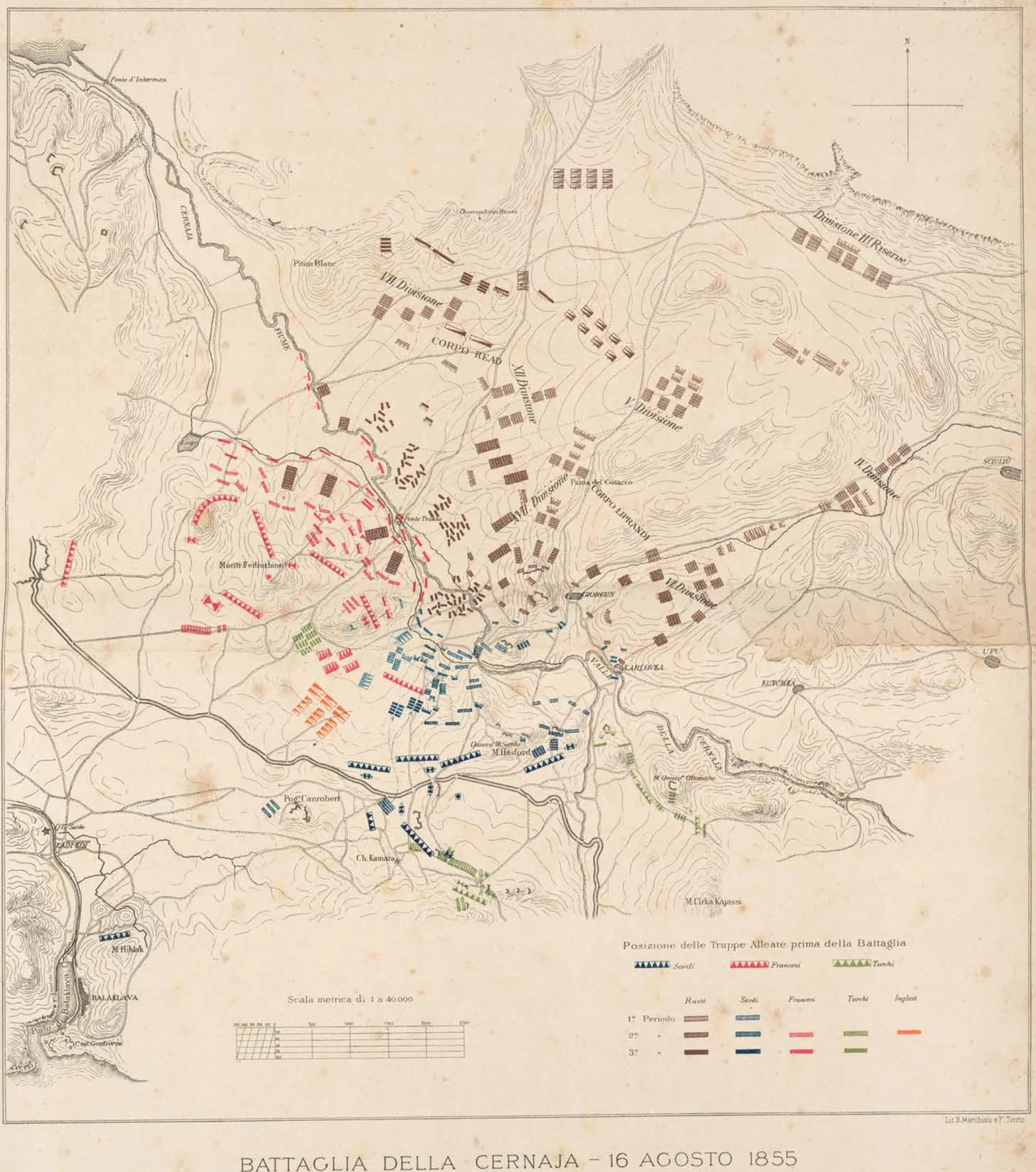

Battle of the Chernaya
A young artillery officer named Leo Tolstoy stood on the heights above the Chernaya River on the morning of 16 August 1855 and watched men die in clusters. Below him, Russian soldiers waded the cold water and started up the far slope into the rising sun, and the enemy guns found them. Shells burst among the ranks; the advance dissolved. Before the morning was out the survivors were streaming back, leaving thousands of their comrades on the hillside. Tolstoy came away sickened, and out of that horror he wrote the only verse of his life. The place he described was this narrow valley near Sevastopol, where a Russian offensive died almost as soon as it began.
An Attack No One Believed In
The battle was ordered from the top and doubted at every level below it. With Sevastopol under a punishing allied siege, Tsar Alexander II wanted his commander in Crimea, Prince Mikhail Gorchakov, to strike before enemy reinforcements arrived, hoping a victory might force a favorable peace. Gorchakov did not expect to win. When he called the war council the Tsar demanded, many of his senior officers argued against the whole plan. Dmitri Osten-Sacken, shaken by the recent death of Admiral Nakhimov, urged abandoning Sevastopol rather than spilling more blood. General Khrulev went the other way entirely, proposing to burn the city and hurl every available man at the enemy; when warned this would cost tens of thousands of lives, he answered that everyone might as well die so long as they left their mark on the map. Gorchakov chose to attack, but refused to accept responsibility if it failed.
Twenty Minutes on the Fedyukhin Heights
The Russians came on before dawn under cover of fog, some 47,000 infantry with cavalry and 270 guns, moving toward the Traktir Bridge. Then confusion undid them. Gorchakov sent his generals a vague note, "Let's start it," and General Read, unsure what exactly he was meant to start, took it as an order to attack and crossed the river before his reserves and artillery were in place. His men reached the far bank and met a wall of French infantry and cannon on the slopes of the Fedyukhin Heights. The arithmetic of it is brutal to record: in roughly twenty minutes, two thousand Russian soldiers fell on that ground. Read then fed his reserve division in piecemeal, regiment by regiment, and accomplished nothing except to lengthen the casualty lists. In the retreat, Read himself was killed.
The Poet on the Hill
Among the thousands who witnessed the slaughter was Count Leo Tolstoy, then an unknown officer, not yet the author of War and Peace. He blamed the disaster on the incompetence of generals who had drawn their plans on paper and forgotten the ground itself. His anger found an outlet in a bitter little marching song, its sharpest line running, roughly, that everything was written smoothly on the paper, but they forgot about the ravines. The verse spread quickly through the ranks, and its phrase passed into the Russian language as a proverb for plans that ignore reality. It is the only poem Tolstoy is known to have written. The bravery of the ordinary soldiers was not in question; British correspondents marveled at the sheer impetuous courage of the doomed advance. What failed them was command.
The Cost and the Reckoning
The defeat was total. Though they had numbers on their side, the Russians lost the battle and suffered nearly five times the casualties of the French, Sardinian, and Ottoman forces opposing them. The Tsar's hope of bargaining from strength was gone. There was one lasting consequence beyond the losses: the valor of the Piedmontese-Sardinian troops that day earned their kingdom a seat at the war's negotiating table, a small step on the long road toward the unification of Italy. For the Russian army, the deeper wound was trust. After the Chernaya, the soldiers no longer believed in their commanders, and it became only a matter of time before Sevastopol itself would fall. Today the river runs quietly through its valley, its banks bearing no trace of the morning that broke here.
From the Air
The battlefield lies along the Chernaya (Chorna) River at roughly 44.467 N, 33.850 E, on the northeastern approaches to Sevastopol. From altitude, trace the river valley between the higher ground of the Fedyukhin Heights and Telegraph Hill; the port city of Sevastopol lies to the southwest. Nearest fields are the Sevastopol area and Simferopol International (UKFF) to the northeast.
Nearby Stories
- Tepe-Kermen 7.4 km away
- Soviet Destroyer Dzerzhinsky 28 km away
- Soviet Destroyer Otvazhny 34 km away
- Novyi Svit Winery 41 km away
- Novyi Svet 61 km away
- Januarius MacGahan 344 km away
- Tottenham (1802 Indiaman) 375 km away
- Abkhazia 541 km away