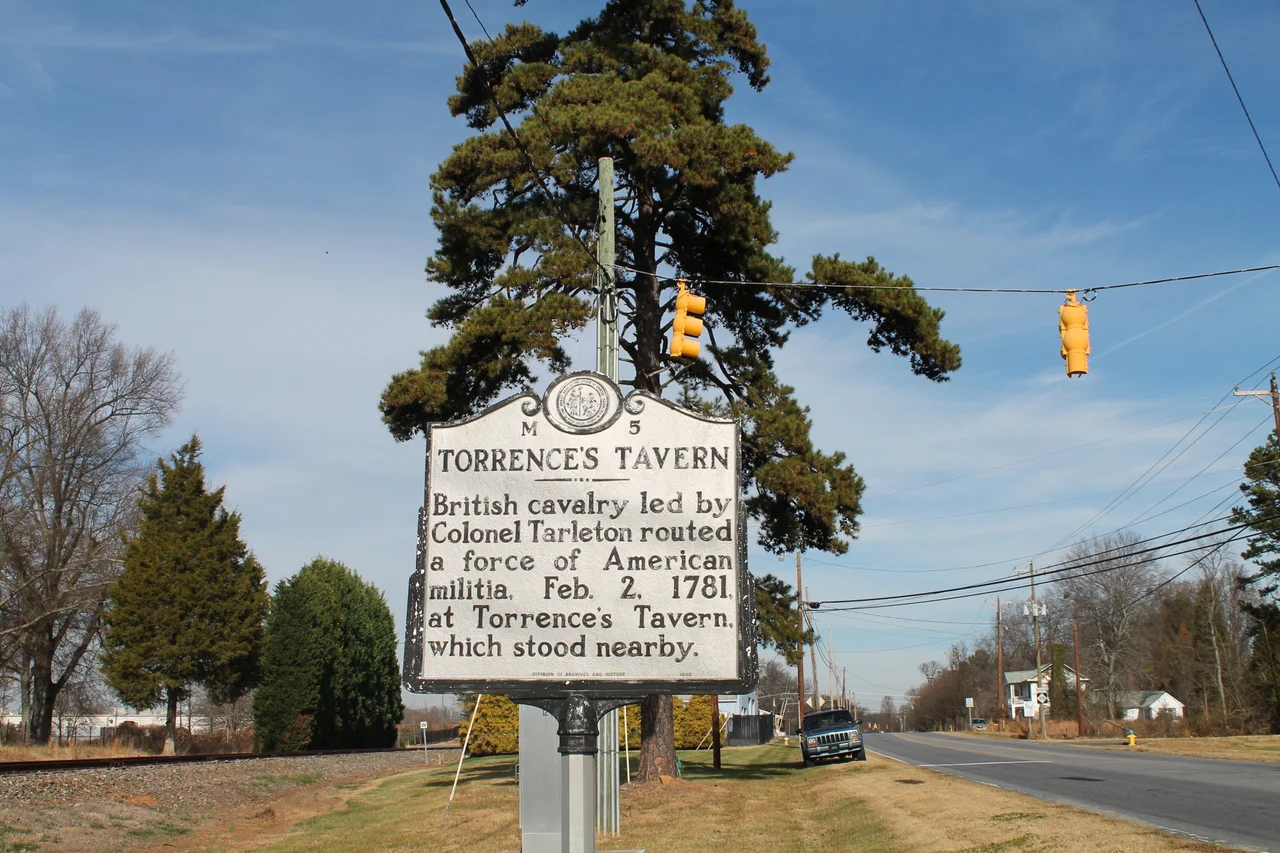

Battle of Torrence's Tavern
Ann Bonar Torrence was already a widow. Her husband Adam had died at Ramsour's Mill the year before, and now, on a wet afternoon in early February 1781, the tavern she ran on the Salisbury Road was about to become a battlefield. Refugees from Cornwallis's advance had crowded her yard. Militiamen who should have been ready to fight had instead emptied her liquor stores. And somewhere east of the Catawba River, Banastre Tarleton's green-coated dragoons were already in the saddle, riding hard to remember the Cowpens.
Rain on the Catawba
The winter of 1780-81 was a season of mud and pursuit. After Daniel Morgan's stunning victory over Tarleton at Cowpens on January 17, Charles Cornwallis stripped his army of its baggage and chased Nathanael Greene's Continentals across the Carolina Piedmont. Every ford on the Catawba River became a potential battlefield. At Cowan's Ford on February 1, militia General William Lee Davidson held the British crossing long enough to inflict casualties, then fell in the fighting himself. With Davidson dead and the militia leaderless, Cornwallis turned to his most feared cavalry commander. Tarleton's British Legion contained infantry, cavalry, and artillery, but the same rain that had swelled the river had also turned the roads to slurry. He took only his horsemen east toward Salisbury, where Greene was gathering his rallying force.
A Crowded Yard
Torrence's Tavern sat on the road from the Catawba fords to Salisbury, a natural gathering point for anyone fleeing east. By midday on February 1 the yard was thick with refugees clutching what valuables they could carry, militia waiting for reinforcements from Mecklenburg and Rowan counties, and Colonel Thomas Farmer's roughly three hundred men taking up a secondary defensive line. The same heavy rain that had spared the British their artillery had soaked the militia's gunpowder until it was useless. To steady their nerves, or perhaps just because the stores were there, militiamen and refugees alike helped themselves to the tavern's liquor. When Tarleton's scouts brought him word of an unprepared enemy waiting for reinforcements, the commander made his decision instantly.
Remember the Cowpens
The British attack came around two in the afternoon. Captain Nathaniel Martin rallied a thin line behind a rail fence, but Tarleton was not interested in a careful engagement. He ordered the charge and reminded his dragoons to "remember the Cowpens" - the humiliation of two weeks before, still raw. The Legion's cavalry crashed through the makeshift defenses before the militia could finish forming. Martin was captured in the first minutes. With no effective command left, the Patriots scattered. Tarleton split his dragoons into smaller parties to chase the fleeing men into the woods. The fight had taken minutes. The next day, Cornwallis's main army burned the tavern to the ground. Ann Torrence had lost her husband at Ramsour's Mill, and now she had lost her livelihood.
The General's Lament
Greene rode into Salisbury after the disaster and found nearly seventeen hundred muskets stacked there, all of them rusted useless by the same weather that had ruined the militia's powder. "These are the happy effects of defending the Country with Militia," he reportedly snapped, "from which the good Lord deliver us!" Yet the small fight bought him something. Tarleton's pursuit had stopped at the tavern instead of pressing on to find Greene at David Carr's farm six miles away. The Continentals slipped across the Yadkin River near Salisbury without harassment, regrouped, and continued the long retreat north. Six weeks later, at Guilford Courthouse, Greene would bleed Cornwallis so badly that the British army limped to Wilmington and eventually to Yorktown.
What the Markers Say
The historian John Buchanan judged the battle's military impact minor and suspected that without Tarleton's own memoirs, Torrence's Tavern "probably would have merited at most a footnote." Cornwallis disagreed in real time. Writing to London afterward, he claimed the engagement "so effectually dispirited the militia, that we met with no further opposition on our march to the Yadkin." Both views may be right. In 1914 the Daughters of the American Revolution placed a stone marker at the site, honoring the men of nearby Centre Presbyterian Church who had fought there. In 1939 the state of North Carolina added a roadside marker on N.C. Highway 115 in Mount Mourne. Torrence's Tavern is now bedroom-community suburbia of Charlotte, the green-coated dragoons replaced by morning commuters - but the road they all rode is still there.
From the Air
Approximate battle site at 35.04N, 80.85W, near Mount Mourne in Iredell County, North Carolina, about 25 miles north of Charlotte. The DAR marker stands at 134 Langtree Road. Cruise at 3,500-5,000 feet AGL for good orientation along the historic Salisbury road corridor (modern NC-115). Nearest airports: Charlotte Douglas International (KCLT) 22 miles southwest, Statesville Regional (KSVH) 18 miles north, and Lake Norman Airport (14A) just east. The Catawba River and Lake Norman are visible to the west, marking the line of Cornwallis's crossing at Cowan's Ford.
Nearby Stories
- Charlotte Motor Speedway 2.3 km away
- Yadkin River 10 km away
- Battle of Colson's Mill 12 km away
- Lancaster County, South Carolina 13 km away
- Battle of Ramsour's Mill 17 km away
- Kings Mountain National Military Park 18 km away
- Cheraw, South Carolina 27 km away
- Battle of Fishdam Ford 30 km away