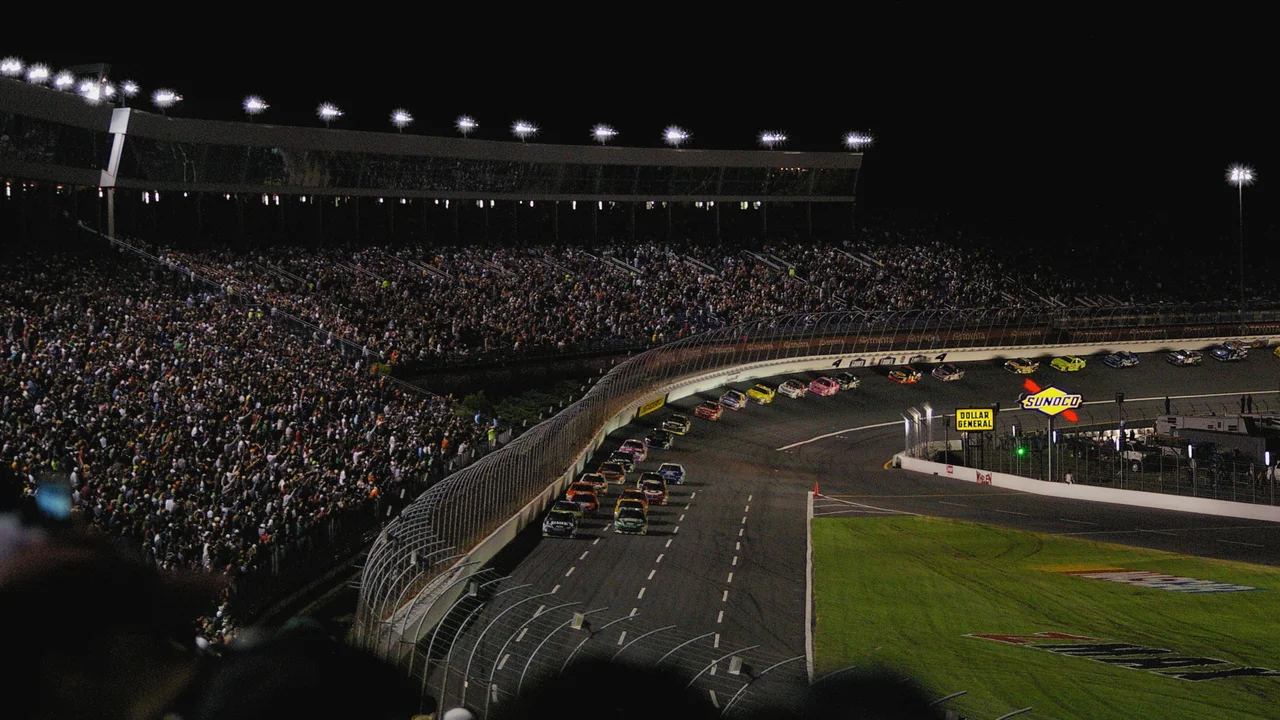

Charlotte Motor Speedway
On the morning of June 19, 1960, contractor W. Owen Flowe parked his earthmovers across the unfinished racing surface of the new Charlotte Motor Speedway and threatened to sue. He hadn't been paid, his checks had bounced, and the World 600 was in ten days. According to Flowe, someone showed up with a shotgun. Co-owner Bruton Smith said only his partner Curtis Turner had brought the weapon, and that a guard quickly took it away. Either way, the bulldozers moved, the asphalt was rushed into place, and the inaugural race ran. Drivers spent the afternoon dodging gravel-deep potholes that the Charlotte Observer's George Cunningham compared to 'an old lady's wrinkled face.' Smith later called it a miracle the track was finished at all.
Smith and Turner, Reluctant Partners
Stock car racing in the late 1950s was outgrowing the dirt bullrings that had birthed it. Promoter Bruton Smith, a Carolinas-based showman with a knack for selling tickets, wanted his own state-of-the-art facility. So did Curtis Turner, a Virginia timber magnate and one of NASCAR's most fearless drivers. After initially refusing, Turner partnered with Smith because each needed the other's stock subscribers to raise capital. Groundbreaking came on July 28, 1959. Three March 1960 snowstorms compounded delays. NASCAR mechanic Smokey Yunick called the location 'a giant mistake,' adding that if anyone had searched North Carolina for the worst possible place to build a racetrack, this was it. The track opened anyway, eleven months after groundbreaking, on a budget that had ballooned to roughly two million dollars.
Bankruptcy and a Federal Judge
Within months of the opening, lawsuits began stacking up. Connecticut General Life Insurance was owed ninety thousand dollars. The Internal Revenue Service wanted forty thousand. McDevitt Street and Company, the prime contractor, claimed two hundred thousand. By November 1961 the track was a million dollars in debt and headed for foreclosure auction. U.S. District Judge James Braxton Craven Jr. stepped in, took CMS into Chapter 10 bankruptcy on November 3, removed all officers, and turned the facility into a ward of the court. A Charlotte lawyer named Robert Nelson Robinson was appointed to manage it. Over the next eighteen months, Craven oversaw a reorganization plan that asked 2,300 shareholders to buy trustee certificates of $100 to $1,000. The shareholders met the goal. By April 1963 over $740,000 in debt had been repaid and the speedway returned to private ownership.
Howard, Smith, and Humpy
Furniture-store owner Richard Howard ran CMS through the late 1960s and early 1970s with a tight grip on costs. The track turned its first profit in February 1964 and paid off its mortgage three years ahead of schedule. But Smith, back in business after a tax-evasion conviction, was buying stock. In 1974 he was elected chairman of the board. A year-long power struggle followed, and at the January 1976 stockholders' meeting a tearful Howard announced his resignation. Smith brought in promoter Humpy Wheeler, who became one of the most inventive impresarios in American sports. To stoke a 1977 rivalry between Cale Yarborough and Darrell Waltrip, Wheeler placed a dead chicken inside a dead shark's mouth, mounted the assemblage on a truck, and paraded it before qualifying. He convinced Janet Guthrie to enter the 1976 World 600, broadening the sport's audience. Under Wheeler and Smith, capacity peaked above 170,000.
The Crown Jewel and the Roval
Two NASCAR weekends now anchor the speedway's calendar. The Coca-Cola 600, first run as the World 600 in 1960, takes six hundred miles to finish, the longest race on the NASCAR schedule. It runs on the Sunday of Memorial Day weekend and is recognized as a Crown Jewel event alongside the Daytona 500, the Brickyard 400, and the Southern 500. The fall race, the Bank of America Roval 400, switched in 2018 from a pure oval to a hybrid 'roval' configuration that uses the infield road course with a backstretch chicane. It produced the most unpredictable racing on the Cup schedule almost overnight. In 1992 CMS became the first superspeedway to install lights for night racing. In 1999 it became the first to sell its naming rights, briefly becoming Lowe's Motor Speedway.
Tragedy and Reinvention
The track's spectator capacity, peaking at 170,000 in the 1980s, has been pared back since the early 2010s. The 1999 VisionAire 500K, an Indy Racing League event, ended in tragedy when a crash sent heavy debris into the grandstands and killed three spectators. A pedestrian bridge collapsed after the 2000 Winston, injuring 107. The complex now spans roughly two thousand acres and includes zMax Dragway, a 1.5-mile dirt track, a clay short track, an infield go-kart layout, and the Ten Tenths Motor Club road course opened in October 2024. Greg Walter has run the facility as general manager since 2018. Wheeler retired in 2008 after a dispute with Smith over the drag strip; Smith himself died in 2022, but the family company Speedway Motorsports still owns the track. The Coca-Cola 600 still runs on Memorial Day weekend. The drivers still need binoculars to see the far end of the frontstretch.
From the Air
Located at 35.353 degrees N, 80.683 degrees W in Concord, North Carolina, immediately adjacent to U.S. Route 29. Best viewed from 3,000 to 5,000 feet AGL. Concord-Padgett Regional (KJQF) is just 4 miles north; Charlotte Douglas International (KCLT) is about 20 miles southwest. The 1.5-mile quad-oval with its seven-story tower and the long zMax Dragway running south are unmistakable from any altitude.
Nearby Stories
- Hickory Motor Speedway 5.5 km away
- Battle of Colson's Mill 6.5 km away
- Battle of Ramsour's Mill 7.8 km away
- Yadkin River 9.8 km away
- Kings Mountain National Military Park 16 km away
- Catawba College 18 km away
- Battle of Torrence's Tavern 20 km away
- High Point, North Carolina 35 km away