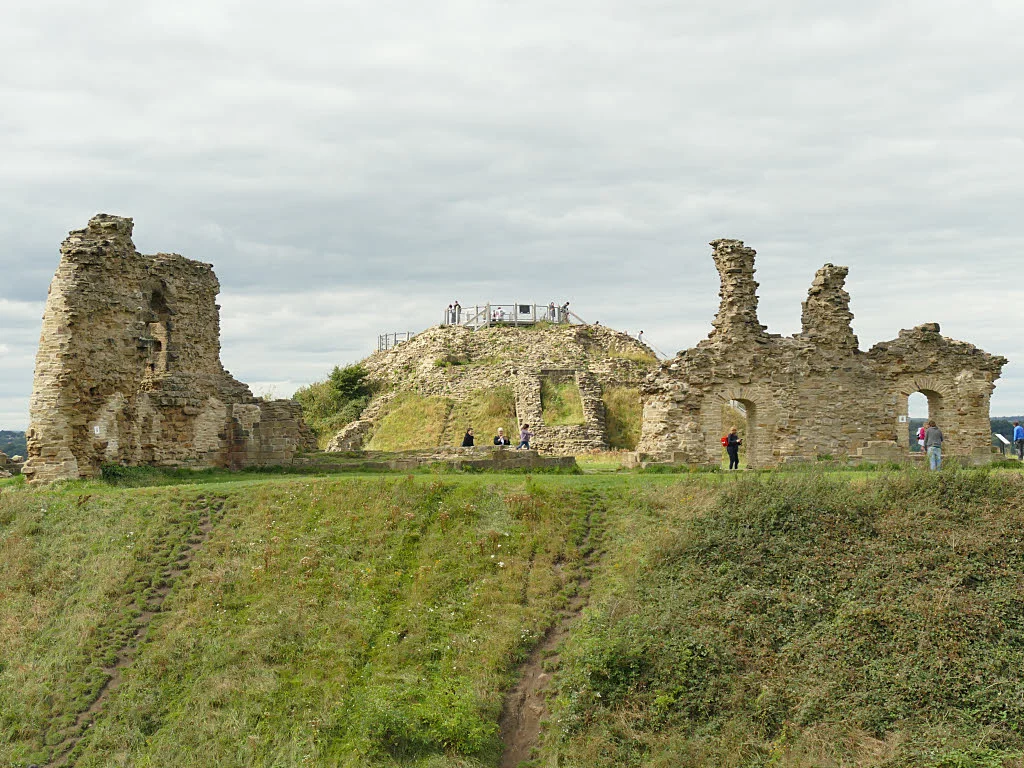

Battle of Wakefield
On 29 December 1460, Richard, Duke of York, set out from his manor at Wakefield to ride north to the city of York. He was 49 years old, recently named heir to the throne of King Henry VI by act of Parliament, and travelling with a small household. Somewhere on the road north, probably near the village of Stanley, his Lancastrian enemies fell upon him. They killed his second son, the 17-year-old Edmund, Earl of Rutland. They captured York himself and took him back to Pontefract, where he was beheaded the next day. With him died Richard Neville, Earl of Salisbury. The heads of all three were sent to the city of York and mounted on Micklegate Bar, with the Duke wearing a crown of paper or reeds. The mocking display became one of the most notorious moments of the Wars of the Roses.
The Quarrel That Brought Him North
Henry VI had been king of England since 1422, when he was nine months old. By the 1450s he had grown into a gentle, prayerful, intermittently mad man, dominated by his French queen Margaret of Anjou and her allies. Richard of York, the wealthiest magnate in England and descended from Edward III through both his parents, believed he had been pushed away from his rightful place at court. The First Battle of St Albans in 1455 was the first armed clash. Five years of intermittent crisis followed. In October 1460 York walked into Parliament and laid his hand on the empty throne to claim it. Even his allies were appalled. The compromise hammered out, the Act of Accord, made him Henry's heir, displacing the king's seven-year-old son Edward, Prince of Wales. Queen Margaret refused. From Scotland and the north of England she organised the armies that would meet York at Wakefield.
What the Earliest Sources Actually Say
Almost everything most people think they know about the Battle of Wakefield is a later embellishment. The Tudor chronicler Edward Hall, writing eighty years after the event, gave the version that Shakespeare made famous: York taunted out of Sandal Castle by Queen Margaret, overwhelmed by Lancastrians hidden in the woods, his son Rutland murdered by Lord Clifford on Wakefield Bridge. Recent research has dismantled this account piece by piece. Manorial records show Sandal Castle could not have accommodated York's party, let alone an army; he stayed in the town of Wakefield itself. Margaret was in Scotland. The supposed battlefield was inundated and held a fishpond in December 1460. Contemporary accounts agree that what happened was an ambush, not a battle. The chronicler Robert Bale wrote in the early 1460s that York, Rutland and Salisbury 'wer trayterously and ageinst lawe of armes... mordered and slain.'
Father and Son
Edmund, Earl of Rutland, was no child despite Shakespeare's portrayal of him as one. At seventeen he was old enough to fight, and the evidence is that he did. He and his father died together or very close to it. Richard Neville, Earl of Salisbury, taken alive on the same day or the day before, was held at Pontefract and beheaded on 31 December. One account states he was dragged from the castle by force and killed by an illegitimate brother of the Duke of Exeter. The three bodies were initially buried at the Dominican friary in Pontefract. Sixteen years later, in 1476, Richard's eldest surviving son, by then King Edward IV, arranged for the bodies of his father and his brother to be exhumed and brought south in elaborate procession to St Mary and All Saints Church in Fotheringhay, the Yorkist family mausoleum. The dignity that had been denied them at Micklegate Bar was finally given back.
The War That Did Not End
York's death did not end the Yorkist cause. His eldest son Edward, Earl of March, was 18 and already commanding armies in the Welsh Marches. The northern Lancastrian army that had won at Wakefield marched south, defeated the Earl of Warwick at the Second Battle of St Albans, and recovered the captive King Henry. But they were refused entry into London. Within weeks Edward of March was proclaimed King Edward IV. He confirmed his title in March 1461 at the Battle of Towton, the bloodiest day on English soil, fought in a blinding snowstorm not far from where his father had died. Edward would reign on and off for more than two decades. His brothers and cousins would tear at each other for another quarter century, ending only when Henry Tudor killed Richard III at Bosworth in 1485. Wakefield was the moment when the Wars of the Roses changed from a struggle between rival factions to a war of mutual extermination.
The Monument in Manygates Lane
In 1897 the local historian Dr J. W. Walker put up a monument in Manygates Lane on the spot where the Duke of York was traditionally said to have died. It may stand near where an older monument stood, destroyed during the English Civil War, but there is no archaeological evidence either way. A cross to the memory of Edmund, Earl of Rutland, was erected at the Park Street end of Kirkgate in Wakefield. Wakefield itself remembers in quieter ways. The mnemonic for the colours of the rainbow taught to English schoolchildren, Richard Of York Gave Battle In Vain, is sometimes traced to him. The northern expression 'Dicky's Meadow,' meaning a place where you should not go, is sometimes said to remember the same field, though the earliest documented use is four hundred years later. The Duke of York's bones rest now at Fotheringhay. The bridge at Wakefield where his son was said to have died still carries the Chantry Chapel of St Mary the Virgin, the city's last medieval chantry.
From the Air
Located at 53.680 N, 1.492 W, just south of central Wakefield in West Yorkshire. Sandal Castle, traditionally identified with the battle, sits on a low hill clearly visible from 2,000-3,500 ft AGL. The actual ambush site cannot be precisely located but is believed to lie north of Sandal, possibly near Stanley. Nearest airports are Leeds Bradford (EGNM) 12 nm north and Doncaster Sheffield (EGCN) 22 nm southeast. The M1 runs 2 nm east of the site. The Chantry Chapel of St Mary the Virgin, where the Earl of Rutland is said to have died, stands 1 nm north on Chantry Bridge over the River Calder.
Nearby Stories
- Stockport Air Disaster 4.5 km away
- Hillsborough Disaster 6.1 km away
- Murder of Sophie Lancaster 6.3 km away
- Battle of Stamford Bridge 9.8 km away
- Wressle Castle 12 km away
- Gordale Scar 12 km away
- Gainsborough Old Hall 19 km away