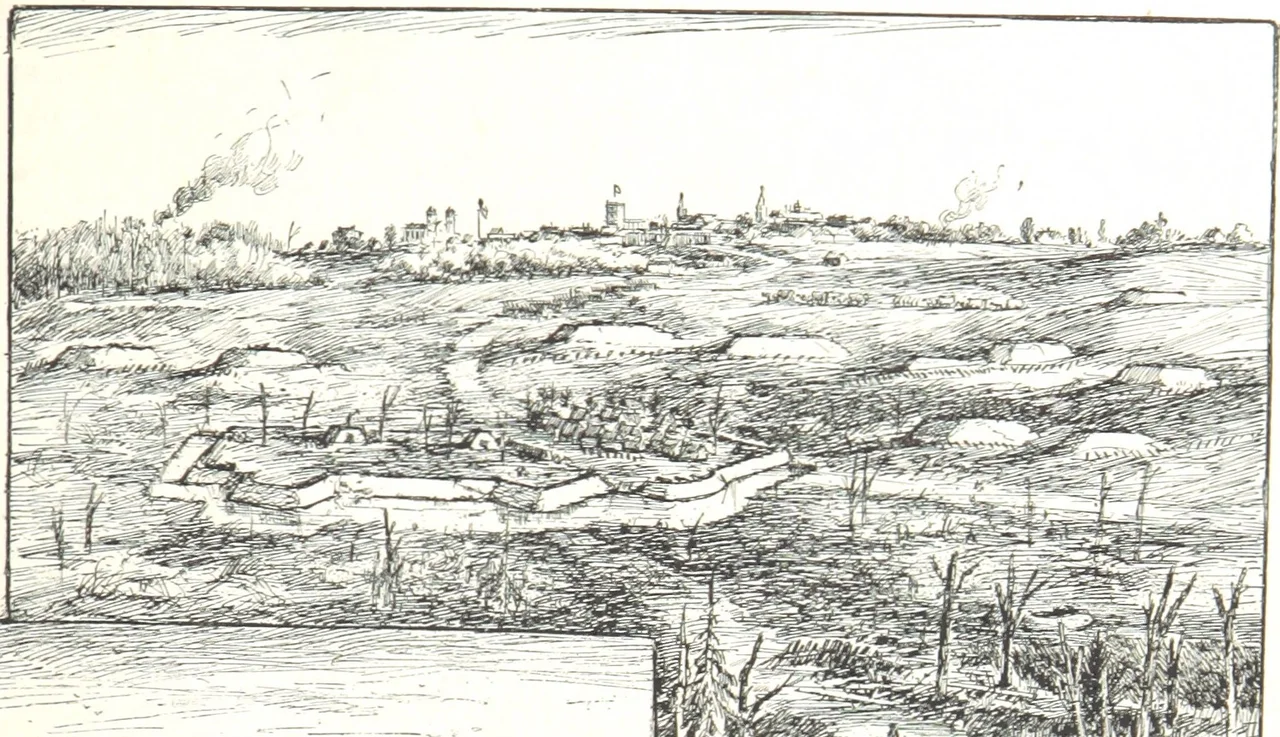

Battle of Williamsburg
The rain had been falling for days, and the roads east of Williamsburg were a soup of red Virginia clay. On May 5, 1862, regimental bands stood among the abatis playing Yankee Doodle, trying to slow troops who had begun to run. About 41,000 Federals and 32,000 Confederates were engaged across that single rainy day, fighting around the earthen walls of Fort Magruder, in pine woods studded with rifle pits, and through fields converted to mud by the boots of two armies. By nightfall, 2,283 Union and 1,682 Confederate soldiers had been killed, wounded, or captured. The battle settled nothing. That, for the Confederate command, was exactly the point.
The Retreat From Yorktown
On the night of May 3, 1862, Confederate General Joseph E. Johnston unexpectedly pulled his army out of the Warwick Line at Yorktown. Union Major General George B. McClellan, who had spent a month preparing a massive siege, woke to find empty trenches and Quaker guns - logs painted black to look like cannon. He sent cavalry under Brigadier General George Stoneman to chase the rearguard and ordered half the Army of the Potomac under Edwin Sumner to follow. The roads to Williamsburg were narrow and rain-soaked, and the chase quickly became a slog. By May 5, Johnston's men were still struggling toward Richmond, slowed by mud and broken wagons. To buy time, Johnston detached a force to make a stand at Fort Magruder, a large earthen fortification straddling the Williamsburg Road that John B. Magruder had built earlier in the campaign.
Fort Magruder in the Rain
Brigadier General Joseph Hooker's 2nd Division of the III Corps led the Union advance and ran straight into Fort Magruder around dawn. The fort was an elongated pentagon with walls 15 feet high and nine feet thick, ringed by a dry moat. Hooker's men attacked the fort and the line of rifle pits curling southwest from it, and were thrown back. Confederate counterattacks under Major General James Longstreet threatened to break Hooker's line. Hooker had expected Brigadier General William F. "Baldy" Smith's division to march to his aid, but Smith had been halted a mile away by Sumner, who feared the Confederates would attack on the Yorktown Road. So Hooker fought alone through the morning, his men slipping in the mud, his artillery sinking into it. Two of his batteries - Webber's and Bramhall's - were lost to the Confederate advance, and the morale of his division began to break.
Kearny and His Sword
Around 2:30 in the afternoon, Brigadier General Philip Kearny's division of the III Corps arrived. Kearny had lost his left arm in the Mexican War and rode his horse out in front of his picket lines to reconnoiter, flashing his saber with his only arm to urge the men forward. The display was theatrical and effective. Hooker's troops, rallied, pushed the Confederates back off Lee's Mill Road and into the woods. Sharp firefights continued in the abatis until late afternoon. On the Union right, Brigadier General Winfield S. Hancock had taken his brigade across Cub Creek to threaten Longstreet's flank. Brigadier General Jubal Early, leading the 24th and 38th Virginia Infantry, pushed through the woods without proper reconnaissance and emerged directly in front of Hancock's eight guns. Early was shot through the shoulder and put out of action for nearly two months. Colonel George Ward of the 2nd Florida was killed leading a charge. The 24th Virginia lost 508 men. The 5th North Carolina, which followed, lost 302. McClellan praised Hancock's performance as "superb," and the nickname Hancock the Superb stuck for the rest of the war.
What the Battle Bought
The Northern press painted Williamsburg as a brilliant Federal victory. McClellan himself claimed it was a triumph over superior numbers. But the defense had done exactly what Johnston needed. During the night of May 5 and into the morning of May 6, the Confederate army slipped away toward Richmond, leaving Williamsburg to the Federals. The Peninsula Campaign would grind on through the summer and end in Confederate strategic success: McClellan never took Richmond. Behind the lines at the College of William and Mary, the wounded of both armies filled the Wren Building, which served as a hospital. Three Union regimental commanders were wounded; one, Lieutenant Colonel John Van Leer of the 6th New Jersey, was killed in action. Colonel William Dwight of the 70th New York was left for dead and taken prisoner. The men who died at Williamsburg died in the kind of confused, half-blind woodland fighting that would come to define the Eastern Theater - smoke in the trees, mud underfoot, regiments lost a few yards from comrades they could not see.
What Survives
Most of the Williamsburg battlefield has been swallowed by development - housing, the parkway, the modern city. But the American Battlefield Trust and its partners have steadily acquired and preserved more than 343 acres between 2010 and mid-2023, including a 29-acre parcel bought in December 2020 and a 245-acre tract preserved in February 2023 for $9.4 million, said to be the second most expensive private battlefield land acquisition in American history. Portions of Fort Magruder's earthworks still stand on Penniman Road, and several redoubts remain along the Colonial Parkway. The College of William and Mary still teaches in the Wren Building where the wounded once lay. Walking the preserved fields in spring, with new leaves on the trees and Canada geese moving across the open ground, it takes effort to imagine the rain, the wagons, the sound of artillery - and the bands playing Yankee Doodle as men fell back through the woods.
From the Air
Coordinates 37.2642°N, 76.6659°W. The preserved Fort Magruder earthworks sit in James City County just south of Williamsburg, between U.S. Route 60 and Penniman Road. From the air, look for the historic district of Colonial Williamsburg, the Colonial Parkway cutting east-west, and the wooded preserved tracts south of the city. Best viewed at 2,000-3,500 feet AGL. Nearest airports: Williamsburg-Jamestown (KJGG) about 5 nm southwest, Newport News/Williamsburg International (KPHF) about 12 nm southeast.
Nearby Stories
- Siege of Petersburg 5.4 km away
- Battle of Gwynn's Island 7 km away
- Norfolk: The Navy's Capital Where the Fleet Calls Home 7 km away
- Southside (Richmond, Virginia) 11 km away
- Chesapeake Bay Bridge-Tunnel 24 km away
- White House (plantation) 25 km away
- Suffolk, Virginia 27 km away
- Fort Christanna 52 km away