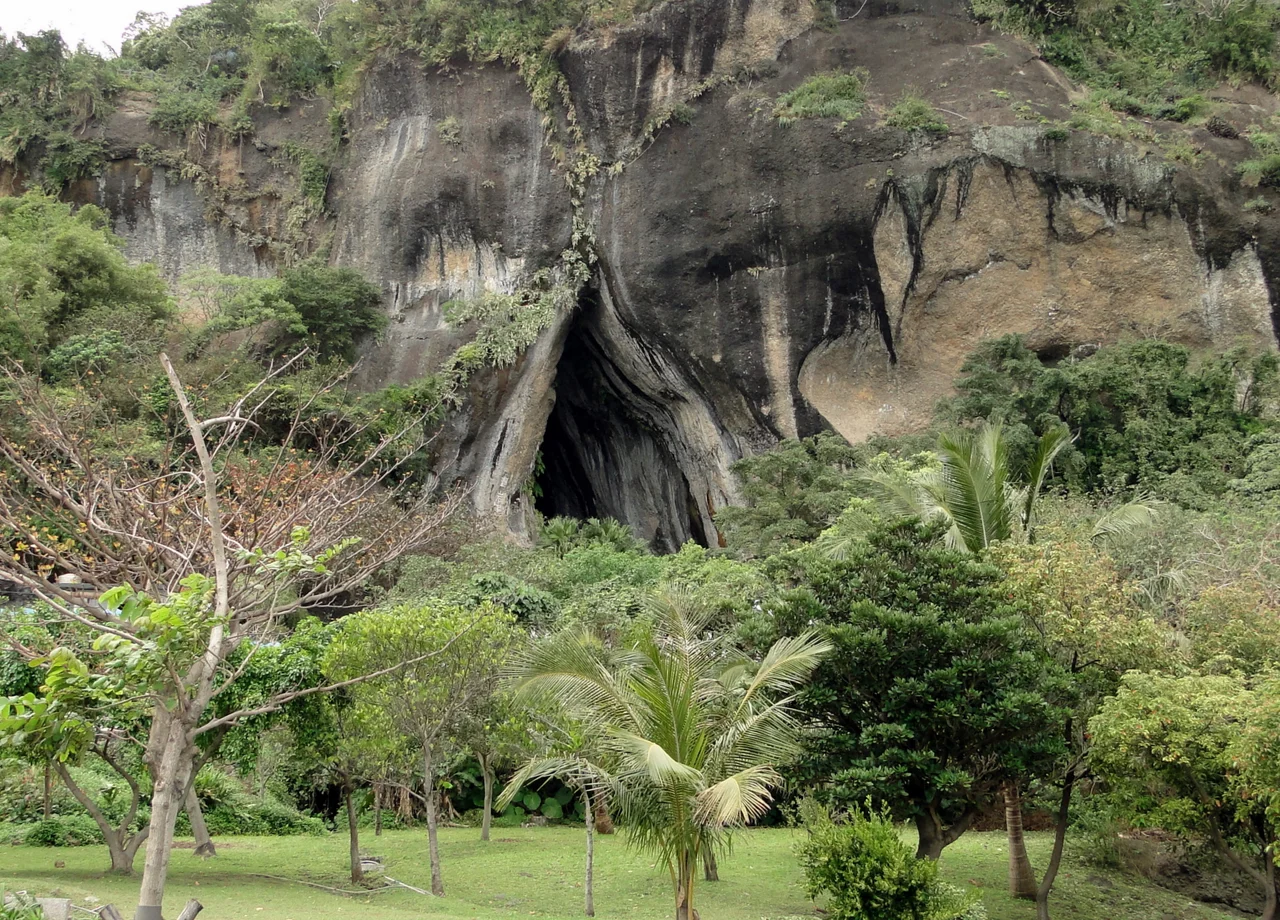

Baxian Caves
The ocean made these caves, and then it left. The hollows in the 100-meter cliff at Baxian — more than thirty of them, each with its own depth and character — were carved by wave action when the sea still reached this height. Then Taiwan's eastern coast continued doing what it has done for millions of years: it rose. The caves ascended with the rock, drawn upward by the same tectonic collision that is slowly fusing the Philippine Sea Plate with the Eurasian continent. Today the Pacific crashes far below, the caves hang high above the water, and the people who first sheltered here tens of thousands of years ago are long gone — leaving only stone tools and the outlines of a life that modern archaeology is still learning to read.
When the Sea Was Here
Geology at Baxian is a story in two chapters. In the first chapter, this cliff face sat at or near sea level, and wave action did its patient work: rushing into cracks, expanding them with hydraulic pressure, grinding away the softer rock and leaving cavities behind. The Paleozoic and younger sedimentary layers that make up this section of Taiwan's east coast were susceptible to this erosion, and over time the waves cut and hollowed and shaped.
In the second chapter, the coast began to rise. Taiwan's eastern shoreline has been tectonically active throughout recent geological history, lifted by the ongoing collision of plates. The cliff moved upward, taking the sea caves with it. The waves retreated to a new, lower base level. What was once a marine environment became an elevated shelf — a wall of dry chambers above the crashing surf, open to the air, sheltered from the elements, overlooking the Pacific from a height no ocean currently reaches.
Taiwan's Oldest Known Inhabitants
The caves are among the most significant prehistoric sites in Taiwan. Archaeological investigation of the Baxian complex has revealed evidence of Paleolithic — Old Stone Age — occupation, making this one of the earliest known locations of human habitation on the island. The people who sheltered here were not the ancestors of any single present-day group; Taiwan's prehistoric human history is complex, layered, and still being reconstructed from fragments found in sites like these.
More than ten caves were documented on the 100-meter-high cliff face, each of different size and depth. The artifacts recovered from them speak to a time when Taiwan's coastline was a different place: its sea levels, climate, and human geography all shaped by conditions that preceded the island's long history of settlement and resettlement by successive waves of peoples. Baxian is, in this sense, a threshold — the earliest door into Taiwan's human past that archaeological evidence currently opens.
A Long Occupation, A Legal Battle
In more recent centuries, the caves took on a different kind of significance. Their shelter and their position — overlooking the sea, dramatic and memorable — drew religious use. The caves were named for the Eight Immortals of Chinese mythology, the Baxian, whose imagery found its way into the site. Some caverns were converted to Buddhist temples; others became places to store cremation ashes, providing a kind of sanctuary in stone for the dead.
This overlap of prehistoric importance and living religious practice created a complicated situation. The Cultural Heritage Preservation Act eventually required that Taiwan's government reclaim the caves from private religious use to protect the archaeological integrity of the site. The process was long and contentious. On November 22, 2017, the Taitung County Government, the East Coast National Scenic Area administration, and the Changbin Township Office together recovered the last remaining occupied cave, completing the reclamation of all thirty caves in the complex. The legal effort to return a prehistoric site to public stewardship had taken a decade.
The Cliff Above the Surf
Stand at the base of the Baxian cliffs today and look up: the cave openings are dark punctuations in pale rock, each at a slightly different elevation, arranged in no pattern the eye can easily decode. The Pacific meets the cliff below, its waves doing in the present what waves did to this rock thousands of years ago — shaping, wearing, excavating. The process that made the upper caves is still making new formations at the current sea level.
Changbin Township, on the east coast of Taitung County, is not a widely visited stretch of Taiwan's coastline. It lacks the dramatic gorge scenery of Taroko to the north or the resorts of Kenting to the south. What it has is this: a cliff face where the geologic past and the human past are physically layered, one above the other, the older story literally higher than the newer one.
From the Air
The Baxian Caves lie at 23.40°N, 121.48°E on the east coast of Changbin Township, Taitung County, where the Hai'an Range meets the Pacific Ocean. From the air, look for the pale cliffed shoreline south of Hualien — the Baxian complex appears as a section of elevated coastal cliff with the characteristic east-coast pattern of mountains descending directly to the sea. Hualien Airport (RCYU) is approximately 55 kilometers to the north. Recommended viewing altitude is 1,000–1,500 meters along the coast to appreciate the terrain relationship between cliff face and ocean. The caves themselves are not readily visible from altitude, but the geological setting — cliff, wave-cut platforms at the base, rising terrain behind — is clear on a low coastal approach.
Nearby Stories
- Lulin Observatory 6.6 km away
- Sanxiantai 10 km away
- Ci En Pagoda 13 km away
- 2024 Hualien Earthquake 14 km away
- Baolai Spring Park 26 km away
- Twin Forts of Romblon 1182 km away
- Sinking of MV Sewol 1228 km away
- Sibuyan Island 1230 km away