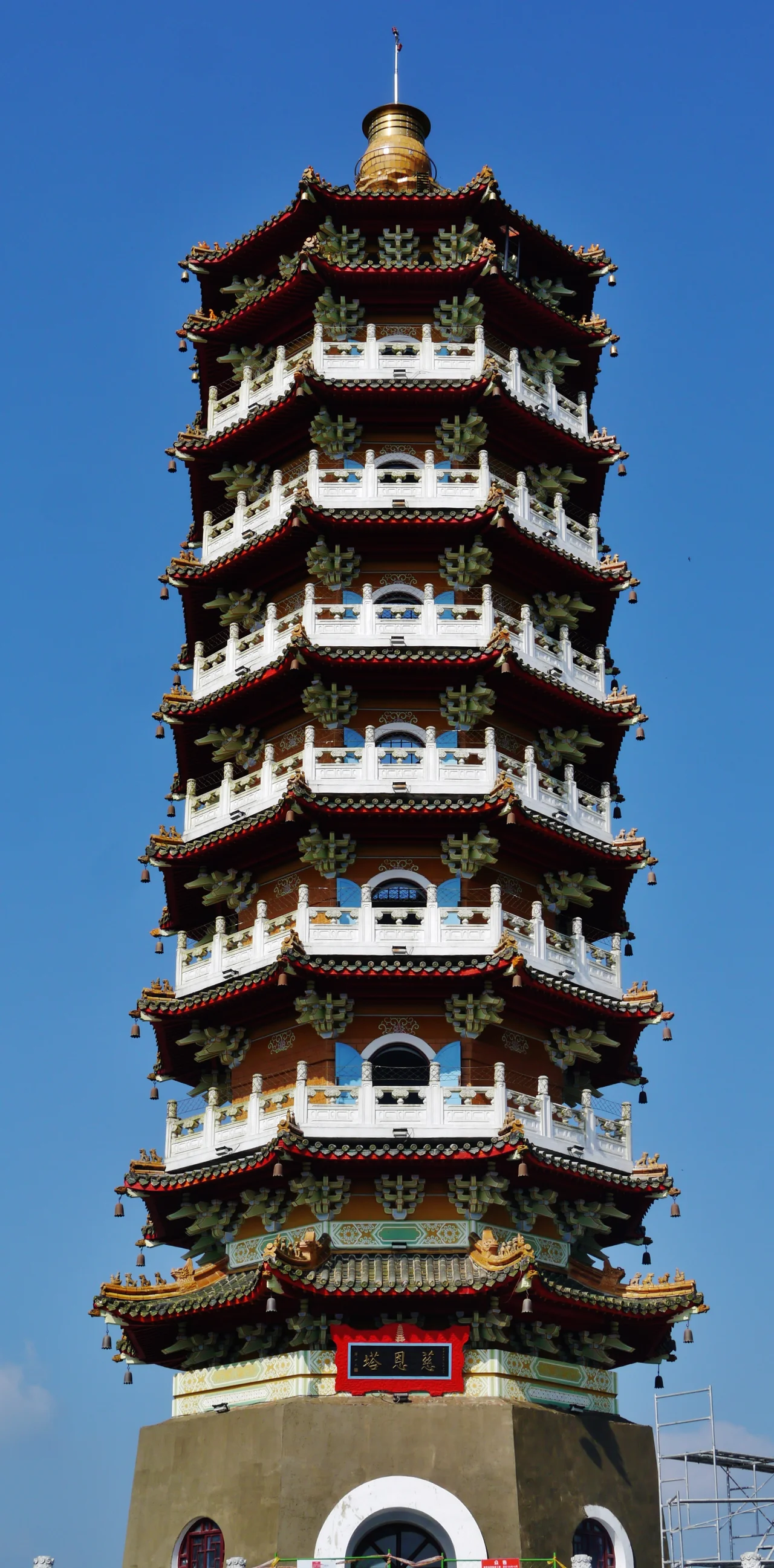

Ci En Pagoda
Chiang Kai-shek built the Ci En Pagoda for his mother. That is the entire origin of the structure that now stands 46 meters above Mount Shabalan, its upper nine floors painted golden red, its lower three white, a beacon visible from across the waters of Sun Moon Lake below. The pagoda was not ordered by a government committee, not funded by a civic campaign — it was the private grief of one of the twentieth century's most consequential figures, rendered in concrete and lacquer at 954 meters above sea level. Construction was completed in April 1971, and every piece of material that went into it had to travel the same improbable route: across Sun Moon Lake by boat, and then up the mountain.
A Son's Monument
Wang Caiyu, Chiang Kai-shek's mother, died when he was still a young man. For decades he carried that loss through revolution, civil war, and exile. When the Nationalist government settled in Taiwan, and Chiang found himself governing an island rather than a continent, he chose a hillside above the most celebrated lake in Taiwan for her memorial. The site was deliberate. Sun Moon Lake sits in the green heart of central Taiwan, ringed by mountains that soften to mist on most mornings. Placing the pagoda on Mount Shabalan meant it would look down on all of it — the lake, the forests, the small villages on the water's edge. In Chinese architectural tradition, a pagoda is both a religious structure and a marker of meaning in the landscape. Here, the meaning was filial devotion writ large.
The Impossible Supply Chain
Building a 12-story octagonal pagoda on a mountaintop at 954 meters presented an immediate logistical problem: there was no easy road up. Every beam, every load of concrete, every tile had to travel first by water across Sun Moon Lake, and then be carried or hoisted up the slopes of Mount Shabalan. The traditional Chinese architectural style demanded specific materials and careful craftsmanship — nothing about it was improvised. The result of this effort is a pagoda that earns the dramatic views from its upper floors. Standing near its base, you look down through forested ridges to the surface of the lake, which shifts color through the day from silver-gray at dawn to deep green under afternoon sun. The climb to reach it is itself an orientation — by the time you arrive, you understand why the site was chosen.
Form and Color
The pagoda's design follows the octagonal form traditional to Chinese Buddhist architecture, a shape associated with the eight directions and with protective spiritual energy. Its twelve floors rise in the stepped-roof pattern that draws the eye steadily upward. The paint scheme is deliberate: white at the base, transitioning to golden red across the upper nine floors. In Chinese color symbolism, gold carries associations with prosperity and heaven; the combination signals both sanctity and grandeur. From a distance — from a boat on Sun Moon Lake, or from the vantage of the Ci En Pagoda viewing platform — the structure reads as a single vertical accent in the green mountain canopy. Up close, the carved eaves and the layers of the receding rooflines reveal the precision that went into it. The pagoda was built to last, and to be seen.
On the Mountainside Above the Lake
The Ci En Pagoda draws visitors who come to Sun Moon Lake primarily for the water — the cycling paths along its shore, the ferries crossing to Lalu Island, the temples tucked into its hills. The climb to the pagoda rewards the detour. At 954 meters, you are above most of the lake's mist layer on clear days, and the panorama takes in both the moon-shaped southern arm of the lake and the sun-shaped northern section, the geographic quirk that gave Sun Moon Lake its name. Below, the small boats moving across the surface look like brushstrokes. The pagoda itself recedes into the background during the climb, only revealing its full height when you reach the summit terrace. Chiang Kai-shek's memorial to his mother has become, by circumstance, one of the finest viewpoints in central Taiwan.
From the Air
The Ci En Pagoda sits at 23.842°N, 120.921°E on the summit of Mount Shabalan at 954 meters elevation, immediately above Sun Moon Lake in Nantou County, central Taiwan. From the air, the golden-red pagoda is a clear visual reference point in the forested mountain terrain south of Taichung. Nearest major airport: RCMQ (Taichung International Airport), approximately 35 km to the northwest. Approach the area from the west over the Changhua Plain, then follow the Zhuoshui River valley eastward. The lake itself is the primary navigation landmark; the pagoda appears on the southern ridge above the lake's eastern arm. Recommend viewing altitude 1,500–2,000 meters for a full perspective on the lake and surrounding mountains. Visibility is best in the morning before afternoon cloud build-up over the central ranges.
Nearby Stories
- Alishan 5.8 km away
- Cultural Heritage Park 10 km away
- Taroko National Park 10 km away
- Ruisui Tropic of Cancer Marker 12 km away
- Taixi, Yunlin 14 km away
- Lintianshan Forestry Culture Park 16 km away
- High-Heel Wedding Church 22 km away
- Taiwan Strait 87 km away