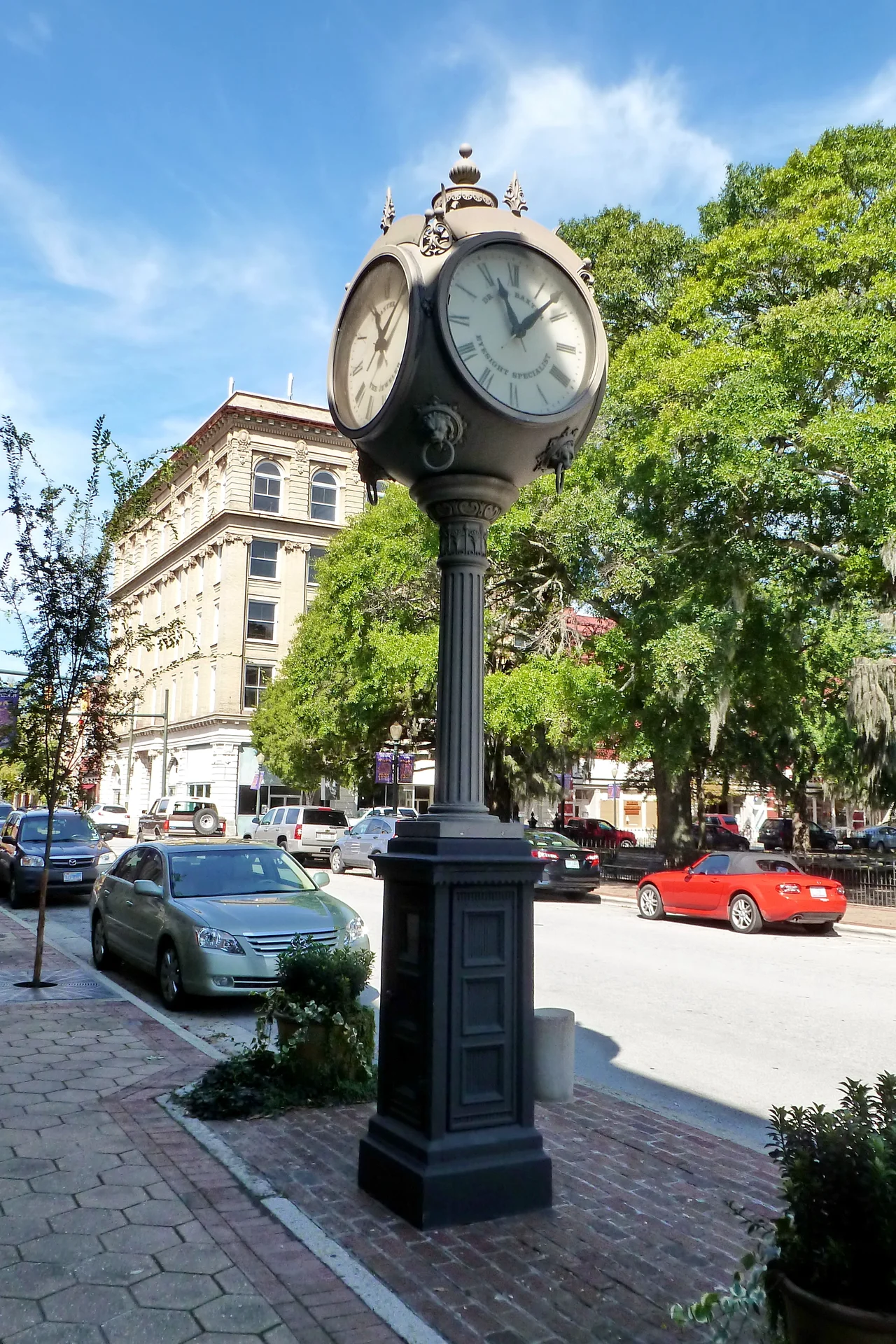

Baxter Clock
On the morning of May 6, 1977, a salvage crane swung the Baxter Clock off its pedestal, and then dropped it. Twenty feet of cast-iron casing, brass and steel works, four glass clock faces, a copper pendulum, and a Corinthian column shattered onto the Pollock Street sidewalk. Benny and Della Baxter, who had hired the crane to repair the damage a runaway furniture truck had done the night before, watched their family heirloom disintegrate. Dabney Coddington, curator at nearby Tryon Palace, summed it up for the New Bern Sun Journal: "That block of Pollock Street really looks naked, believe me." The clock would stay broken in a jewelry-store basement for fourteen years. Then New Bern decided to put it back together.
An Old-Fashioned Object, Newly Made
Seth Thomas Clock Company of Thomaston, Connecticut, cast the Baxter Clock in 1920, though its design - lions with iron rings in their mouths, Corinthian capitals trimmed in fern palmettes, fluted columns and arabesque crockets - belonged to the late 19th century. By 1920, the era of the American street clock was already closing. They had thrived from the 1860s through the 1910s, when jewelers, opticians, and watchmakers used them as both advertisement and public service: tell time, sell time, draw the eye. The Baxter Clock arrived a decade late to that party. It would not be installed on the sidewalk until 1930, when Baxter's Jewelry Store had been at 323 Pollock Street for a decade and could finally afford the ironwork. Its four faces read "BAXTER THE JEWELER" on the north and south and "DR. J.O. BAXTER EYESIGHT SPECIALIST" on east and west. One business, two trades, twenty feet of advertising.
The Day It Fell
On May 5, 1977, a furniture truck backed into the pedestal hard enough to bend it. The Baxters acted fast. The next morning, a salvage company arrived to lift the clock off cleanly so it could be repaired. The cast-iron casing came up. The cable slipped. The clock fell. The casing was bent but not destroyed; the inner workings - the iron weight that descended along two rods, the steel-and-copper pendulum, the small interior clock with the inscription Seth Thomas, No. 2139, July 24, 1920 - took the brunt of the impact. The Baxters tried to find someone who could repair it. They tried to find someone who could replace it. Both efforts failed. The fragments went into the basement of the jewelry store. For fourteen years, only the empty pedestal stood on the sidewalk, like a tooth socket with no tooth.
Swiss Bear's Resurrection Project
In 1990, the Swiss Bear Downtown Development Corporation - a non-profit named for the Bernese coat of arms that gave New Bern its symbol - took on the clock as a restoration project. The Baxter family transferred ownership on the condition that it actually be restored. Swiss Bear in turn told the city: if you take over maintenance afterward, we will lead the campaign. A Swiss Bear representative tracked down the Verdin Company of Cincinnati, Ohio, which had inherited Seth Thomas's original casting patterns. Verdin still had the molds. The Baxter Clock Restoration Campaign raised $28,000 from local donors. New castings were poured to match the originals. The surviving pieces were repaired or rebuilt. On April 20, 1991, with Patricia Dorsey, North Carolina's Secretary of Cultural Resources, in attendance, the clock was unveiled back on its pedestal at 323 Pollock Street. It is believed to be the only operating clock of its kind remaining in North Carolina, and one of only three of its design known to remain anywhere in the United States.
What It Still Tells
Today the building behind the clock houses Baxters 1892, a jazz club and bar. The Pollock Street block has changed and rearranged itself many times since 1930. The clock has not. Its four faces still carry the same lettering - BAXTER THE JEWELER, DR. J.O. BAXTER EYESIGHT SPECIALIST - the way a tombstone keeps a name long after the family has moved away. The lions still bite their iron rings. The Corinthian capital still wears its ferns. At night, the faces glow. From the air, the clock is invisible - a dot under tree canopy - but Pollock Street is one of the legible thoroughfares of the New Bern Historic District, running east from the Trent River bridge into the heart of the colonial town. Approach New Bern from the west, look for the cluster of slate roofs and the white spire of First Presbyterian, and you are looking down at the block where time was nearly lost, and then was not.
From the Air
323 Pollock Street, New Bern at 35.1064 N, 77.0394 W. The street runs east-west through the New Bern Historic District. Best viewed from 1,500 to 3,000 feet AGL on approaches to Coastal Carolina Regional Airport (KEWN), 3 nm south. Alternates: KMRH (30 nm SE), KISO (30 nm W). The historic district shows as a tight grid of streets between the Trent and Neuse Rivers; Tryon Palace's gardens form a green wedge on the southwest corner.
Nearby Stories
- Swansboro 13 km away
- Harkers Island, North Carolina 15 km away
- Beulaville, North Carolina 18 km away
- 1961 Goldsboro B-52 Crash 23 km away
- Battle of Washington 26 km away
- Pender County, North Carolina 37 km away
- Crystal Coast 43 km away
- Lake Mattamuskeet 45 km away