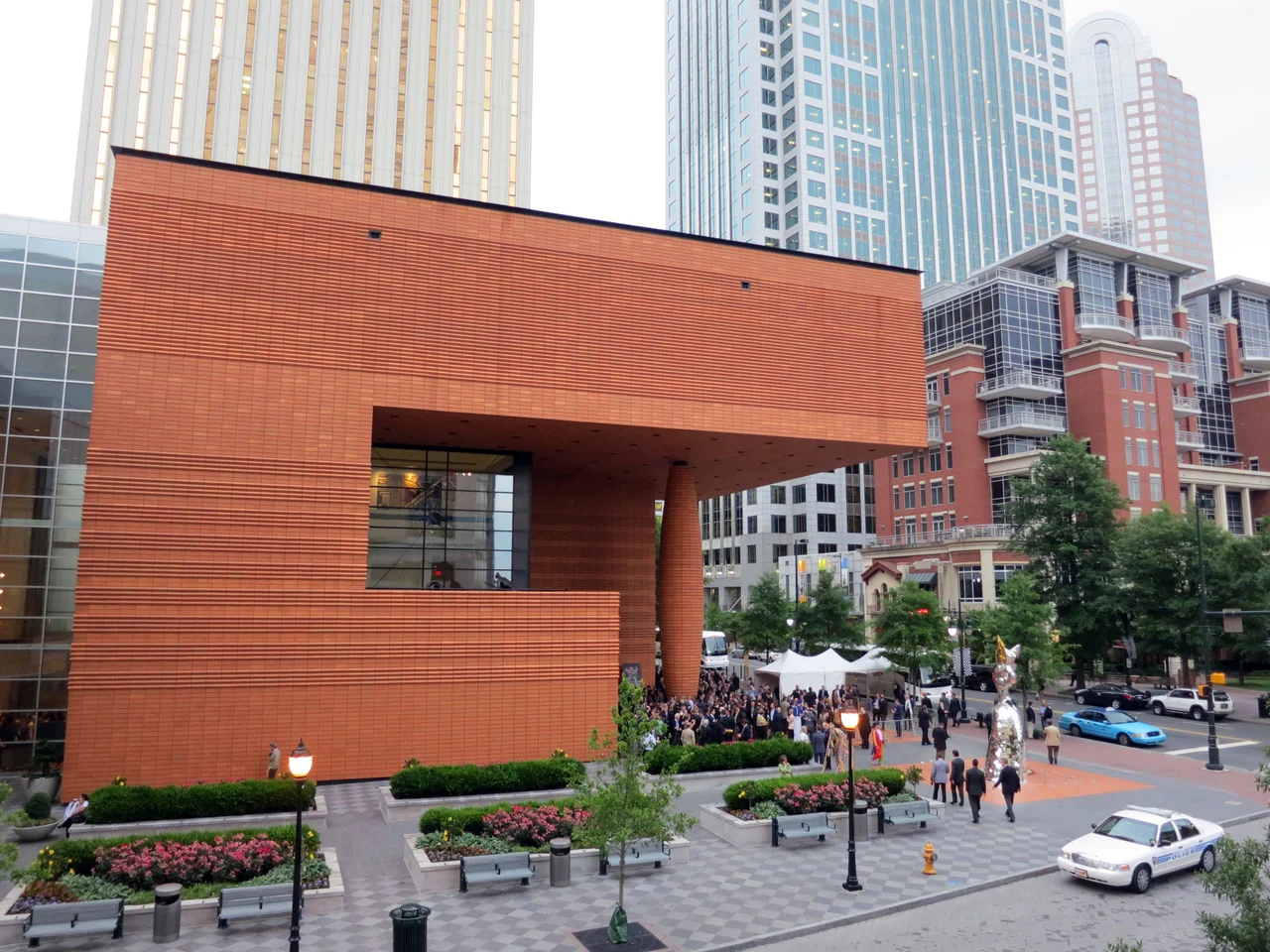

Bechtler Museum of Modern Art
On a Charlotte plaza, a seventeen-foot bird stands frozen mid-flight, covered in seventy-five hundred mirror mosaics that catch the sun and throw it back in shards. Niki de Saint Phalle finished the sculpture in 1991, called it Le Grand Oiseau de Feu sur l'Arche, and sold it to Andreas Bechtler in 2006. The Firebird now marks the entrance to the museum the Bechtler family built around its private collection - a four-story terracotta-tiled cube by Swiss architect Mario Botta, whose only other American building is the San Francisco Museum of Modern Art. The Bechtler is not a big museum. It is, however, a museum where you can stand four feet from a Giacometti, fifteen feet from a Picasso, and nobody is in your way.
How a Family Collects for Seventy Years
Hans Bechtler and his brother Walter started visiting the Kunsthaus Zürich in 1950. They were Swiss industrialists, not heirs to a fortune - they made their money in engineering - and they began buying art they liked from artists they met, often in studio visits, often before the artists became famous. Hans and his wife Bessie acquired drawings and preparatory work alongside finished pieces because they wanted to see how artists thought. The collection grew for nearly seventy years and ended up holding more than 1,400 works. Their son Andreas inherited part of it, augmented it with his own purchases, and brought it to Charlotte when business ties drew him here. In 2010 he gave the city a museum.
Botta's Cube
Mario Botta likes weight, mass, geometry. The Bechtler is a four-story building dominated by a single forty-seven-foot column that supports a cantilevered fourth-floor gallery - half the top floor extends out from the core, held up by that one shaft rising from the plaza. The exterior is terracotta tile in warm reddish-brown, broken by a multi-story glass atrium that scales the building's face and lets daylight slip through to the interior. Inside, the materials are uncompromising: steel, glass, terra cotta, black granite, polished concrete, wood. Botta designed the furniture too - reception desk, café bar, gallery benches, hanging globe lights. The cantilever is the building's signature gesture. It says: a museum is a piece of architecture that asks something of gravity.
Who You'll Find Inside
The collection's deepest holding is the School of Paris - the loose grouping of European artists working in Paris after World War II, mostly toward abstraction but flexible enough to include figural work. You will find Alberto Giacometti's elongated figures, Joan Miró's biomorphic shapes, Max Ernst's surrealist dream-objects, Jean Tinguely's kinetic mechanisms, Andy Warhol's Pop interventions, Barbara Hepworth's pierced stone forms, and Pablo Picasso pieces that show him working through ideas. There are British artists - Ben Nicholson, who spent summers in Ascona on the Italian-speaking edge of Switzerland and became an artistic mentor to a young Andreas Bechtler. There are Americans like Mark Tobey, who lived for years in Zurich and knew the family. Many of these works had never been seen in the United States before the museum opened.
The Atrium and the LeWitt
The glass atrium in the multi-story foyer holds the twenty-three-foot mural Wall Drawing 995 by Sol LeWitt - geometric, hand-drawn on the wall itself rather than painted on canvas, installed in October 2009 on long-term loan from his estate. Wall Drawing 995 is the kind of LeWitt that requires the building to be its frame; you cannot take it home. It greets visitors the moment they walk in, scaled to match the architecture, and it provides one of the museum's signature visual experiences. Light from the atrium falls across it differently at different times of day. The drawing changes without changing.
Why Small Is the Right Size
The Bechtler holds 36,500 square feet and a curated slice of one family's taste. You can see most of it in an afternoon. That is not a limitation - it is the museum's pitch. Big museums force triage; the Met or MoMA can swallow a whole day and you still leave wondering what you missed. The Bechtler trusts you with intimacy. The galleries are small enough that the works are at conversational scale, the wall labels are written by people who know the collection personally, and the building itself is part of the visit. Charlotte built its arts district around Tryon Street - the Mint Museum Uptown, the Harvey B. Gantt Center, the Knight Theater all stand nearby. The Bechtler anchors it like a cornerstone, terracotta and unmistakable.
From the Air
Located at 35.2244°N, 80.8473°W on South Tryon Street in Uptown Charlotte, part of the Levine Center for the Arts arts district. The terracotta cube is harder to identify from cruise than nearby skyscrapers, but the Firebird sculpture out front catches sunlight and may glint. Nearest airport is Charlotte/Douglas International (KCLT) about 4 nautical miles west. Best viewing altitude 2,500-5,000 feet over Uptown. Concord-Padgett Regional (KJQF) lies northeast.
Nearby Stories
- Battle of Colson's Mill 12 km away
- Kings Mountain Mine 13 km away
- Thyatira Presbyterian Church, Cemetery, and Manse 16 km away
- Andrew Jackson State Park 19 km away
- Charleston Naval Hospital Historic District 22 km away
- Hickory Motor Speedway 22 km away
- North Carolina Aviation Museum 29 km away
- Battle of Fishdam Ford 47 km away