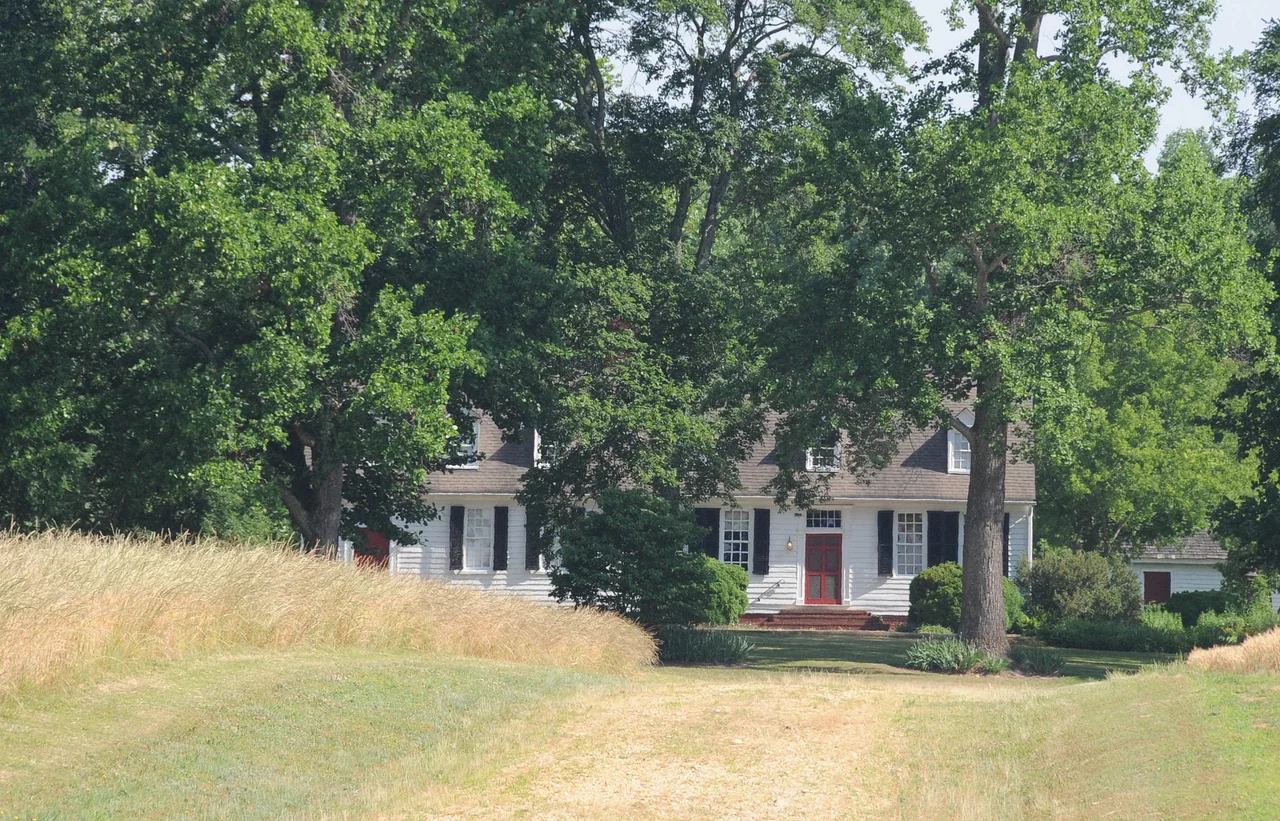

Belle Air Plantation
The summer beams run the length of the ceiling, exposed, hand-hewn from oak trees felled three hundred years ago. They are the only example of post-medieval English timber framing visible in a wood-frame Virginia building. Belle Air's interior shows you, plainly, how seventeenth-century Englishmen built houses when they remembered the Old Country and had not yet quite invented America. The bones are extraordinary. So is the context. Belle Air is a plantation house, and like every plantation house on the James, it was built and run by people whose names mostly were not written down — enslaved Africans and African-Americans who made up the majority of Charles City County's population for most of two centuries.
Whose House, Whose Name
The conventional account begins with Thomas Stegg Jr., who inherited the property when his father died in 1651/1652 and took possession in 1653, beginning the original manor house in 1655. In 1662 David Clarke purchased part of Stegg's holdings, including the house, which he named 'Windsor.' The Clarke family owned the property until 1800. During those 138 years — probably between 1725 and 1750, per dendrochronological studies — the existing house was built, and the property acquired its current name: 'Belle Air.' Hamlin Willcox bought it in 1800; his family held it until 1945. A 1994 monograph by the genealogist David Thomas Bradford contests this lineage and argues the Bradford family — not the Clarkes — held the property through the late 1720s. The deed record is incomplete enough that both versions still have defenders.
Who Did the Work
Every owner named above was a slaveholder. Slavery was not incidental to Belle Air; it was the foundation. In the 1860 federal census — the year before the Civil War — enslaved people made up 62 percent of the total population of Charles City County. Across Virginia, 90 percent of enslaved people had been born in North America by the late eighteenth century, the children and grandchildren of the original captives carried across the Atlantic. The Virginian economist Thomas Roderick Dew, who was himself a slaveholder and an apologist for slavery, calculated the capital value of Virginia's enslaved population in 1832 at $100 million — roughly one-third of the state's total accumulated wealth. The economic engine of the Tidewater plantation was not tobacco. It was the people forced to grow it.
Skilled Hands, Resistance
The Chesapeake plantation economy was more diversified than the rice or cotton economies of the Deep South. Enslaved people on the James worked as carpenters, blacksmiths, coopers, masons, watermen, midwives, cooks, and field hands — the full range of skills needed to run a substantially self-sufficient plantation. Belle Air's hand-hewn timbers, the surviving smokehouse with its pyramidal roof, the frame kitchen behind the house: every one of these structures was built by enslaved craftsmen whose work we admire today without knowing their names. Resistance was constant — sabotage, work slowdowns, flight — and sometimes erupted into the planned rebellions that terrified the planter class: Gabriel's Rebellion in 1800, Nat Turner's Rebellion in 1831. Planters responded with increasingly harsh slave codes through the 1840s and 1850s.
The Architecture That Survived
Belle Air is unusual for what it preserves. The exposed interior timber framing in post-medieval style — common in seventeenth-century English country houses, almost always plastered over or modernized in American examples — is, according to the Virginia Department of Historic Resources, the only such example in any Virginia frame building. The summer beams, the principal supports for the upstairs floor joists, run straight through the ceilings into the chimneys. The original five-bay portion combines seventeenth-century framing techniques with eighteenth-century floor plan and window patterns, suggesting the present house may have replaced or absorbed Stegg's earlier 1655 structure. Walter O. Major and his wife restored the house in the 1950s and operated it as a private historic house museum; that work earned it National Register listing in 1974.
From Above
Belle Air sits on the north bank of the James River near Charles City, Virginia, along Route 5 — the historic 'Plantation Route' that links the great James River estates from Richmond to Williamsburg. From a few thousand feet, the river meanders below in great horseshoe bends, fields stretch back from the bluffs, and the white houses of plantation after plantation step along the bank: Berkeley, Westover, Sherwood Forest, Shirley. Belle Air is smaller than its neighbors, less grand, but among the oldest. The smokehouse and the kitchen still stand. The river still rises with the tide twice a day. The bones of the seventeenth century are still inside.
From the Air
Belle Air Plantation sits at 37.347°N, 77.061°W on the north bank of the James River near Charles City, Virginia. From 2,000 to 3,500 feet AGL the property is visible as a small cluster of historic outbuildings near Route 5, set among the cornfields and tobacco-era field patterns that still define the James River plantation corridor. Nearest airports: Richmond International (KRIC) about 22 nm northwest, Williamsburg-Jamestown (KJGG) about 18 nm east. Class E airspace; no Class C restrictions in this stretch. Best viewing on an east-to-west pass at 2,500 feet along the river, when the late-afternoon light brings out the bluff line and the historic field divisions.
Nearby Stories
- Rosewell Plantation 6.4 km away
- Christopher Newport University 13 km away
- Cactus Hill 18 km away
- Huguenot Memorial Chapel and Monument 24 km away
- Lewis Ginter Botanical Garden 27 km away
- Fort Christanna 44 km away
- USS Texas (1892) 50 km away