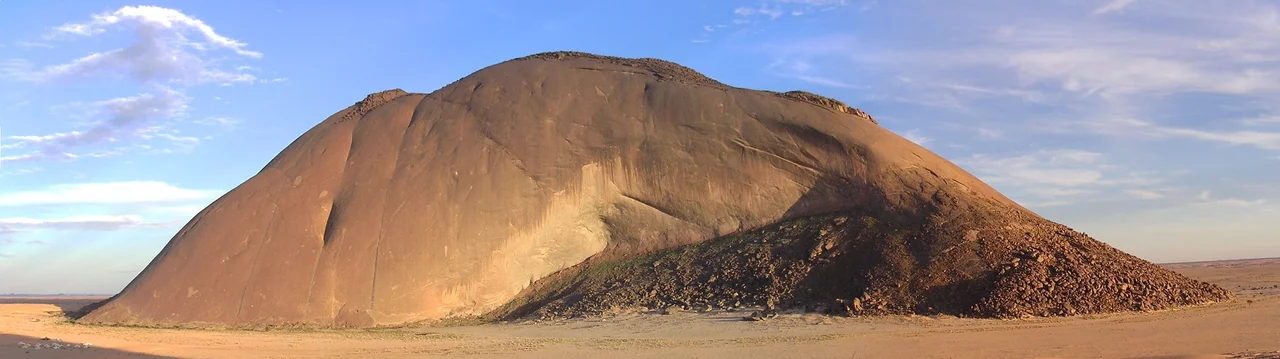

Ben Amera
There is no sign, no gate, no visitor center. To reach Ben Amera you leave the last paved road near Atar, hire a driver who knows the sand, and follow a track that runs alongside the iron ore railway until it crosses the rails near the 395-kilometer marker. Then, out of the flat ochre nothing, a mountain of bare rock heaves into view. It is a single, seamless dome of granite, 633 meters of stone with no soil, no scrub, nothing but rock burnished smooth by ten thousand years of wind. This is Africa's largest monolith and the second largest in the world. Almost no one has heard of it.
A Rock Without Equal
Only one monolith on Earth is bigger than Ben Amera, and it sits on the other side of the planet: Uluru, the sacred red heart of Australia. Ben Amera is the runner-up, and locals in the Adrar like to point out that the contest may not even be fair. Geologists suspect that much of Ben Amera's bulk lies buried beneath the Saharan sand, and that if you could measure the whole hidden mass, it might outrank Uluru entirely. What rises above the desert floor is already staggering: a smooth gray dome catching the sun, its surface streaked dark where rare rains have run down over the millennia. Brandberg in Namibia and Zuma Rock in Nigeria draw far more attention. Ben Amera, hidden deep in one of the least-visited countries on the continent, draws almost none.
Ben Amera and Ben Aicha
The great dome does not stand alone. It anchors a scattered chain of smaller monoliths marching across the plain, and at the far end stands a second formation, slightly smaller, called Ben Aicha. Mauritanian folklore makes a story of the pairing: Ben Amera and Ben Aicha are husband and wife, two giants turned to stone and left to keep each other company in the emptiness. Where Ben Amera is a single rounded dome, Ben Aicha is rougher, its flanks sculpted by erosion into ribs and hollows that some travelers swear resemble carved figures. Between and around them, the desert is silent enough that you can hear your own pulse.
The Long Way In
Getting here is half the experience. There is no paving once you leave the Atar-to-Zouérat road, only deep, soft sand that swallows tires and strands the unprepared. A four-wheel-drive vehicle and an experienced driver are not optional. The rough path shadows the tracks of the famous Iron Ore Train, the marathon freight line that hauls hematite from the mines at Zouérat to the coast. Near the rails sits a small encampment and a security checkpoint. Travelers once needed printed identity slips called fiches to pass these posts; today a photocopy of your passport usually does the job. The reward for the effort is solitude on a scale that is hard to find anywhere else on Earth.
Stone, Light, and Silence
Ben Amera is best understood at the edges of the day. At dawn and dusk the low sun rakes across the dome and the gray granite warms to amber and rose, the same trick of light that draws crowds to Uluru and almost no one here. Camp at its base and the night brings a sky uncluttered by a single electric light, the Milky Way arching from horizon to horizon over the sleeping giant. By midday the heat presses down and the rock radiates it back. This is a place that asks for patience and offers, in return, a sense of scale and stillness that most travelers never encounter in a lifetime.
From the Air
Ben Amera lies at 21.23°N, 13.67°W in northern Mauritania's Adrar region, roughly 4 km north of the Iron Ore Train line and about midway between Choum and Zouérat. The bare granite dome stands out sharply against flat ochre desert and is visible from cruising altitude in clear weather, which is the norm here. Nearest airport is Atar (GQPA) to the south; Nouadhibou (GQPP) lies far to the west on the coast. Expect intense daytime heat, very low humidity, and occasional blowing dust that can reduce visibility.
Nearby Stories
- Zug, Western Sahara 15 km away
- Agrour Amogjar 49 km away
- Azougui 59 km away
- Agounit 92 km away
- Inal, Mauritania 92 km away
- Chinguetti Mosque 104 km away
- Akjoujt 135 km away
- Tourine Ambush 162 km away