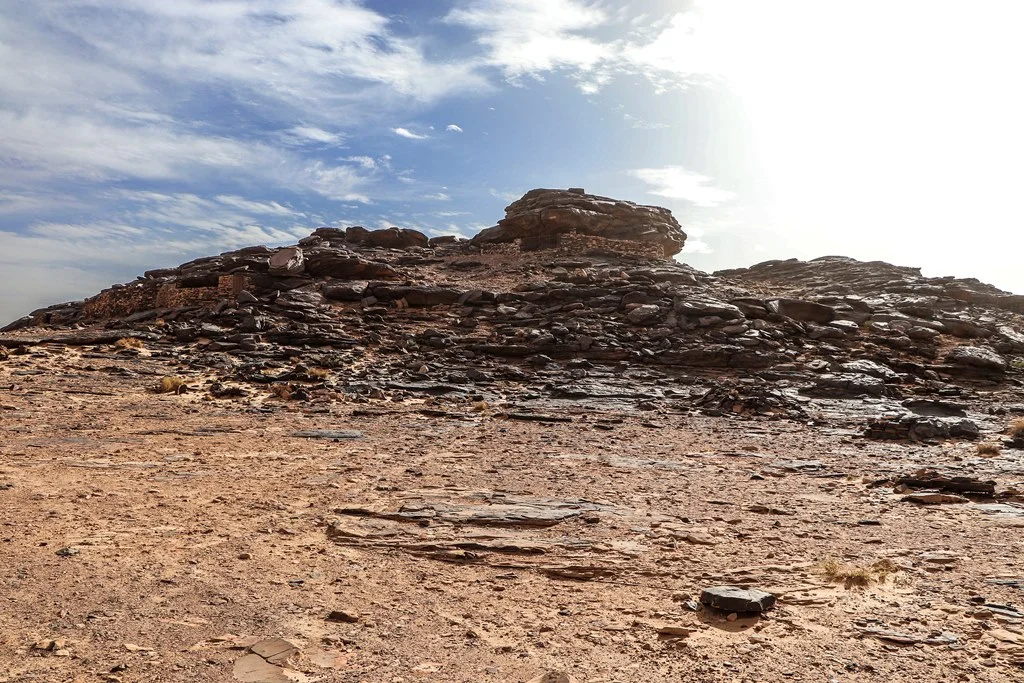

Agrour Amogjar
Crocodiles once swam where the camels now walk. On the rock walls of Agrour Amogjar, a 690-meter peak guarding the desert pass that bears its name, ancient artists left painted proof of a Sahara that no longer exists, a world of herds and water and dancing figures rendered on stone in the Adrar plateau of central Mauritania. The shelters are small and the images are fading, but together they form one of the great open-air galleries of the Sahara, a record of human life stretching back across millennia.
A Pass Worth Painting
The Amogjar Pass is one of the natural gateways through the cliffs of the Adrar, the kind of place where geography funnels travelers and time leaves its marks. The peak of Agrour rises beside it, and tucked into its flanks are modest natural shelters, overhangs and shallow caves where generations took refuge from the sun and turned the rock around them into a canvas. An enclosure now protects some of the most important shelters, and access is subject to a fee, a small fence around a very large stretch of the human past.
The Layers on the Wall
The art here is not the work of a single moment but of many. Researchers have recorded eight distinct stylistic groups, layered across the centuries, ranging from the so-called pastoral period to graffiti scratched in far more recent times. The oldest images at Amogjar may be more than five thousand years old, though most Saharan rock art is thought to date from before about 2000 BC, when the pastoral period ended and the Sahara dried out. To stand before these panels is to read a palimpsest written by many hands over a span of time longer than most written history, each generation adding to what the last had left.
A Bestiary of a Greener World
The painted and pecked images conjure a landscape almost impossible to imagine here today. There are giraffes, a lion, and a crocodile, animals of savanna and water rather than dune and rock. There are herds of cattle, evidence of the herders who once moved their animals across what was then grassland. And there are people, gathered in collective scenes that hint at ceremony and community. Alongside the animals run more abstract marks: geometric circles with sunburst rays, and the pressed outlines of human hands, that universal and oldest of signatures, an artist reaching out to say, simply, I was here.
The Dancers
The most celebrated of all the panels is a frieze of dancers, figures caught mid-movement across the stone. We cannot hear the rhythm they moved to or know the occasion they marked, whether harvest, rain, mourning, or joy. But the impulse is unmistakable and deeply human, bodies in motion, celebration made permanent on rock. The paintings are damaged now, worn by weather and the long centuries, and that fragility is part of what makes them precious. They are a message sent forward through thousands of years by people whose names are lost but whose dance, against all odds, survives.
From the Air
Agrour Amogjar stands at 20.54 degrees N, 12.78 degrees W in the Adrar plateau, near the Amogjar Pass between Atar and Chinguetti. The nearest airport is Atar (GQPA), roughly 30 km to the west. From the air, look for the dramatic cliff line of the Adrar escarpment broken by the pass, with the peak rising beside it. The rugged sandstone terrain and deep shadows are most striking at low sun. Clear, dust-free conditions give the best visibility over this remote stretch of desert.
Nearby Stories
- Geography of Mauritania 40 km away
- Maaden El-Irvane 44 km away
- Ben Amera 63 km away
- Mauritania Railway 66 km away
- Jbilet Winselwan Meteorite 69 km away
- Ancient Ksour of Ouadane, Chinguetti, Tichitt and Oualata 74 km away
- Akjoujt 119 km away
- Inchiri region 135 km away