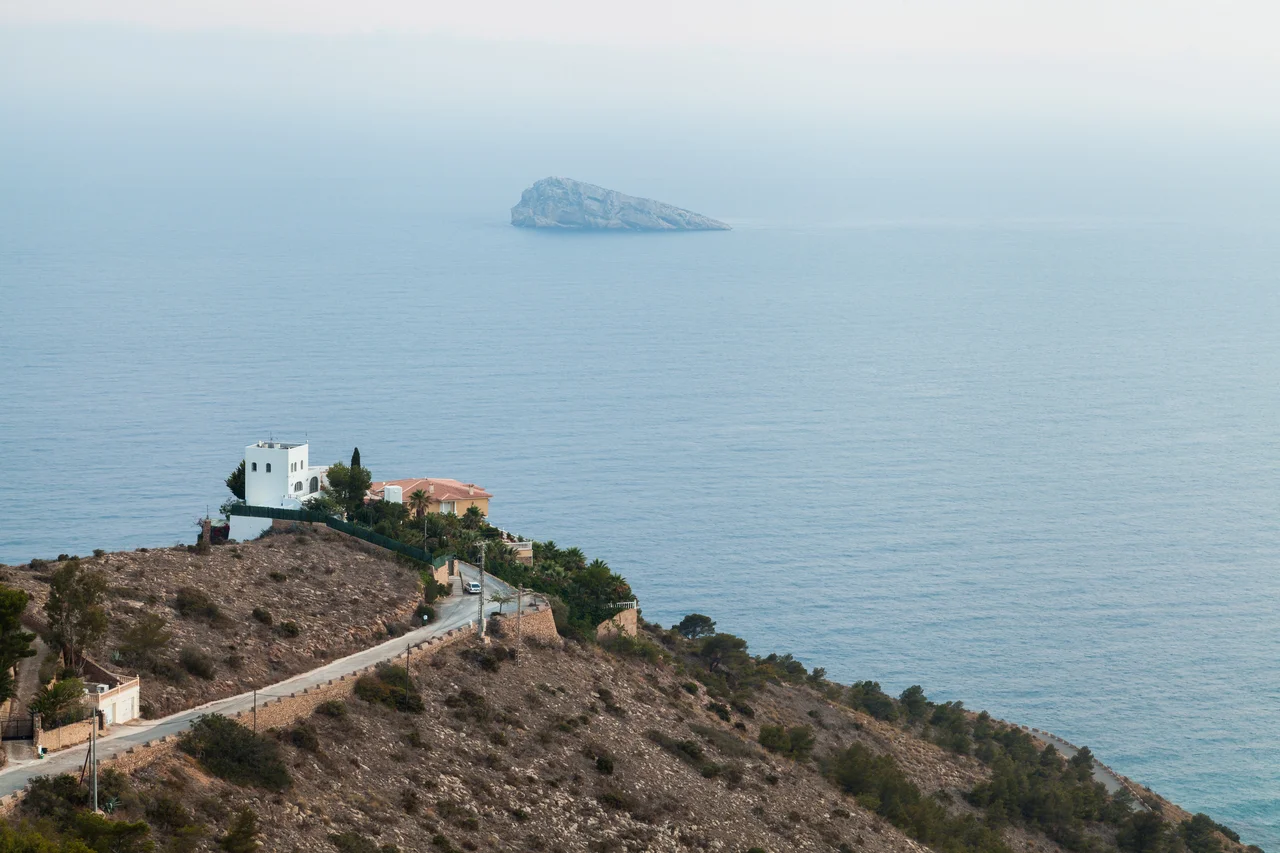

Benidorm Island
Look up from the crowded beaches of Benidorm toward the mountains inland, and you may notice something odd about the ridge of Puig Campana: a clean, square notch bitten from its summit, as if someone had snapped off a piece and thrown it away. According to local legend, that is exactly what happened. And the missing fragment, the story goes, is the small island that now floats a few kilometers offshore.
The Sword and the Missing Peak
The most colorful version stars Roldán, the Spanish name for Roland, a warrior in the army of Charlemagne. The tale has him fighting a Moorish chieftain on the summit of Puig Campana. Roldán had the upper hand, and with his opponent at his mercy he swung his great sword Durandarte for the killing blow. The Moor ducked. The blade missed flesh and bit rock instead, gouging the square gap still visible today, known as el Tajo de Roldán, Roldán's cut, or El Portell, the gate. The chunk that broke loose sailed out to sea and settled as Benidorm Island. A gentler telling casts the same knight as a grieving husband: warned that his wife would die at sunset, he tore a piece from the peak so the last light could pour through the gap a little longer. Geology tells a plainer story, of course. But standing on the sand, tracing a line from that notch to the offshore rock, the myth is hard to shake off.
The Island of Peacocks
Benidorm Island was once called Peacock Island, Illa dels Paons in Valencian and Isla de los Pavos Reales in Spanish, though no peacocks strut there now. It sits roughly 3.5 kilometers from the mainland, a modest wedge of rock about 350 meters long that rises to cliffs some 70 meters high on its seaward flank. From the beach it reads as a low blue-grey silhouette, easy to mistake for a moored ship. No one lives on the island now. Most days of the week, boats leave Benidorm's harbor to make the short crossing, carrying day-trippers who want to stand on the thing they have been squinting at from their sun loungers, then bringing them back before dark to a shore that never really lets the islet out of its sight.
A Wild Place in a Package-Holiday Sea
The contrast is the whole charm of it. Benidorm the town is a wall of high-rises and a beach packed elbow to elbow, one of the most concentrated resort skylines in Europe. The island is the opposite: a protected nature reserve within the Serra Gelada Natural Park, left deliberately wild. The waters around it form a marine reserve, and the clarity of the Mediterranean here draws snorkelers and divers to shoals of fish moving over pale rock. Seabirds wheel over the cliffs. What the mainland spends on concrete, the island keeps in stone and salt and open sky.
Approaching by Water
Come by boat and the island performs a slow reveal. From the harbor it is a smudge; halfway across it hardens into cliff and scrub; up close it towers, and the glass-bottomed cruisers slow so passengers can watch the seabed slide past beneath their feet. A path climbs from the small landing, and from the higher ground the view swings back toward the coast, toward the towers of Benidorm and, above them, the broken crown of Puig Campana. From here the legend arranges itself neatly: the wound in the mountain, the water in between, and the rock beneath your feet that supposedly fills the gap.
From the Air
Benidorm Island lies at 38.502 degrees north, 0.130 degrees west, roughly 3.5 km off the Costa Blanca resort of Benidorm. Best appreciated from 1,500 to 3,000 feet, where the islet reads as a distinct wedge against the Mediterranean and the notched summit of Puig Campana (1,406 m) stands clearly inland to the northwest, a reliable coastal landmark. The nearest major field is Alicante-Elche (LEAL) about 45 km to the southwest; Valencia (LEVC) lies farther up the coast to the north, and Murcia (LEMI) well to the south. Summer skies here are typically clear with excellent visibility, though afternoon sea haze can soften the coastline.
Nearby Stories
- Route of the Castles of Vinalopó 3.1 km away
- Cova Foradà 8.4 km away
- El Fondo Natural Park 16 km away
- Ciudad de la Luz 31 km away
- Cuevas de la Araña 32 km away
- Es Vedrà 73 km away
- Cala d'Hort 83 km away
- Battle of Cape Cherchell 227 km away